

How Healthcare Claims Processing Software Works for Payers

Health payers process roughly 3 billion medical claims every year. For payer organizations, the challenge isn't just volume. It's accuracy, speed, and compliance. Every manual touch, every delayed adjudication, and every provider dispute adds friction to your operation and weakens network trust.
That's where healthcare claims processing software comes in. It's not just a faster way to push transactions. It's the infrastructure that lets payer organizations auto-adjudicate clean claims, route exceptions intelligently, maintain regulatory compliance, and keep provider networks satisfied with predictable payment cycles.
If you're evaluating your first platform or thinking about upgrading, this guide will walk you through what the software actually does, which features move the needle for payers, and how the right system can reshape your operations.
Customize Claims Processing Workflow
What Is Healthcare Claims Processing Software?
Healthcare claims management software is a technology platform that manages the full lifecycle of a medical claim from the payer's side. It handles intake, validation, adjudication, payment, and reporting. Instead of routing transactions through disconnected systems and manual spreadsheets, the software digitizes every step and applies rules-based logic to move claims forward automatically.
For payer organizations, this means the platform ingests electronic claims in HIPAA-standard EDI formats, checks them against member eligibility data and provider contracts, applies coding edits and medical policies, and either auto-adjudicates, denies, or pends the claim for review. Modern systems also integrate with provider networks, member portals, and analytics tools so data flows without manual re-entry.
The best claims processing software in healthcare does more than speed things up. It creates an audit trail for every adjudication decision, flags suspicious patterns for fraud detection, and generates the analytics that finance and network teams need to monitor performance. Whether you're a TPA managing multiple employer plans, an IPA overseeing delegated risk, or an ACO navigating value-based contracts, the software becomes the central nervous system of your operation.
If you've ever asked yourself what the best claims processing software for a busy payer environment is, start by looking at how well a platform handles your specific mix of claim volume, contract complexity, and regulatory requirements.
Learn more about the fundamentals in our companion piece on
understanding claims adjudication and how it works.
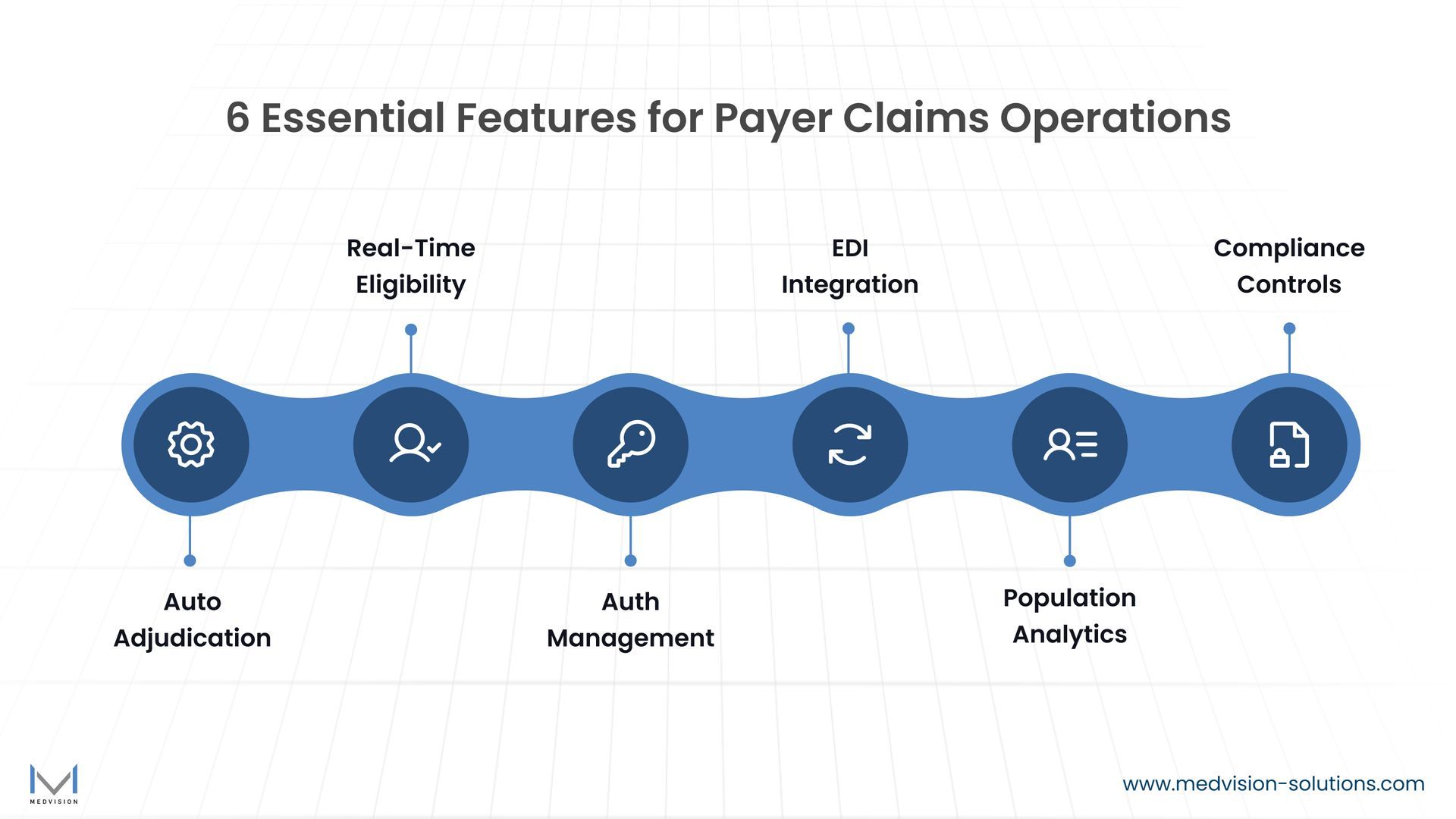
Key Features of Healthcare Claims Processing Software
Not every platform is built for the complexity that payer organizations face. When you're evaluating healthcare claims processing software, look for these capabilities.
Automated Claims Adjudication
This is the engine of your operation. Automated adjudication applies your business rules, fee schedules, coding validations, and medical policies the moment a claim hits the system. Clean claims are auto-adjudicated, and exceptions route to the right specialist. The result is higher straight-through processing rates and fewer manual touches.
Real-Time Eligibility Verification
Eligibility mismatches are a leading cause of pended claims and provider abrasion. Real-time verification lets you confirm member coverage, benefits, and authorization requirements at intake. That one step prevents downstream rework and keeps your call volume manageable.
Referral and Authorization Management
Prior authorizations can bottleneck care and frustrate providers. Built-in authorization workflows let you track requests, set automatic alerts for pending items, and communicate decisions back to providers through a portal. That transparency strengthens network relationships.
EDI Integration and Interoperability
Your software needs to speak the same language as the rest of the healthcare ecosystem. Embedded HIPAA standard EDI formats, along with HL7 and FHIR support, ensure seamless data exchange with hospitals, clinics, and clearinghouses without custom middleware.
Analytics and Population Health Reporting
Payer organizations need visibility beyond individual claims. Advanced
analytics dashboards let you monitor auto-adjudication rates, track network provider performance, stratify population health risks, and forecast expenses. These insights turn transaction data into strategic decisions.
Compliance and Security Controls
HIPAA compliance is non-negotiable. Look for role-based access controls, detailed audit trails, and encryption that protects PHI at every step. The right compliance features should be built in, not added later on, because regulators and accreditors will ask for that documentation.
For a deeper look at the claims journey, check out our
guide to healthcare claims processing.
Benefits of Automating Healthcare Claims Processing
Switching from manual to automated healthcare claims processing isn't just a technology upgrade. It's an operational strategy. The global claims processing software market grew from USD 47.80 billion in 2025 to USD 51.47 billion in 2026. The sector is quickly embracing automation, AI, and cloud-native architectures, transforming how insurers, government agencies, and third-party administrators operate.
Here are practical benefits automated healthcare claims processing brings to the table:
Higher Straight-Through Processing Rates
Automation cuts the time from claim submission to adjudication from weeks down to days, sometimes hours. Best-in-class payer operations auto-adjudicate the vast majority of standard claims without manual intervention, freeing staff to focus on complex cases, appeals, and special investigations.
Lower Administrative Costs
With expected U.S. national health spending reaching $5.7 trillion in 2025 and administrative costs growing faster than clinical spending, the need to streamline is intense. By automating repetitive tasks like data entry, coding checks, and payment posting, payer organizations can significantly reduce the administrative burden that now consumes roughly a quarter of every healthcare dollar.
Fewer Provider Disputes and Appeals
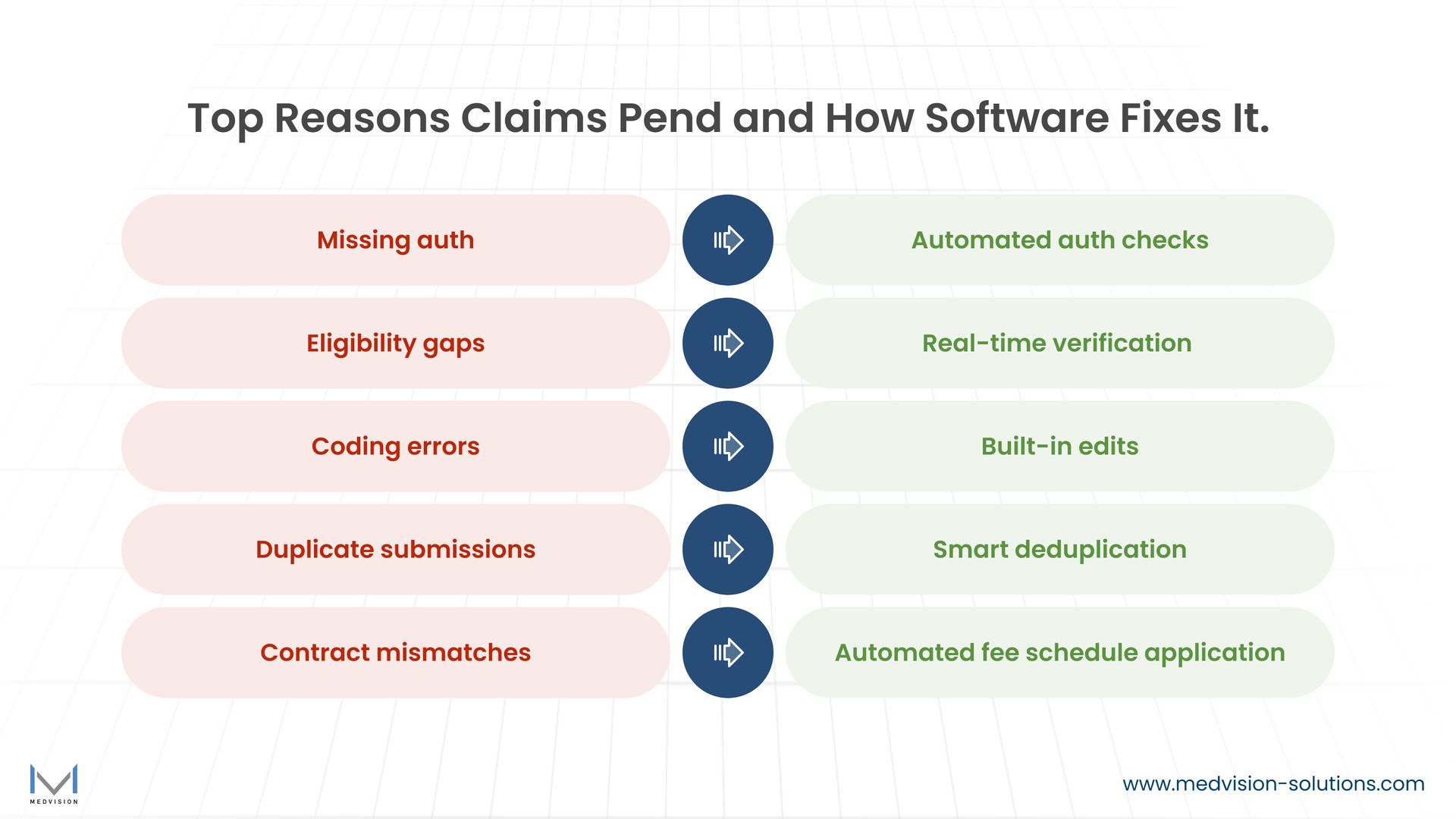
Built-in edits catch mismatched codes, missing authorizations, and eligibility gaps at intake rather than at payment. That means fewer pended claims, fewer provider phone calls, and less appeals paperwork. Your network teams spend less time firefighting and more time managing relationships.
Better Fraud, Waste, and Abuse Detection
AI-powered pattern recognition spots unusual billing behaviors, duplicate submissions, and phantom charges in real time. For payer organizations, this translates to recovered dollars, cleaner networks, and stronger SIU performance.
Improved Member and Provider Satisfaction
When claims move fast and accurately, everyone wins. Members get clearer explanations of benefits and fewer surprise bills. Providers get paid on time with predictable cycles. And your customer service team spends less time fielding angry phone calls from both sides.
How Payer Organizations Can Improve Claims Processing Through Software
Buying software is only half the battle. The real gains come from how you deploy it. Here are practical steps payer organizations can take to get the most from their investment.
Map Your Current Workflow First
Before you configure anything, document how claims actually move through your organization today. Identify where claims sit in queues, which teams handle exceptions, and where manual rework most often occurs. That baseline shows you exactly where automation will help.
Standardize Your Edits and Rules
One of the biggest mistakes payers make is carrying over inconsistent business rules from legacy systems. Use the implementation phase to clean house. Standardize your coding validations, fee schedules, and authorization requirements so the software enforces consistency from day one.
Integrate with Your Provider Network
Give your providers a self-service portal where they can check eligibility, submit claims, track status, and download EOBs without calling your office. When providers can resolve their own questions, your administrative volume drops significantly, and network satisfaction rises.
Monitor Performance Relentlessly
Use your analytics dashboards to track auto-adjudication rates, pended claim reasons, and turnaround times by provider and by line of business. Patterns will emerge. Maybe one clinic consistently submits with outdated codes, or a particular service line lacks proper authorization workflows. Fix the root cause, not just the symptom.
Train for Exceptions, Not Routine
Once automation handles the bulk of standard claims, retrain your staff to become exception specialists and relationship managers. They should understand how to interpret complex cases, negotiate with high-volume providers, and spot the edge cases that software might miss.
How MedVision's QuickCap v7 Supports Healthcare Claims Processing
MedVision has been building healthcare administration software since 1994, and QuickCap v7 is the platform that brings it all together for payer organizations. It's a web-based solution designed specifically for the complexities of value-based care, managing over 480,000 claims and $250 million in claim volume every month.
What sets QuickCap v7 apart as one of the best claims processing software for payers and payer organizations:
Built for Payers
Unlike generic solutions, QuickCap v7 is tailored to handle the complexities of payer workflows, including Medicare, Medicaid, and commercial claims.
End-to-End Automation
From intake to payment, QuickCap v7 automates every step, reducing manual intervention and accelerating turnaround times.
Seamless Integrations
QuickCap v7 integrates with your existing systems, ensuring a smooth transition without disrupting your current infrastructure.
Real-Time Analytics
Track KPIs like approval rates, processing times, and compliance metrics with customizable dashboards.
Proactive Compliance
Built-in compliance checks and automatic updates keep your organization aligned with the latest regulatory standards.
Conclusion
Healthcare claims processing software has moved from a back-office convenience to a strategic necessity for payer organizations. With U.S. national health spending reaching $5.7 trillion and administrative complexity only increasing, payers can't afford to rely on manual workflows and legacy systems.
The best software solutions for healthcare payers to optimize claim processing combine automation, real-time integration, and analytics into one cohesive platform. They increase auto-adjudication rates, reduce operational costs, and give your team the visibility to manage networks and population health more effectively.
If your organization is ready to modernize its claims operation, the right technology partner makes all the difference.
Designed for Value-Based Care Success
Frequently Asked Questions
What is healthcare claims processing software?
From a payer's perspective, it's a digital platform that automates the intake, validation, adjudication, payment, and reporting of medical claims. It replaces manual workflows with rules-based automation and integrates with provider networks, member systems, and analytics tools.
How does automated claims processing reduce costs for payers?
By eliminating manual data entry, automating coding checks, and auto-adjudicating clean claims, software reduces labor costs and minimizes the operational overhead of pended claims, appeals, and provider disputes.
What should payers look for in claims management software?
Prioritize automated adjudication, real-time eligibility verification, EDI integration, referral and authorization management, population health analytics, and built-in HIPAA compliance with audit trails.
Is QuickCap v7 suitable for small payer organizations?
Absolutely. QuickCap v7 serves organizations of all sizes, from IPAs and specialty carve-out networks to large TPAs and ACOs. Its modular design lets you scale features as your organization grows.
Recently published articles


Keep in touch
Subscribe to get the latest update
Trending topics


Share your insights on social media
Upcoming events and company news