

ACO LEAD Model: A Roadmap for Payers and ACOs

Payers and payer groups built their entire ACO REACH strategy around a model that closes for good on December 31, 2026. CMS has now named its replacement: the Long-term Enhanced ACO Design, or ACO LEAD Model. It's a ten-year accountable care model, making it one of CMS's longest value-based care demonstrations. It changes how benchmarks, risk sharing, and capitated payments work for ACOs and the payer organizations that operate them.
Your organization either already runs ACO REACH, applied for the first LEAD cohort, or is still weighing whether accountable care fits your operation. The ACO LEAD Model is now worth understanding in detail. This guide covers what LEAD actually changes, who qualifies, what happens to current ACO REACH participants, and what your operations team needs in place before performance year one begins.
20+ Years In Payer Operations
What Is the ACO LEAD Model?
The ACO LEAD Model, short for Long-term Enhanced ACO Design, is CMS's newest accountable care initiative for Medicare, set to launch on January 1, 2027, immediately after ACO REACH concludes. Unlike prior models that reset benchmarks every few years, LEAD runs for a full decade, through December 31, 2036, without traditional rebasing. That's a structural shift payer groups have been asking for: a stable, predictable window to plan investments in care coordination, data infrastructure, and risk-based contracting.
The CMS ACO LEAD Model builds on lessons from ACO REACH and sits alongside other value-based care models, such as the
Medicare Shared Savings Program. It keeps the core idea (organizations take financial accountability for the cost and quality of care for an assigned Medicare population) but changes the mechanics of how ACOs get benchmarked, how they get paid, and who CMS wants at the table.
Why CMS Is Replacing ACO REACH with LEAD
ACO REACH demonstrated that value-based care could drive better outcomes and lower costs. But the short timeline, complex benchmarks, and financial volatility made it difficult for many providers, especially smaller or rural practices, to commit to the long term.
LEAD addresses several limitations from previous accountable care models by:
- Establishing a 10-year benchmark methodology without traditional rebasing, removing the penalty of success seen in earlier models.
- Simplifying alignment and financial guarantees, making it easier for new ACOs to join.
- Integrating Medicare and Medicaid services for dually eligible patients, starting with a state partnership framework in 2026–2027.
- Supporting specialists through CMS-Administered Risk Arrangements (CARA), including a falls prevention program to reduce avoidable hospitalizations.
The bottom line: LEAD is CMS’s way of saying, "We want more providers in value-based care, and we’re giving you the tools to succeed."
Key Features of the ACO LEAD Model
Financial Stability and Flexibility
- 10-year performance period with no rebasing, so successful ACOs aren’t penalized for their efficiency.
- Prospective capitated payments (Primary Care Capitation, Total Care Capitation) for predictable cash flow.
- Two risk-sharing tracks:
- Global Risk: Up to 100% savings/losses.
- Professional Risk: Up to 50% savings/losses.
Support for High-Needs Patients
- Enhanced risk adjustment to fairly compensate ACOs serving complex, chronic populations.
- Benefit Enhancements and Beneficiary Engagement Incentives, including:
- Part B cost-sharing support to reduce out-of-pocket costs.
- Part D premium buydown (available by 2029) to lower prescription drug barriers.
- Chronic disease prevention rewards, like healthy food support for beneficiaries engaging in evidence-based programs.
Specialist and Medicaid Integration
- CMS-Administered Risk Arrangements (CARA): Standardized, episode-based risk sharing with specialists, including a falls prevention program.
- Medicaid partnership framework: CMS will work with two states to develop ACO-Medicaid coordination for dually eligible beneficiaries.
Technology and Data Requirements
- Certified Electronic Health Record Technology (CEHRT) is mandatory, with 1-year and 3-year transitional pathways for compliance.
- Organizations should have capabilities to:
- Integrate claims and clinical data.
- Identify high-risk beneficiaries.
- Support care coordination and quality reporting.
- Monitor utilization and performance.
Who Can Participate in ACO LEAD?
CMS designed LEAD to pull in a wider range of organizations than ACO REACH did. Expected and eligible participants include:
- Current ACO REACH participants eligible to apply for LEAD, once REACH ends
- ACOs currently participating in the Medicare Shared Savings Program
- Medicare fee-for-service providers that have never joined an ACO before
- Federally Qualified Health Centers, Rural Health Clinics, and organizations serving high-needs populations
- Organizations serving a high share of dually eligible beneficiaries
LEAD uses Tax Identification Number-based participation, the same structure MSSP uses, which should simplify onboarding for organizations already familiar with that model. Standard ACOs need
5,000 aligned beneficiaries in performance year one. Organizations where more than 40% of their aligned population meet the High Needs criteria qualify for a much lower minimum of 800, and new-entrant ACOs can join with as few as 1,000.
For payer groups, this broader participant base means more potential partners and more variation in the organizations you'll contract with, from large multi-state ACOs to small independent practices testing accountable care for the first time.
What Happens to Current ACO REACH Participants?
ACO REACH runs through December 31, 2026, and CMS has said that continuity for current participants is a central goal of LEAD's design. Current ACO REACH participants have several paths after the model ends. Organizations may transition to LEAD, continue participating through the Medicare Shared Savings Program (MSSP), pursue other value-based arrangements, or exit Medicare accountable care. For organizations seeking to remain in a prospective, capitated CMS Innovation Center model, LEAD is the intended successor to ACO REACH.
That said, participation wasn't automatic. Applications and Letters of Interest for LEAD's first performance year closed on May 17, 2026, and organizations that applied are now moving through CMS review. If your organization missed that window, the door isn't closed for good: CMS has confirmed it expects future application cycles, though the timing and details haven't been announced yet. Either way, the underlying REACH benchmarks don't simply carry over. It's worth comparing your REACH performance data against LEAD's capitation and risk-sharing structure now, whether you're preparing to launch in 2027 or positioning for a later cohort.
Timeline: Through the 2027 Launch
- December 2025: CMS announced the LEAD Model as ACO REACH's successor.
- March 31, 2026: CMS released the Request for Applications.
- May 17, 2026: Application and Letter of Interest deadline for LEAD's first performance year.
- Mid-2026: CMS completed submission reviews and notified accepted applicants.
- September 15 through December 31, 2026: Implementation Period for accepted ACOs, with no financial risk, to build provider networks and beneficiary outreach.
- December 31, 2026: ACO REACH concludes.
- January 1, 2027: LEAD's first performance year begins.
- 2029: Part D premium buy-down becomes available for qualifying ACOs.
- December 31, 2036: LEAD's ten-year performance period ends.
If you are an accepted PY2027 participant, the Implementation Period starting in mid-September is your next real deadline. If you are planning for a future cohort, treat the months ahead as a strategic readiness window rather than downtime.
Operational Readiness: What It Takes to Succeed Under LEAD
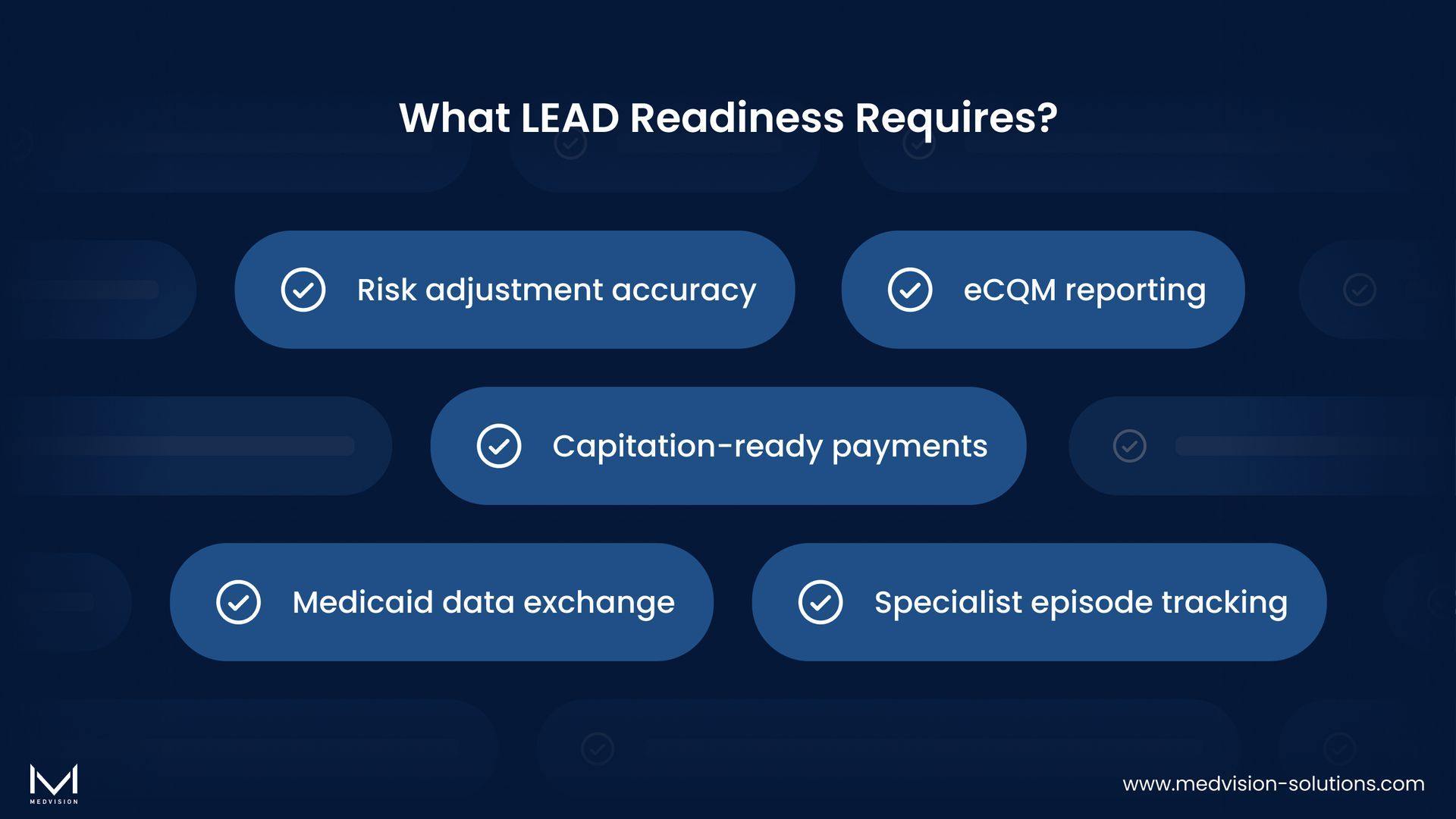
A ten-year benchmark window rewards organizations that get their infrastructure right early. Payer groups and ACOs, accepted or not yet applied, should take a hard look at:
Risk adjustment accuracy
LEAD's benchmarking leans on accurate coding and documentation for high-needs and dually eligible members. Weak risk adjustment here costs real money over ten years, not just one.
Capitation-ready payment systems
Monthly Primary Care and Total Care Capitation payments require systems built for prospective, capitated cash flow, not just retrospective claims adjudication.
Specialist contracting infrastructure
Organizations participating in CARA arrangements should be able to monitor specialist performance and episode-based outcomes. This is a different reporting layer from what most claims systems traditionally handle.
eCQM reporting readiness
Electronic clinical quality measure reporting is optional for performance years 2027 and 2028, but the certified EHR technology and reporting workflows needed to support it must be in place before it becomes mandatory.
Medicaid data coordination
Organizations in the two Medicaid integration pilot states will eventually need to exchange data across Medicare and Medicaid systems, a capability most ACOs don't currently have.
None of this is next-gen technology. It's the same population health infrastructure that has separated strong ACO performers from struggling ones for years, now applied to a longer, more complex model.
How MedVision Helps Organizations Prepare for Value-Based Models Like LEAD
MedVision has supported ACOs, IPAs, MSOs, and payer organizations through Medicare's shift to value-based care since 1994. QuickCap, MedVision's managed care administration platform, is built for exactly the kind of operational complexity LEAD introduces:
- Capitation and claims in one system:
QuickCap handles prospective capitated payments alongside traditional claims adjudication, so your team isn't stitching together separate systems for Primary Care Capitation and standard claims. - Population health analytics:
Risk stratification dashboards flag high-needs and dually eligible members early, supporting the accurate risk adjustment LEAD's benchmarking depends on. - Compliance built into daily workflows:
Automated CMS, NCQA, and HEDIS reporting, plus configurable audit trails, keep your organization audit-ready without a last-minute scramble. - Care coordination tools:
Centralized referral tracking, authorization management, and provider network integration support the specialist relationships CARA's episode-based arrangements require.
Whether you're implementing as an accepted PY2027 participant or building the case for a future cohort, MedVision's professional services team can help assess where your current systems stand against what LEAD requires
Get Ready for ACO LEAD with MedVision Inc.
With ACO REACH concluding on December 31, 2026, organizations should use the remaining implementation window to prepare. This will give you a real head start on a model built to reward long-term planning. MedVision Inc has 20+ years of expertise in payer operations and is here to help you navigate this shift efficiently.
Conclusion
The ACO LEAD Model represents the biggest structural change to Medicare accountable care in years: a decade-long benchmark, new capitation options, expanded participant eligibility, and a real emphasis on high-needs and dually eligible populations. For ACOs and payer groups running ACO REACH today, or those still evaluating accountable care, the practical work starts now. Review your risk adjustment accuracy, confirm your systems can handle capitated payments, and talk to your technology partner about what LEAD actually requires, whether you're heading into implementation this year or positioning for the next cohort.
Succeed in Value-Based Models
Frequently Asked Questions
When does the CMS ACO LEAD Model start?
LEAD's first performance year begins January 1, 2027, and the model runs through December 31, 2036. Applications for the first performance year closed May 17, 2026, and CMS expects to open future application cycles, though details haven't been announced.
What happens to ACO REACH participants when the model ends?
ACO REACH ends on December 31, 2026. Eligible participants may apply to transition into the LEAD Model through a streamlined application process, but acceptance is not automatic. Organizations may also choose other accountable care pathways, such as MSSP, depending on their strategy.
Who can join the ACO LEAD Model?
LEAD is open to current ACO REACH and MSSP participants, Medicare fee-for-service providers new to ACOs, Federally Qualified Health Centers, Rural Health Clinics, and organizations serving high-needs or dually eligible populations. Standard ACOs need 5,000 aligned beneficiaries, with lower minimums for high-needs-focused and new entrant ACOs.
How is the LEAD ACO Model different from ACO REACH?
LEAD runs for ten years without rebasing, versus REACH's shorter cycles. It adds new capitation payment options, CMS-Administered Risk Arrangements for specialist contracting, and applies high-needs and dually eligible support across every ACO instead of a separate track.
Recently published articles


Keep in touch
Subscribe to get the latest update
Trending topics


Share your insights on social media
Upcoming events and company news