

How Healthcare Claims Processing Works: A Complete Guide for Payers

Every claim that enters your system sets off a structured sequence of checks. For health plans, TPAs, ACOs, and other delegated risk organizations, healthcare claims processing sits at the intersection of financial performance and operational integrity. It's where coverage commitments become payment decisions, where data quality determines throughput, and where inefficiencies compound fast.
The sheer size speaks to the importance of the issue. Millions of claims are processed each year by payers, and the risk inherent in the process begins at its outset and lasts until completion. A flawed eligibility determination procedure, outdated fee schedules, or an absence of duplication detection capability is more than just inefficient—it causes losses that are difficult to recoup.
This guide covers the full lifecycle of claims processing in healthcare from a payer perspective: what each stage involves, where breakdowns tend to occur, and what the right claims processing system should do to keep operations running smoothly.
Comprehensive Claims Processing for Payers
What Is Healthcare Claims Processing?
Healthcare claims processing is the administrative and financial workflow payers use to receive, evaluate, and pay claims submitted for services delivered to covered members.
The scope is broader than it sounds. At the payer level, claims processing in healthcare isn't a single transaction. It's an end-to-end operational cycle that spans multiple systems, benefit configurations, coverage rules, and payment terms. A single claim passes through eligibility verification, authorization checks, coding validation, duplicate detection, and fee schedule calculation before a payment determination is made.
For organizations managing delegated risk through capitation arrangements, value-based contracts, or full-risk agreements, this process carries even more financial weight. Payment accuracy and processing speed directly affect risk margins, network relationships, and compliance standing. That's why the design and configuration of your healthcare claims processing systems matter far beyond basic functionality.
The Healthcare Claims Processing Workflow
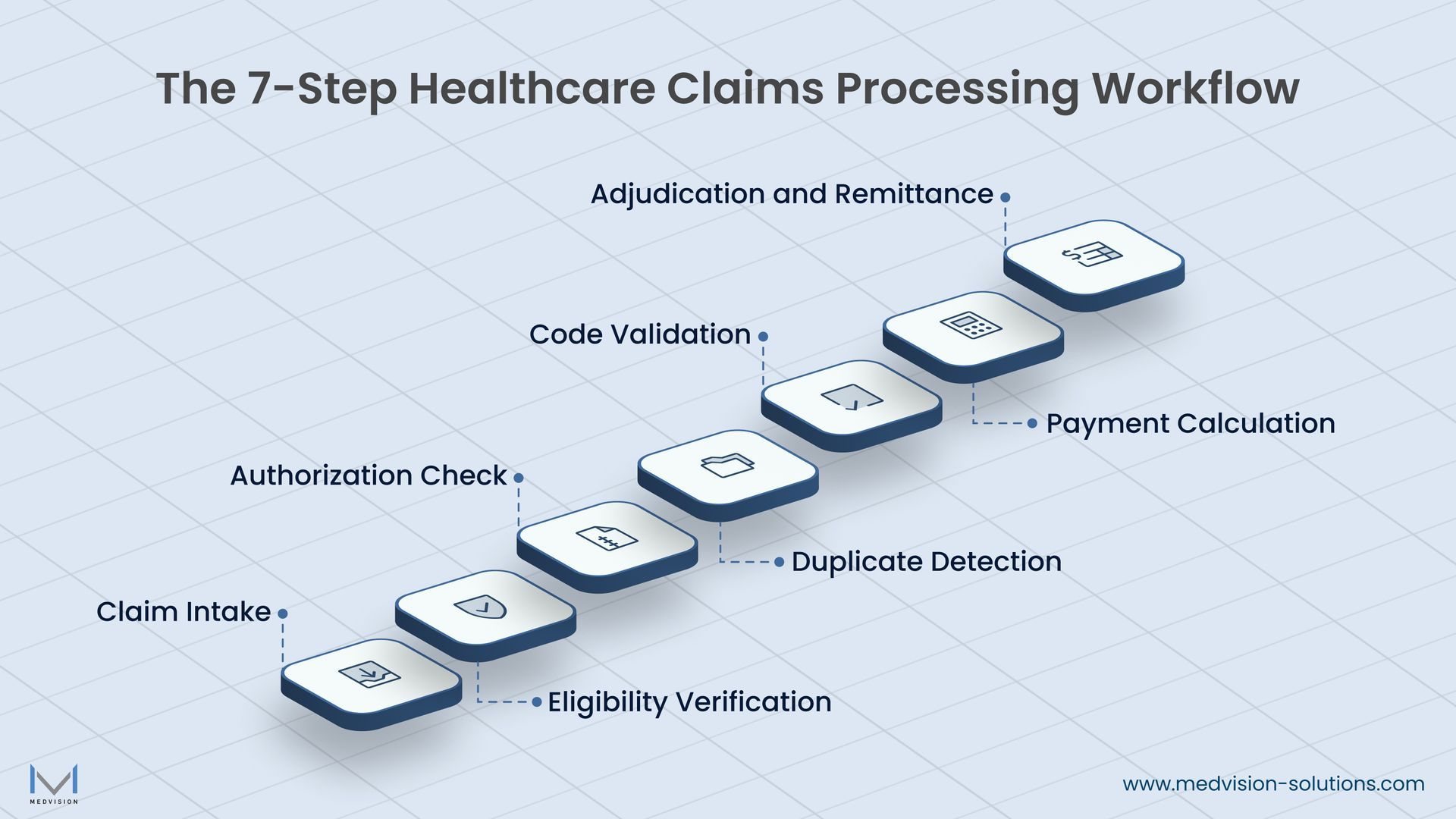
Every claim-processing system in healthcare follows the same core sequence, even if the tools and configurations vary. Here's how the workflow breaks down at the payer level.
1. Claim Intake
Claims arrive through multiple channels: EDI file submissions, clearinghouse routing, manual entry, and increasingly, direct system integration. A capable healthcare claims-processing system validates submissions for format compliance and completeness before routing them. Missing required fields or malformed transactions are caught here before they consume downstream processing capacity.
2. Eligibility and Benefit Verification
The system compares the claim to the member's current coverage, their benefit plan, and the periods during which the plan is applicable. If the patient is not eligible for the benefit plan or the date the service was rendered falls outside the coverage period, the claim will be marked instead of being sent to the payment process.
3. Authorization Verification
For services requiring prior authorization, the system checks whether a valid authorization exists for the claim being submitted. Missing or expired authorizations are a consistent friction point, particularly for specialty and high-cost services.
4. Duplicate Detection
A properly configured healthcare claims processing system screens each incoming claim against historical submission records. By matching on member, provider, date of service, and procedure code, it flags submissions that have already been paid or denied before any payment action is taken. This step protects payer organizations from costly duplicate reimbursements and is especially critical at high submission volumes.
5. Code and Policy Validation
The diagnosis, procedure, and modifiers codes are examined according to coding criteria and payer policies. Wrongly coded CPT codes, no modifier use, and code combinations violating medical necessity requirements are all identified during this process. Here is when the impact of contract edits and clinical logic used by the adjudication engine becomes more evident.
6. Payment Calculation
After passing prior validation tests, the amount for which the claim will be reimbursed is calculated using contract fees and other parameters such as co-payments, deductibles, capitation carve-outs, etc. When payers deal with DRG, APC, or RBRVS claims, automatic fee schedule retrieval avoids human error.
7. Adjudication and Remittance
Clean claims are approved and queued for payment. Claims that fail one or more checks are either denied or escalated for manual review, depending on the issue's nature and severity. Once adjudicated, the system generates remittance advice and, where applicable, routes ERA transactions back to the submitter.
The Role of Claims Adjudication in the Processing Cycle
The claim adjudication process in healthcare is the decision-making core of the entire workflow. It's the stage where each claim is evaluated against coverage rules and payment logic to determine whether, and how much, to pay.
Payers do have their considerations when it comes to manual and automated adjudication. For one, manual review is prone to inconsistency. When people use the same guidelines but apply them differently, it leads to varied results and subsequent revisions to address them. Automated adjudication ensures that all claims are assessed consistently each time according to the established logic.
Consistency is especially important in bulk. For example, an organization receiving several hundred thousand claims per month cannot go through each one manually. The objective is to ensure that automated adjudication is applied to as many valid claims as possible, while complex issues should be resolved manually.
For a closer look at how automated adjudication works and what a strong auto-adjudication rate looks like in practice, our blog,
auto-adjudication in healthcare covers the benchmarks and what drives performance in each direction.
Common Challenges Payers Face in Claim Processing
Even well-resourced payer operations encounter persistent friction in their healthcare claims-processing workflows. A few challenges show up consistently across organization types.
Data Quality at the Point of Submission
Eligibility records that aren't updated in real time, demographic mismatches, and missing plan identifiers all create avoidable exceptions. Improving data quality at the source reduces the volume of exceptions that manual reviewers have to handle downstream.
Rule Maintenance Across Multiple Contracts
Payers managing multiple lines of business, such as Medicare Advantage, Medicaid, commercial, PACE, or ACO REACH, often maintain different benefit structures and fee schedules within a single system. Keeping claim-processing steps in healthcare synchronized with current contracts without requiring constant IT intervention is one of the more persistent operational challenges.
Fraud, Waste, and Abuse Detection
Fraud or abusive billing, when viewed at scale, is not always easy to detect through a manual review process. Duplicate submissions, out-of-network billing without approval, and abnormal use statistics for specific procedure codes are all behaviors that can be detected only through systematic monitoring.
EDI Complexity and Submitter Variability
Not all submitters configure their EDI transactions the same way. Payers working with large, diverse provider networks regularly deal with variability in submission formats and trading partner configurations. A claims system that requires submitters to change how they work creates friction across the entire network.
For a broader look at what makes claims processing in healthcare operationally difficult, our blog ‘Here's why claims processing in healthcare can be tough’ covers the common failure points in detail.
The Future of Healthcare Claims Processing for Payers
The direction of healthcare claims processing systems is fairly clear, even if the pace of adoption varies.
Real-time adjudication is gaining ground. The ability to adjudicate a claim at or near the point of service, rather than days after submission, reduces administrative back-and-forth and supports faster network reimbursement.
CMS interoperability mandates are accelerating the infrastructure investment needed to make this practical at scale.
With respect to the role of AI in logic, this is moving from pilots to full-blown production applications across more payer settings. Rather than relying solely on hard-coded rules in their logic processes, claims processors are now incorporating intelligent adjudication engines into their workflow, which detect pattern anomalies early and uncover rule flaws before they affect payment accuracy. QuickCap’s AI-enabled adjudication process is an example of this.
In relation to value-based care, the introduction of this payment structure creates another element of complexity for the healthcare claims processor. When reimbursement is contingent on achieving outcomes rather than service volume, the claims processor needs to be able to incorporate capitation and shared savings mechanisms into the system.
How QuickCap Supports the Full Claims Processing Lifecycle
QuickCap, MedVision's managed care platform, is built specifically for the operational needs of payers, TPAs, ACOs, IPAs, MSOs, and other delegated risk organizations. It handles the full healthcare claims processing lifecycle within a single platform.
The Auto-Adjudication Engine
This applies configurable rules to each claim, validating eligibility, checking authorizations, detecting duplicates, and calculating payments automatically. Configurable trading partner parameters handle EDI variability across submitters without requiring changes on their end.
ClaimShop Integration
The integration automates fee schedule retrieval for DRG, APC, and RBRVS claim types, with support for value-based pricing, sequestration, and HMO payer structures. Payment calculations reflect actual contracted terms rather than manual lookups or static tables.
The SQL Query Builder
It lets operations teams build and adjust adjudication rules using live data, without coding expertise. For organizations managing complex, multi-contract environments where rules need regular updates, this means changes don't require IT tickets or development cycles.
A Centralized Claims Workflow Dashboard
This dashboard gives teams visibility across every claim in the system, with tools to sort, prioritize, and assign exception claims while maintaining a clear picture of what's been processed, what's pending, and what needs escalation.
CAQH CORE-Certified
QuickCap is also CAQH CORE-certified for Eligibility and Benefits, Claim Status, and Payment and Remittance, meaning its interoperability standards meet nationally recognized benchmarks for automated healthcare data exchange.
For organizations weighing adjudication approaches,
vetting standard auto-adjudication vs. SQL-based adjudication is a useful reference before deciding which configuration fits your environment.
Conclusion
Healthcare claims processing is one of the most operationally demanding functions a payer manages. The workflow is long, the failure points are numerous, and the costs of inefficiency accumulate quickly. Getting it right requires more than capable software. It requires a platform built specifically for the payer environment, with configurability to handle multiple lines of business, automation depth to reduce manual review at scale, and reporting visibility to keep operations under control.
That's what QuickCap is built to deliver. For payers and delegated risk organizations looking to improve throughput, reduce processing errors, and build a claims operation that scales, the platform is worth a closer look.
Smart Claims Processing Starts Here
Frequently Asked Questions
What is healthcare claims processing?
Healthcare claims processing refers to the end-to-end process through which payers receive, process, adjudicate, and pay claims submitted by their covered members for services rendered. This process covers eligibility, benefits, authorizations, duplication, and fee scheduling.
What are the key steps in a healthcare claims processing workflow?
Some of the processes involved in claim handling in the healthcare field include claim intake, eligibility and benefits verification, authorization verification, duplicate detection, code/policy validation, payment calculation, and adjudication with remittance advice. Each process will involve rule processing unique to the contract or benefit plan.
What challenges do payers face in healthcare claims processing?
Some of the challenges include outdated eligibility files, rule processing across many contracts and LOBs, EDI submissions that vary from one network to another, fraud and duplicate detection at high volumes, and ensuring that adjudication logic aligns with the fee schedule or benefit plan.
How does QuickCap support healthcare claims processing for payers?
QuickCap helps in the whole claims processing cycle for health insurance payers, including TPAs, ACOs, IPAs, and MSOs. With QuickCap’s auto adjudication engine, ClaimShop fee schedule, SQL query builder, and claims workflow dashboard, it becomes easier to process regular claims.
Recently published articles


Keep in touch
Subscribe to get the latest update
Trending topics


Share your insights on social media
Upcoming events and company news