The CMS ACO LEAD Model: 8 Readiness Questions for 2027

For most ACOs, the most consequential part of LEAD may not be the 10-year timeline. It is what happens to the way they manage financials, providers, and performance within that timeline.
LEAD removes traditional rebasing, introduces new prospective payment mechanisms, changes how high-needs populations are handled, and creates new routes for working with specialists. That means the transition is not simply administrative. It affects how an ACO operates.
Here are eight questions that can help determine whether your organization is ready.
Ready For LEAD's Capitated Payments
What Is the CMS LEAD Model?
The Long-term Enhanced ACO Design Model, or LEAD, is the CMS Innovation Center's newest ACO-focused model and the direct successor to ACO REACH. It builds on lessons from ACO REACH and the Medicare Shared Savings Program, with benchmarking and payment changes designed to broaden participation among smaller, independent, rural, and other providers, including Community Health Centers and Rural Health Clinics.
LEAD's biggest structural change is stability. There's no rebasing during the entire 10-year window, which means ACOs that lower costs early aren't punished with a tougher benchmark the next year. The program integrates High Needs and dually eligible beneficiaries into every ACO's population instead of treating them as a separate track. Additionally, it opens a pilot for Medicare-Medicaid integration in two states, according to the CMS LEAD Model overview.
The timeline matters as much as the design. For the 2026 inaugural cycle, applications closed on May 17. Accepted ACOs entered an optional Implementation Period running from September 15 through December 31, 2026, leading up to the official launch of Performance Year 2027.
8 Critical Questions Every ACO Leader Should Ask
1. Did we make the first cohort, and what's our path if we didn't?
If your organization applied and got accepted, you're likely preparing for the Implementation Period right now. If you missed the window, you're not locked out permanently. CMS expects additional application cycles, though timing isn't confirmed. ACO REACH participants from Performance Year 2026 got an abbreviated application; everyone else, subscribe to the
LEAD Model listserv for updates on future cohorts rather than waiting quietly.
2. Global Risk or Professional Risk, which fits us?
LEAD offers two risk-sharing paths. Global Risk allows ACOs to receive up to 100% of total savings and makes them liable for up to 100% of total losses, and it is the only track eligible for Total Care Capitation. Under the updated 2026 methodology, both tracks qualify for CARA, while Professional Risk features up to 60% savings against up to 50% losses. ACOs must remain in Professional Risk for at least
four Performance Years before they can elect to move to Global Risk.
3. Which payment mechanism actually fits our cash flow?
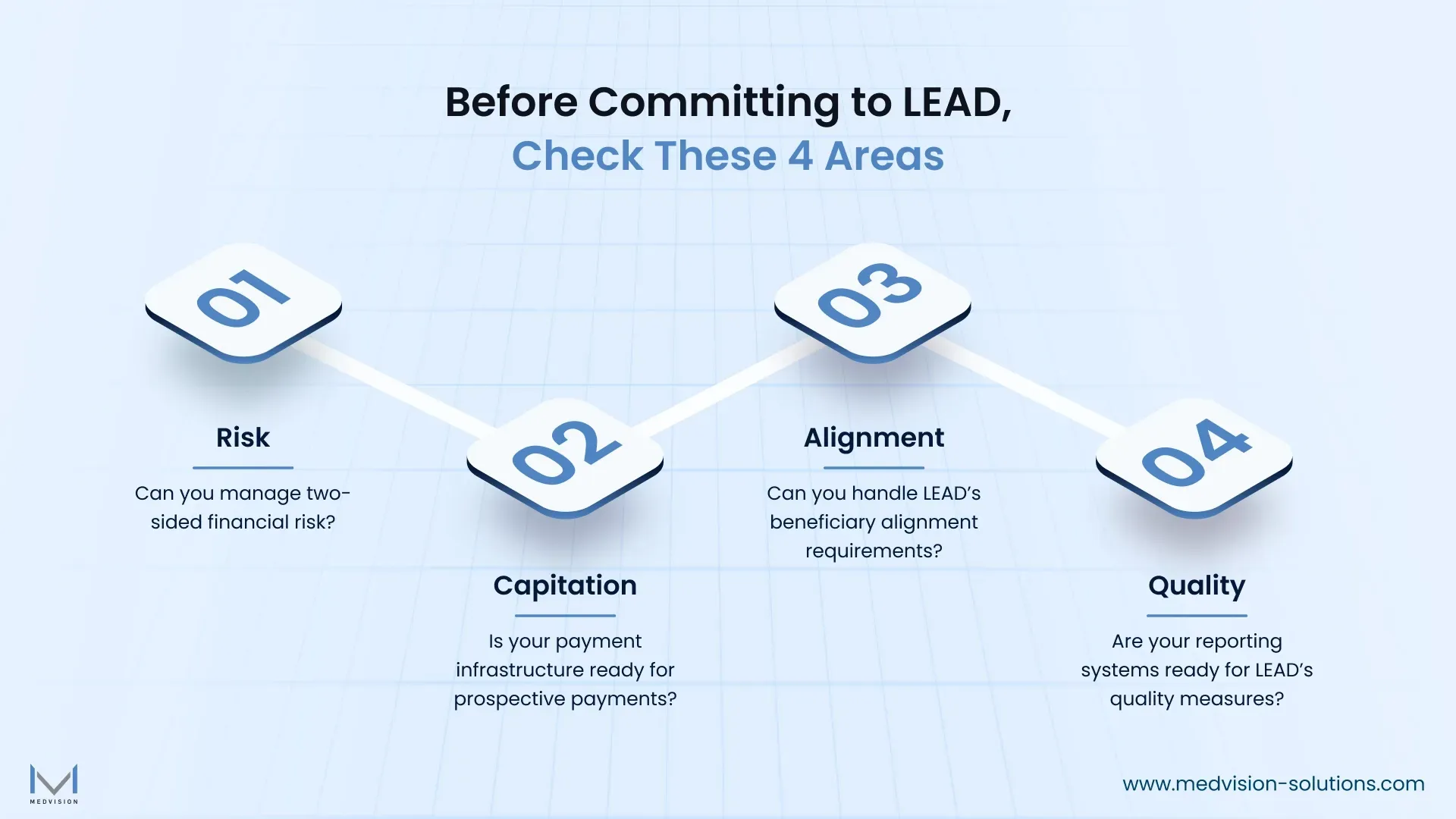
LEAD offers four prospective payment options. Primary Care Capitation covers primary care and includes an Enhanced component that must be repaid at year-end. Total Care Capitation, Global Risk only, covers all Medicare Parts A and B services. Non-Primary Care Capitation is a true, non-reconciled capitated payment for specialty and post-acute services. The Advanced Payment Option fronts money for non-primary care but reconciles it against actual fee-for-service billing. Each one changes how much revenue arrives upfront versus at settlement.
4. Can our systems adjudicate and reconcile capitation at the TIN and NPI level?
LEAD applies fee reductions and capitated payments to specific Participant TIN and Preferred Provider NPI combinations. That's a different operational lift than fee-for-service claims processing. You need claims infrastructure that can apply fee reductions correctly, track capitation against actual billing, and produce clean, audit-ready reports when CMS comes asking. This is where many ACOs discover their existing systems weren't built for this kind of granularity.
5. Are we ready to serve High Needs and dually eligible beneficiaries under one model?
Unlike ACO REACH, LEAD doesn't carve out a separate High Needs ACO type. High Needs criteria now apply across every ACO, with concurrent risk adjustment and lower alignment minimums for ACOs whose aligned population includes more than 40% High Needs beneficiaries. LEAD also pilots Medicare-Medicaid integration in two selected states starting with a planning phase through December 2027.
6. Are we ready to operate through the Implementation Period?
The IP runs September 15 through December 31, 2026. No beneficiaries are formally aligned, and no payments or risk apply during this window, but accepted ACOs use it to run voluntary alignment activities, collect attestations, and prep for Performance Year 2027. You'll also choose between Prospective Alignment, which is conducted before each Performance Year, and Hybrid Alignment, which allows monthly additions of voluntarily aligned beneficiaries during the Performance Year. Line up your outreach and data collection processes before the clock starts.
7. Is our quality reporting infrastructure ready for LEAD's measure set?
LEAD's quality strategy includes four claims-based measures, a CAHPS patient experience survey, and two electronic clinical quality measures covering diabetes glycemic status and blood pressure control. Reporting on those eCQMs is optional in 2027 and 2028, followed by pay-for-reporting in 2029 and 2030 and pay-for-performance beginning in 2031. Up to 3% of your benchmark is at risk for quality performance, so eCQM reporting and CEHRT compliance aren't back-office details; they directly touch your bottom line.
8. Do we have the financial guarantee and reserves for a 10-year commitment?
LEAD requires ACOs to secure a financial guarantee covering Shared Losses and other amounts owed under the model. The required amount varies by risk option and capitation payment mechanism. Because there's no rebasing, the benchmark assumptions you agree to now follow you for a decade. The size of the financial guarantee varies materially depending on an ACO's risk option and capitation choices, making financial modeling an important part of LEAD preparation. Model your numbers carefully before you sign anything.
QuickCap v7 is Built to Run the Numbers Behind LEAD
Answering these questions is one thing. Operating on them for a decade is another. MedVision's ACO software, QuickCap v7, is an administration platform built for this kind of delegated, risk-based model. It supports claims adjudication, capitated payment structures, fee reductions, and reporting across the TIN and TIN-NPI structures used under LEAD. QuickCap v7 also automates fee reductions and tracks risk stratification alongside the quality and financial data your teams need. Executive dashboards keep benchmark performance, savings, and quality withholds visible in one place instead of scattered across spreadsheets.
If your organization is heading into LEAD, whether in the first cohort or planning for the next, the administrative backbone matters as much as the strategy.
Conclusion
A 10-year performance period is rare in Medicare value-based care, and that's both the appeal and the weight of the CMS ACO LEAD Model. The risk option, payment mechanism, alignment strategy, and technology infrastructure you choose will shape how your organization operates under LEAD. Getting those decisions right early can make the transition more manageable and leave more room for long-term care transformation.
Whether your ACO is preparing for the Implementation Period this month or still watching for the next application window, treat these 8 questions as a checklist, not just background reading.
Designed for Value-Based Care Success
Frequently Asked Questions
When does the CMS LEAD Model start?
Performance Year 2027 begins January 1, 2027, and the model runs through December 31, 2036.
What happens to ACO REACH participants after 2026?
ACO REACH ends December 31, 2026. Organizations that participated in Performance Year 2026 were eligible for an abbreviated LEAD application.
What's the difference between Global Risk and Professional Risk?
Global Risk shares up to 100% of savings and losses and unlocks Total Care Capitation and CARA. Professional Risk caps both at 50% with no TCC or CARA access.
Does LEAD integrate Medicare and Medicaid?
Yes. CMS is running a planning phase through December 2027 to select two states for an ACO-Medicaid partnership framework serving dually eligible beneficiaries.
Recently published articles


Keep in touch
Subscribe to get the latest update
Trending topics


Share your insights on social media
Upcoming events and company news