

What Does IPA Stand For in Healthcare? The Full Breakdown

If you work in managed care, you've heard the term IPA thrown around in contract meetings, network reviews, and capitation reports. But what is an IPA in healthcare, exactly, and why does it matter so much to how payers structure their networks?
An independent physician association sits at an important junction between payers and providers. It's not an insurance company, and it's not a hospital system. It's a business entity that lets independent physicians keep their own practices while gaining the negotiating power, infrastructure, and risk-sharing ability of a larger group. For payers and payer groups, understanding how IPAs function and how to support them with the right technology directly affects network performance, claims accuracy, and cost control.
This guide covers the IPA model from the ground up: what it is, how it works, what IPA insurance actually means, and where a platform like QuickCap v7 fits into the picture.
Built For ACO Success
What Is an IPA in Healthcare?
An Independent Physician Association, or IPA, is a legal entity formed by a network of independent physicians who join together for contracting, administrative support, and shared resources, while each physician keeps ownership of their own practice. It's a common IPA medical abbreviation you'll see across managed care documentation, provider directories, and health plan contracts.
The model has existed in the United States since the late 1970s, and it grew out of a simple need: independent physicians wanted the negotiating leverage of a large group without giving up their practices to a hospital system or employer. Today, IPAs still serve that purpose, but their role has expanded well beyond basic contracting. Many now manage referral authorizations, coordinate care, take on financial risk, and report quality data to payers and CMS.
For payers, an IPA acts as a single point of contact representing dozens or even hundreds of physicians. Instead of negotiating and administering contracts with each doctor individually, a payer works through the IPA, which distributes responsibilities, reconciles payments, and manages performance across its member practices.
How Does an IPA Work in Healthcare?
An IPA functions as an intermediary layer between the payer and the individual physicians in its network. Here's how that structure typically plays out.
Contracting with Payers
The IPA negotiates contracts with health plans on behalf of its member physicians. This might include fee-for-service arrangements, capitation, or shared-risk models, depending on the plan and line of business involved.
Distributing Patients and Referrals
Once a health plan assigns members to the IPA, the organization manages primary care assignment, specialist referrals, and prior authorization processes across its network.
Managing Claims and Reimbursement
The IPA (or a delegated administrator) may manage claims administration, reimbursement workflows, and payment reconciliation for member physicians, depending on its contractual responsibilities. This is where accurate IPA in medical billing workflows matters most. A missed authorization check or a miscalculated capitation payment doesn't just affect one claim; it can throw off reconciliation across the entire network.
Coordinating Care and Reporting Quality
IPAs increasingly play a role in care coordination, especially in value-based arrangements, tracking quality measures, gaps in care, and utilization patterns that health plans require for reporting.
Sharing Financial Risk
In capitated or risk-based contracts, the IPA takes on some or all of the financial risk for its attributed patient population, which means the accuracy of its data and payment systems directly impacts its margins.
For a closer look at how claims move through this kind of network once they're submitted, our guide to claims adjudication walks through the process step by step.
IPA and Insurance: What It Means
This is one of the most common points of confusion. An IPA is not an insurance company, and IPA insurance isn't really a product you buy. The IPA doesn't underwrite risk for a health plan member the way an insurer does.
The term usually refers to the IPA's role within an insured member's care. When someone is enrolled in a health plan that contracts with a specific IPA, their primary care and referrals typically route through that IPA's network of physicians. So when people ask about IPA insurance, they're usually asking how their coverage connects them to a specific physician network, not about a separate insurance product.
That said, in risk-based contracts, IPAs do function a bit like a mini insurer within their own network. They accept a fixed payment per member per month (capitation) and are financially responsible for the cost of care that the population uses. If costs come in under that budget, the IPA benefits. If they run over, the IPA absorbs the loss. That's the piece that makes accurate financial tracking so critical for these organizations.
Role of IPAs in Managed Care and Value-Based Care
IPAs have become central players in the shift toward value-based care, largely because they give independent physicians a way to participate in models that typically favor larger, more integrated systems.
In managed care, IPAs help payers extend their networks without having to contract and credential every physician one by one. In value-based arrangements, they help physicians pool the infrastructure, data, and reporting capability needed to succeed in Accountable Care Organizations, Medicare Advantage risk contracts, and Medicaid managed care programs.
According to MGMA's 2025 survey, fewer than half (40%) of medical group leaders report a positive outlook on value-based care, with operational complexity and administrative burden remaining significant concerns. That gap between participation and preparedness is exactly where IPAs add value: they give smaller practices a shared platform for the analytics, care coordination, and reporting that risk-based contracts demand.
A well-run IPA also strengthens a payer's own value-based strategy. Better data flow and tighter network coordination mean fewer gaps in care, better quality scores, and more predictable cost trends across the attributed population. For a broader view of how these claims and cost dynamics play out across a payer's full network, our claims processing guide for payers covers the operational side in more depth.
Common Challenges Healthcare IPAs Face
Running an IPA well is harder than it looks on paper. A few challenges show up again and again.
Fragmented Data Systems
Many IPAs still operate with claims, eligibility, and quality data spread across disconnected systems, which makes it difficult to get a real-time view of network performance or capitation accuracy.
Credentialing and Delegation Complexity
When an IPA takes on delegated credentialing responsibilities from a health plan, it has to meet strict standards. Organizations seeking or maintaining NCQA-recognized delegated credentialing arrangements must meet NCQA credentialing standards. NCQA describes credentialing as "the cornerstone of a high-quality provider network," requiring processes such as primary source verification, ongoing monitoring, and credentialing committee oversight.
Capitation Reconciliation
Tracking whether capitation payments actually match attributed membership, especially with member churn, is a recurring pain point. Errors here directly affect the IPA's margin.
Network Growth Without Losing Control
Despite ongoing consolidation across healthcare,
42.2% of U.S. physicians still practice in independent, physician-owned practices. That leaves a substantial population of independent providers who may choose to participate in IPAs to gain scaling power while maintaining ownership of their practices.
Reporting and Compliance Burden
Quality reporting requirements from CMS, state Medicaid programs, and commercial payers pile up quickly, and manual reporting processes rarely keep pace.
How MedVision Supports IPA Success
This is where a platform built for the full complexity of managed care operations makes a real difference. QuickCap v7, MedVision's managed care platform, is purpose-built to support IPAs, ACOs, MSOs, TPAs, and PHOs managing risk-based and delegated contracts.
Unified Claims and Network Data
QuickCap brings claims, eligibility, authorizations, and provider network data into one system, so IPA administrators aren't piecing together a picture from five different tools.
Configurable Adjudication Engine
The platform's rule-based adjudication engine handles eligibility checks, authorization validation, and payment calculation automatically, which matters just as much for IPAs in medical billing accuracy as it does for a payer's own claims operations.
Capitation and Risk Tracking
QuickCap gives IPAs visibility into attributed membership, capitation payments, and financial performance against risk-based budgets, so reconciliation issues get caught early instead of at year-end.
Delegated Credentialing Support
For IPAs managing delegated credentialing responsibilities, QuickCap supports the documentation, monitoring, and reporting workflows needed to keep those agreements in good standing with health plan partners.
Flexible Reporting for Compliance
Configurable dashboards and reporting tools help IPAs meet quality and compliance requirements from CMS and state programs without building custom reports from scratch every cycle.
For more than 20 years, QuickCap has supported IPAs at every stage of growth, from fee-for-service arrangements through full-risk capitation. You can see the full breakdown of capabilities on the QuickCap v7’s platform page.
Conclusion
The IPA model gives independent physicians a way to compete and thrive in a healthcare system that increasingly rewards scale, data, and risk-bearing capability. For payers, IPAs extend network reach and simplify contracting, but only when the IPA itself has the operational foundation to manage claims, risk, and compliance accurately.
That foundation is what separates a struggling IPA from one that grows sustainably. The right technology doesn't replace good management, but it makes good management possible at scale. That's the gap QuickCap is built to close.
Seamless Managed Care with QuickCap v7
Frequently Asked Questions
What does IPA stand for in healthcare?
IPA stands for Independent Physician Association, a business entity formed by independent physicians who join together for contracting, administrative support, and shared resources while keeping ownership of their individual practices.
Is an IPA the same as an insurance company?
No. An IPA doesn't underwrite insurance. It's a network entity that contracts with health plans and manages care and claims for its member physicians. In risk-based contracts, it does take on financial responsibility for its attributed patient population, which is where the confusion around "IPA insurance" usually comes from.
What's the difference between an IPA and an ACO?
Both involve networks of physicians working together, but an IPA is primarily a contracting and administrative entity, while an ACO is a CMS-recognized model specifically focused on shared savings and quality performance under Medicare and other value-based programs. Many IPAs participate in ACOs, but the two aren't the same structure.
How does QuickCap help IPAs manage claims and risk?
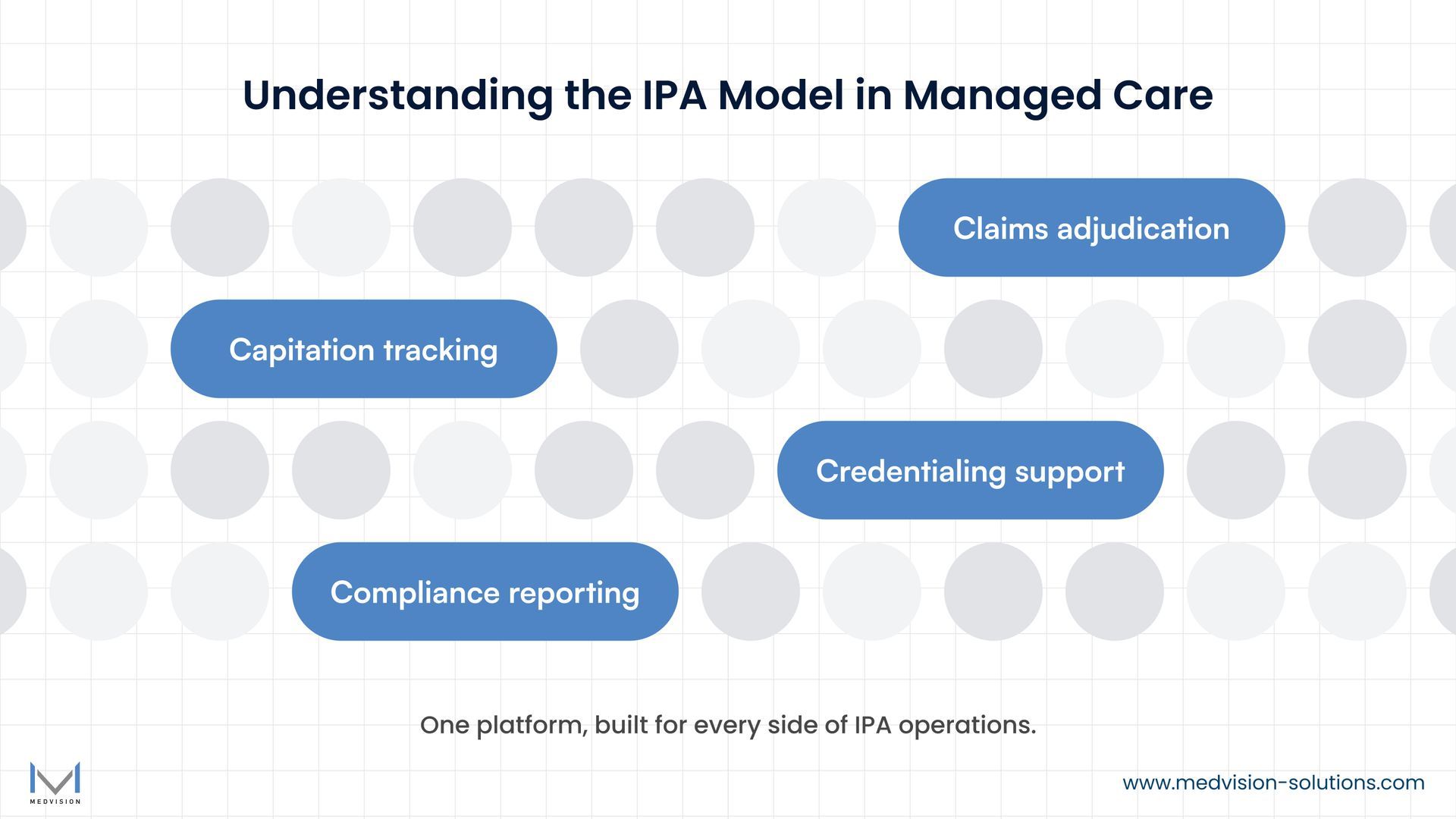
QuickCap gives IPAs a unified platform for claims adjudication, capitation tracking, delegated credentialing support, and compliance reporting, replacing fragmented systems with one connected view of network performance.
Recently published articles


Keep in touch
Subscribe to get the latest update
Trending topics


Share your insights on social media
Upcoming events and company news