

Which Value-Based Care Model Is the Most Appropriate for Your ACO – MSSP or LEAD?

The strategic blueprint for value-based care is undergoing a fundamental design split. For years, ACO networks navigated a balanced market by choosing between two options. They could select the stable framework of the Medicare Shared Savings Program (MSSP) or the innovative features of the ACO REACH Model. However, the rollout of the ten-year ACO LEAD Model shifts the playing field entirely. It introduces a separate long-term roadmap built specifically for value-based care enterprises ready for deeper financial and clinical integration.
The MSSP vs. ACO LEAD question isn't abstract. It determines how your organization gets paid, how much risk it carries, and how long you can plan around a stable benchmark. For ACOs, MSOs, IPAs, and payer groups weighing accountable care strategy right now, understanding the difference between ACO LEAD and MSSP matters more than it has in years. Here's how the two models compare, and how to think about which one fits your organization.
20+ Years in Payer Operations
What Is MSSP?
The Medicare Shared Savings Program, or MSSP, is CMS's original and largest permanent ACO program, launched in 2012. It lets groups of doctors, hospitals, and other providers form a Tax Identification Number-based ACO. They take shared accountability for the cost and quality of care for an assigned Medicare fee-for-service population. When an MSSP ACO spends below its benchmark and hits quality targets, it shares in the savings. Under a two-sided track, it can also owe money back if it exceeds the benchmark.
MSSP runs on two tracks. The BASIC track provides a glide path from one-sided to two-sided risk for eligible ACOs, with two-sided levels offering shared savings of up to 50%. The ENHANCED track, built for organizations ready to take on greater risk, can offer up to 75% of shared savings. If ACO REACH is still part of your evaluation, we broke down how it compares to MSSP in an earlier piece.
According to
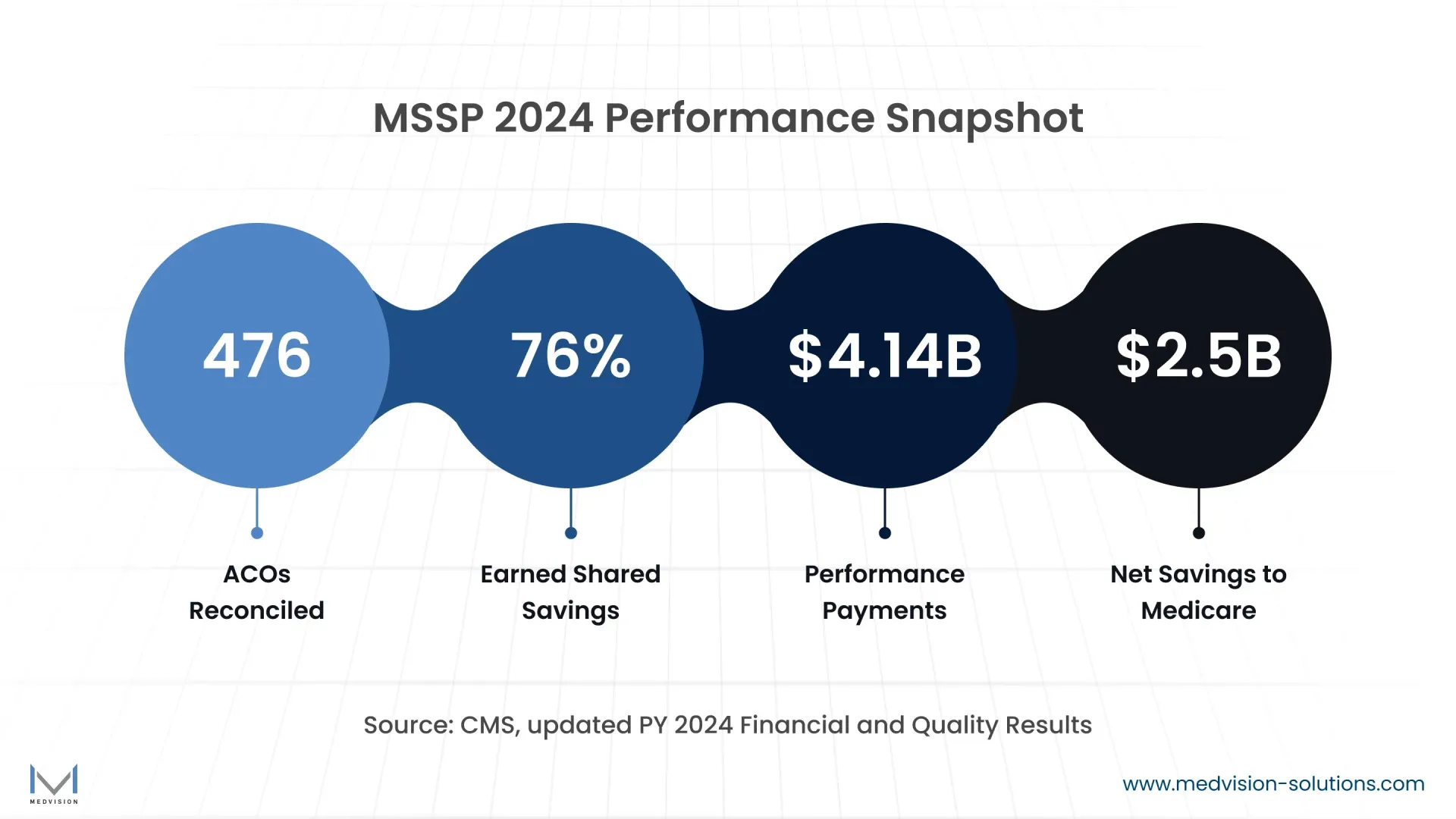
CMS's updated 2024 performance results, MSSP ACOs generated $2.5 billion in net savings for Medicare, while 76% of participating ACOs earned shared savings.
MSSP benefits include a well-established annual application cycle, more than a decade of CMS benchmarking history, and a lower entry barrier than a fully capitated model. The tradeoff: it still runs largely on fee-for-service claims beneath the shared-savings layer, so the operational lift of true prospective payment isn't part of the equation.
What Is the ACO LEAD Model?
The ACO LEAD Model, short for Long-term Enhanced ACO Design, is CMS's newest accountable care model and the direct successor to ACO REACH. It launches January 1, 2027, and runs for a full decade through December 31, 2036, the longest performance period CMS has tested in this space. Unlike MSSP's periodic benchmark resets, ACO LEAD builds toward a stable, ten-year benchmark without traditional rebasing.
ACO LEAD offers two voluntary risk-sharing options. Under Global Risk, an ACO can receive up to 100% of savings and is liable for up to 100% of losses against its benchmark. Under Professional Risk, that split caps at 50% in either direction. LEAD offers prospective payment options, including Primary Care Capitation and, for eligible Global Risk participants, Total Care Capitation.
Standard ACOs generally need 5,000 aligned beneficiaries in Performance Year 1. ACOs with a high proportion of High Needs beneficiaries can qualify with 800 beneficiaries in the first performance year, while Newly Entering ACOs can qualify with 1,000. Those lower thresholds increase over the course of the model. That's a deliberate move to widen participation beyond the large, established organizations that dominated ACO REACH. We covered the ACO LEAD model's mechanics, eligibility rules, and 2027 timeline in more depth in our guide to the
ACO LEAD Model.
MSSP vs ACO LEAD: Key Differences
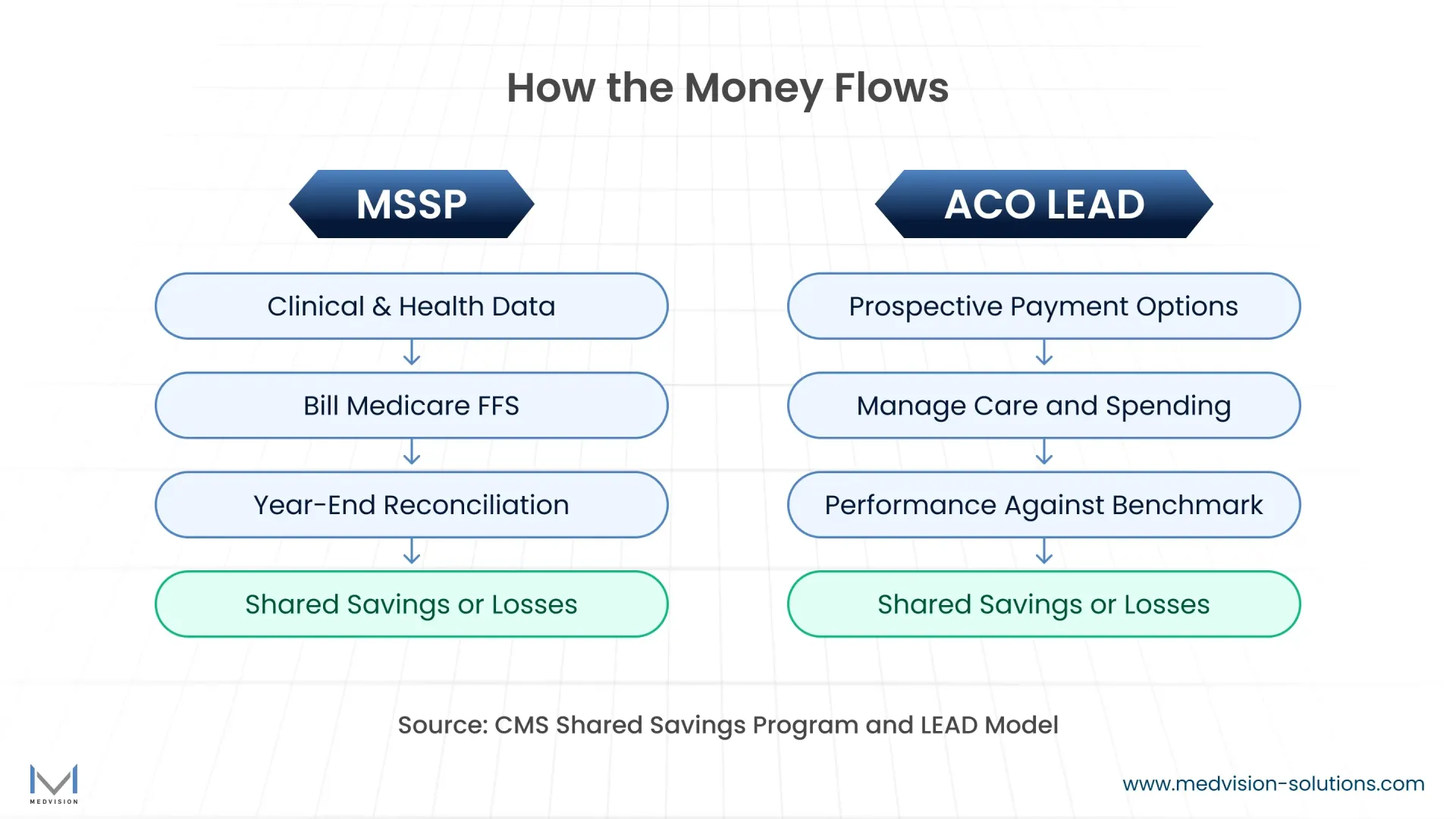
Put side by side, the ACO LEAD vs MSSP comparison comes down to five things: how you get paid, how much risk you carry, how your benchmark behaves, who can join, and how long the model runs.
Payment structure
Retrospective reconciliation versus prospective capitation.
Risk and reward
MSSP's BASIC track offers up to 50% in shared savings under its two-sided levels, while the ENHANCED track offers up to 75%. LEAD's Professional Risk option offers up to 50% of savings and losses, while Global Risk increases both to up to 100%.
Benchmark stability
MSSP benchmarks reset periodically based on regional and national trends. LEAD provides a ten-year performance window without traditional rebasing. This creates greater benchmark predictability for organizations making long-term investments in care coordination and population health.
Eligibility
MSSP is open for annual applications, with new agreement periods starting each January. LEAD's first application cycle has closed. Organizations interested in future participation should monitor CMS for additional application opportunities and timelines.
Population focus
LEAD integrates enhanced approaches to risk adjustment and benchmarking for high-needs populations. This includes individuals who are dually eligible for Medicare and Medicaid, across the model. MSSP applies risk adjustment too, but LEAD's approach is more deliberately designed around complex, high-cost populations.
Benefits and Challenges of Each Model
Both models share some metrics and offer unique possibilities. Here is the breakdown.
MSSP
The model still makes sense for a lot of organizations. Benefits include a predictable, well-documented application process for eligible organizations. It also offers a pathway that can begin with one-sided risk and over a decade of CMS benchmarking history to plan against. The challenge: benchmark rebasing means strong performers can see their targets tighten over time, and the fee-for-service billing layer underneath adds administrative complexity that a purely capitated model avoids.
ACO LEAD
LEAD trades some of that familiarity for structural advantages. A ten-year benchmark without rebasing rewards long-term investment in care coordination and data infrastructure. Prospective payment options can provide more predictable payment timing and support longer-term care investments. Enhanced risk adjustment for high-needs and dually eligible beneficiaries makes it a stronger fit for organizations serving complex populations. The tradeoffs: there's no multi-year track record yet, and capitated payments require billing and reconciliation systems that many organizations built for fee-for-service claims aren't ready to run on day one.
| Model | Maximum Savings Share | Maximum Loss Share |
|---|---|---|
| MSSP BASIC | Up to 50%* | Varies by level |
| MSSP ENHANCED | Up to 75% | Up to 75% |
| LEAD Professional | Up to 50% | Up to 50% |
| LEAD Global | Up to 100% | Up to 100% |
*For applicable two-sided BASIC levels.
Footer: Source: CMS
Shared Savings Program and
LEAD Model
How to Choose the Right Model for Your ACO or Payer Group
A few questions can narrow the decision:
- Is your organization ready for capitation?
LEAD's prospective payment options require organizations to assess whether their financial, claims, and reconciliation systems can support a different payment and operational model. If your platform only handles fee-for-service reconciliation, that's a gap to close first. - How much risk can you carry?
LEAD's Global Risk option offers the highest upside and the highest downside. MSSP's phased BASIC track lets newer ACOs ease into two-sided risk instead of committing to it immediately. - Who are you serving?
Organizations with a high share of high-needs or dually eligible beneficiaries may find LEAD's built-in risk adjustment and benchmarking a better fit than MSSP's standard methodology. - What's your timeline?
MSSP has recurring application cycles for organizations seeking to begin new agreement periods. LEAD's first cohort has already closed, so organizations positioning for a future cohort have a real planning window between now and the next application cycle.
At the organizational level, different ACO entities may participate in different accountable care arrangements, subject to CMS participation and overlap rules. A single ACO entity cannot simply treat ACO LEAD and MSSP as interchangeable concurrent agreements.
How QuickCap Supports Your Transition to Value-Based Care
Whichever direction your organization is headed, the operational demands are similar: accurate risk adjustment, clean data flow between claims and clinical systems, and reporting that holds up under CMS scrutiny. MedVision has supported ACOs, IPAs, MSOs, and payer organizations through Medicare's shift to value-based care since 1994. QuickCap, our managed care administration platform, is built for exactly this kind of complexity:
- Capitation and claims in one system.
QuickCap handles prospective capitated payments alongside standard fee-for-service claims adjudication, so teams aren't stitching together separate platforms for MSSP-style reconciliation and LEAD-style capitation. - Population health and risk stratification.
Dashboards flag high-needs and dually eligible members early, supporting accurate risk adjustment under either model. - Compliance built into daily workflows.
Configurable reporting and audit capabilities can help organizations organize the data and documentation needed to support value-based care reporting requirements. - Savings and loss reporting.
Flexible dashboards give executive teams real-time visibility into performance against benchmarks, no matter which risk track you're on.
Conclusion
ACO LEAD or MSSP isn't really a competition between a better and worse option. It's a question of fit. MSSP offers a familiar, lower-barrier path with a decade-long track record. ACO LEAD offers a longer runway, more aggressive risk-sharing options, and a benchmark built for organizations ready to invest in capitated, coordinated care. Review your risk appetite, your population mix, and your systems' readiness for prospective payment before you commit either way. The right technology partner can make either path considerably easier to run.
Designed for Value-Based Care Success
Frequently Asked Questions
What's the main difference between ACO LEAD and MSSP?
MSSP pays retrospectively through fee-for-service claims and shared savings reconciliation, with a periodically rebased benchmark. ACO LEAD offers prospective payment options and provides a ten-year performance window without traditional rebasing
Can an ACO participate in both MSSP and ACO LEAD?
An ACO can only hold one active agreement at a time, but organizations can move between models. Eligibility to participate in LEAD depends on CMS's model requirements and application rules. Organizations considering a transition from MSSP, ACO REACH, or another accountable care arrangement should evaluate the applicable eligibility and participation requirements for the relevant model.
What are the benefits of MSSP for payer groups?
MSSP offers a well-documented annual application process for eligible organizations, providing a pathway that can begin with one-sided risk. With over a decade of CMS benchmarking data to plan against, this initiative represents a lower-barrier entry point into accountable care.
When does ACO LEAD start and how long does it run?
LEAD's first performance year begins January 1, 2027, immediately after ACO REACH concludes, and the model runs through December 31, 2036, a full ten-year performance period.
Recently published articles


Keep in touch
Subscribe to get the latest update
Trending topics


Share your insights on social media
Upcoming events and company news