

Maximizing Operational Efficiency: The Payer’s Guide to Pre-Adjudication

In the high-stakes environment of healthcare claims management, payers, Third-Party Administrators (TPAs), and Managed Care Organizations (MCOs) face a constant challenge. They must balance speed with absolute accuracy. Every claim that enters the system represents a potential financial and administrative risk. If a claim is processed with incorrect data, the resulting fallout, ranging from overpayments to expensive appeals, can significantly impact a payer’s operational budget.
This is why pre-adjudication has become an essential strategy for modern payer organizations. Rather than waiting for errors to surface during the final stages of processing, savvy payers use pre-adjudication as a proactive "scrubbing" phase. By identifying discrepancies and verifying data at the point of entry, organizations can ensure that only high-quality, "clean" claims move forward. This approach does more than just save time; it protects the integrity of the entire payment ecosystem.
Streamline Your Claims Workflow
What Is Pre-Adjudication in Healthcare Claims Processing?
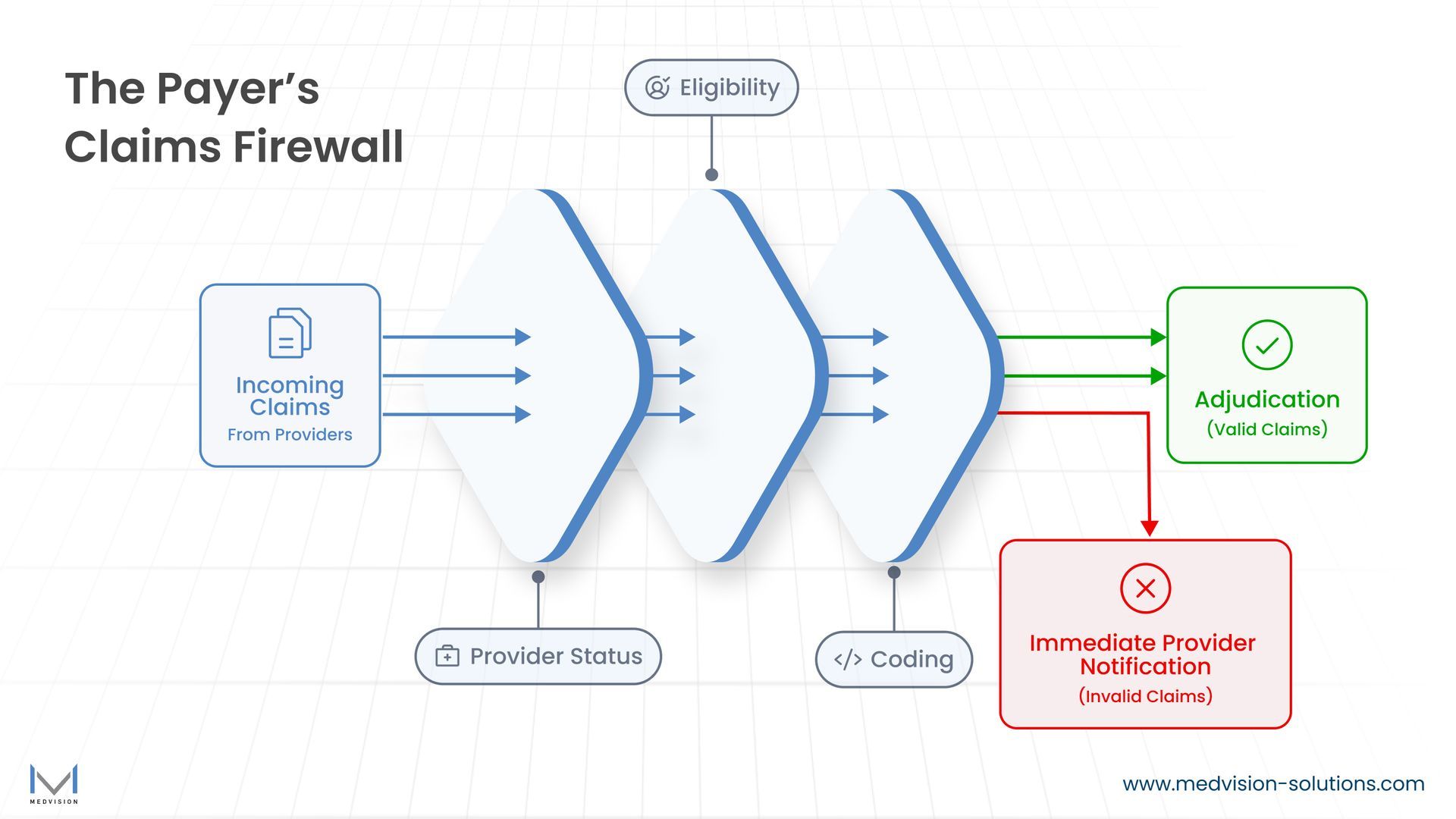
For a payer, pre-adjudication in healthcare is the systematic validation of claim data before it reaches the formal adjudication engine. When a claim is submitted electronically, it must pass through a series of automated gates designed to catch technical errors, eligibility issues, and coding inconsistencies.
During this phase, the system performs a "sanity check" on the data. Is the member actually enrolled in the plan? Is the provider's NPI valid and active in the system? Are the submitted codes compliant with standard billing practices? By using the best tools for pre-adjudication claims editing, payers can instantly reject or flag non-compliant claims. This prevents "dirty data" from ever reaching the financial ledger, ensuring that the payer’s resources are only spent on valid, processable requests.
Pre-Adjudication vs. Adjudication: The Payer’s Perspective
It is helpful to view these two stages as distinct functional layers within a payer’s workflow:
- Pre-Adjudication:
This is the administrative "filter." It focuses on data integrity, member eligibility, and compliance with basic billing rules. Its goal is to ensure the claim is "clean" and ready for a financial decision. - Adjudication:
The "decision" engine. Once a claim is validated, the system applies the specific terms of the member’s benefit plan, such as deductibles, co-insurance, and out-of-pocket maximums, to determine the final payment amount.
Without a robust pre-adjudication layer, the adjudication engine must work harder, often resulting in "pend" statuses that require costly manual intervention by claims examiners.
Why Pre-Adjudication is Critical for Healthcare Payers
The primary motivation for a payer to prioritize pre-adjudication is to avoid the "pay and chase" cycle. When a payer realizes an overpayment was made due to an administrative error, the cost of recovering those funds often exceeds the value of the error itself. Pre-adjudication stops these errors at the door.
Furthermore, a high volume of denied claims leads to a high volume of provider appeals and grievances. Each appeal incurs high administrative costs for the payer, requiring staff time for review and correspondence. By using claims-editing software to catch errors early and provide immediate feedback to providers, payers can significantly reduce the number of disputed claims entering the appeals pipeline.
Key Steps Involved in the Pre-Adjudication Process
An optimized payer workflow, such as the one found in QuickCap v7, typically involves several automated checks:
- Compliance Scrubbing:
Ensuring the EDI file adheres to HIPAA standards and that all required fields are populated correctly. - Eligibility Verification:
Real-time checking of the payer’s member database to confirm active coverage on the date of service. - Provider Credentialing Check:
Confirming the billing provider is contracted and authorized to provide the services billed. - Coding Logic Edits:
Using claims editing software to identify unbundled codes or mutually exclusive procedures based on NCCI guidelines. - Duplicate Detection:
Scanning the historical database to ensure the exact same service has not already been submitted or paid for.
Common Challenges Without Pre-Adjudication
Payer organizations that skip a formal pre-adjudication phase often suffer from "operational drag." Common symptoms include:
- Bloated Pend Queues:
Claims examiners become overwhelmed by claims that are pended for simple issues, like a missing modifier or an expired member ID. - Increased Administrative Spend:
Additional staff are needed to handle manual re-entry and provider phone calls about rejected payments. - Regulatory Scrutiny:
Frequent errors in claims processing can lead to poor performance on state and federal audits, potentially resulting in fines. - Strained Provider Relations:
While payers do not lose money on a denial, the administrative friction caused by "preventable" denials can damage the payer’s reputation within their provider network.
How Pre-Adjudication Reduces Claim Rework
For a payer, "rework" means processing the same claim more than once. This is an invisible drain on profitability. Pre-adjudication ensures that a claim is either "clean" enough to be auto-adjudicated or is returned to the provider for correction before it consumes any more of the payer’s processing power.
By shifting the burden of correction back to the provider at the earliest possible moment, the payer maintains a leaner, more efficient operation. This allows the claims team to focus on complex cases that truly require human expertise, rather than fixing simple data entry errors.
Role of Automation in Pre-Adjudication
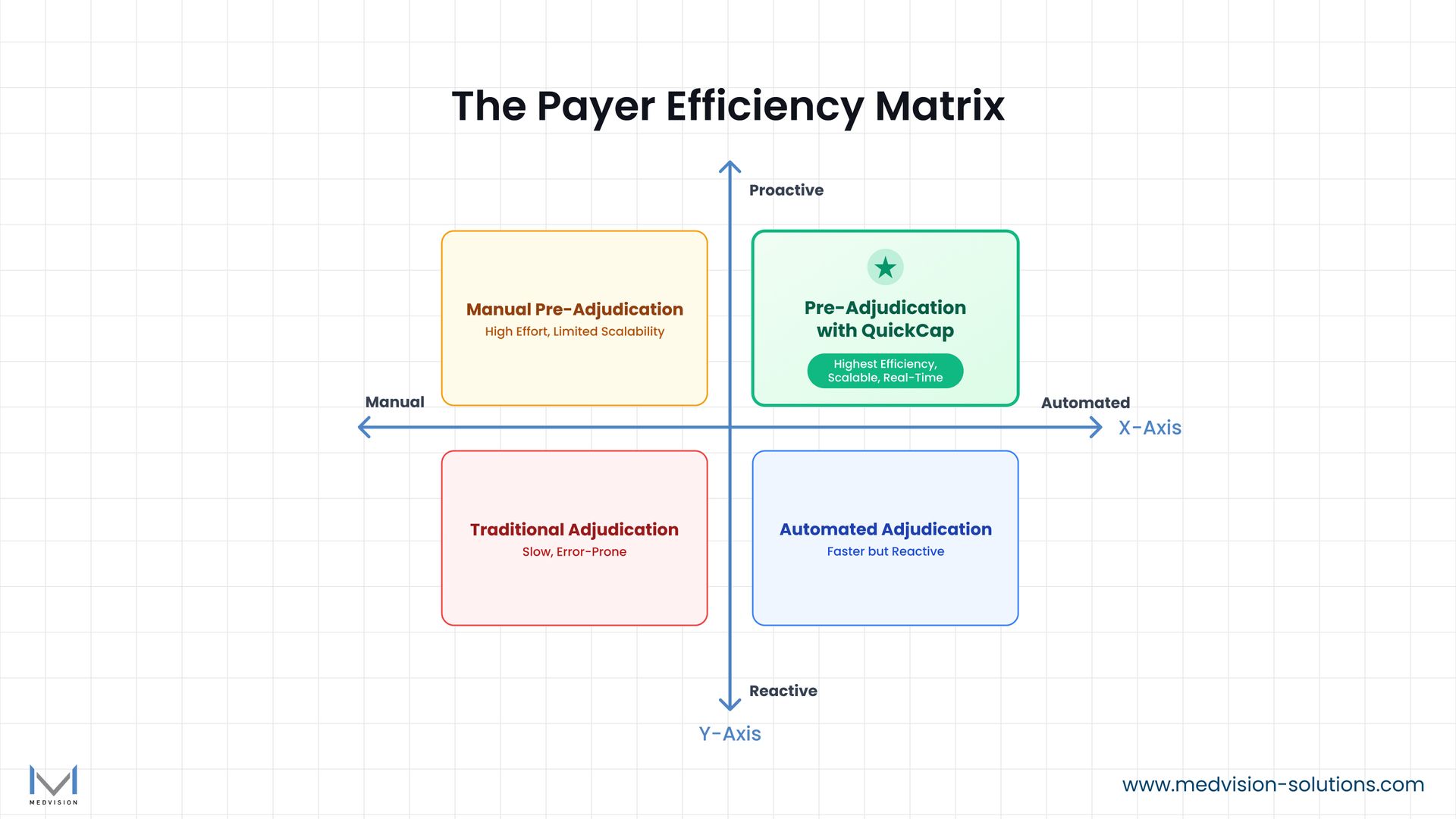
The sheer volume of claims handled by modern payers makes manual pre-adjudication impossible. MedVision’s QuickCap v7 provides the automation necessary to process thousands of claims per hour with surgical precision.
By integrating the best tools for pre-adjudication claims editing directly into the intake workflow, QuickCap can automatically compare billed services against the payer’s specific business rules and contract terms. For example, if a contract specifies that a certain procedure requires a prior authorization, the system can automatically link the claim to the authorization record. If no record is found, the claim is flagged immediately, preventing an unauthorized payment from being issued.
Best Practices for Implementing Pre-Adjudication
To maximize the benefits for your organization, follow these industry best practices:
- Automate NCCI Edits:
Ensure your claims-editing software is configured to apply NCCI edits automatically. - Leverage Real-Time EDI Responses:
Use 277CA (Claim Acknowledgment) files to give providers immediate feedback on why a claim failed the pre-adjudication check. - Customize Rules by Line of Business:
A Medicaid claim may require different pre-adjudication logic than a Commercial or Medicare Advantage claim. Ensure your system can handle these nuances. - Regularly Audit the Scrubber:
Periodically review the rules in your pre-adjudication engine to ensure they align with the latest clinical guidelines and contract updates.
Future Trends in Pre-Adjudication for Healthcare Payers
The future of pre-adjudication in healthcare lies in predictive analytics. Advanced systems will soon be able to predict the likelihood of a claim being fraudulent or abusive based on historical patterns, even if the claim appears "clean" on the surface.
Additionally, as the industry moves toward more value-based care models, pre-adjudication will evolve to check claims against quality metrics and episode-of-care bundles in real-time. Payers who adopt these advanced best tools for pre-adjudication claims editing now will be better positioned to handle the complexities of future reimbursement models.
Conclusion
For healthcare payers, the value of pre-adjudication is found in the costs that are never incurred. It is the cost of the overpayment that was not made, the appeal that did not have to be filed, and the manual review that was not necessary. By serving as a sophisticated gatekeeper, pre-adjudication ensures that your claims department operates at peak efficiency.
Implementing a solution like QuickCap v7 allows payer organizations to automate the heavy lifting of data validation, protecting the bottom line while improving the speed of service. In an industry where margins are tight and regulations are strict, a robust pre-adjudication strategy is no longer optional; it is a fundamental requirement for success.
Watch How It Works
Frequently Asked Questions
Does pre-adjudication increase the time it takes to pay a claim?
No. While it adds a validation step at the beginning, it significantly reduces the total cycle time by preventing delays caused by pended claims and manual reviews.
How does pre-adjudication help with "Pay and Chase"?
It identifies errors, such as duplicate billings or ineligible members, before the payment is issued. This eliminates the need for the payer to attempt to recover funds from providers after the fact.
Can we customize the pre-adjudication rules in QuickCap?
Yes. QuickCap v7 is highly configurable, allowing payers to set specific rules based on their unique provider contracts, member benefits, and internal business logic.
What is the difference between a "clean claim" and a "validated claim"?
A validated claim has passed the pre-adjudication scrubbing process and is confirmed to have all the necessary, accurate data required for the adjudication engine to make a final payment decision.
Recently published articles


Keep in touch
Subscribe to get the latest update
Trending topics


Share your insights on social media
Upcoming events and company news