

Claims Auto-Adjudication: Benefits, Rates, and Best Practices for Payers
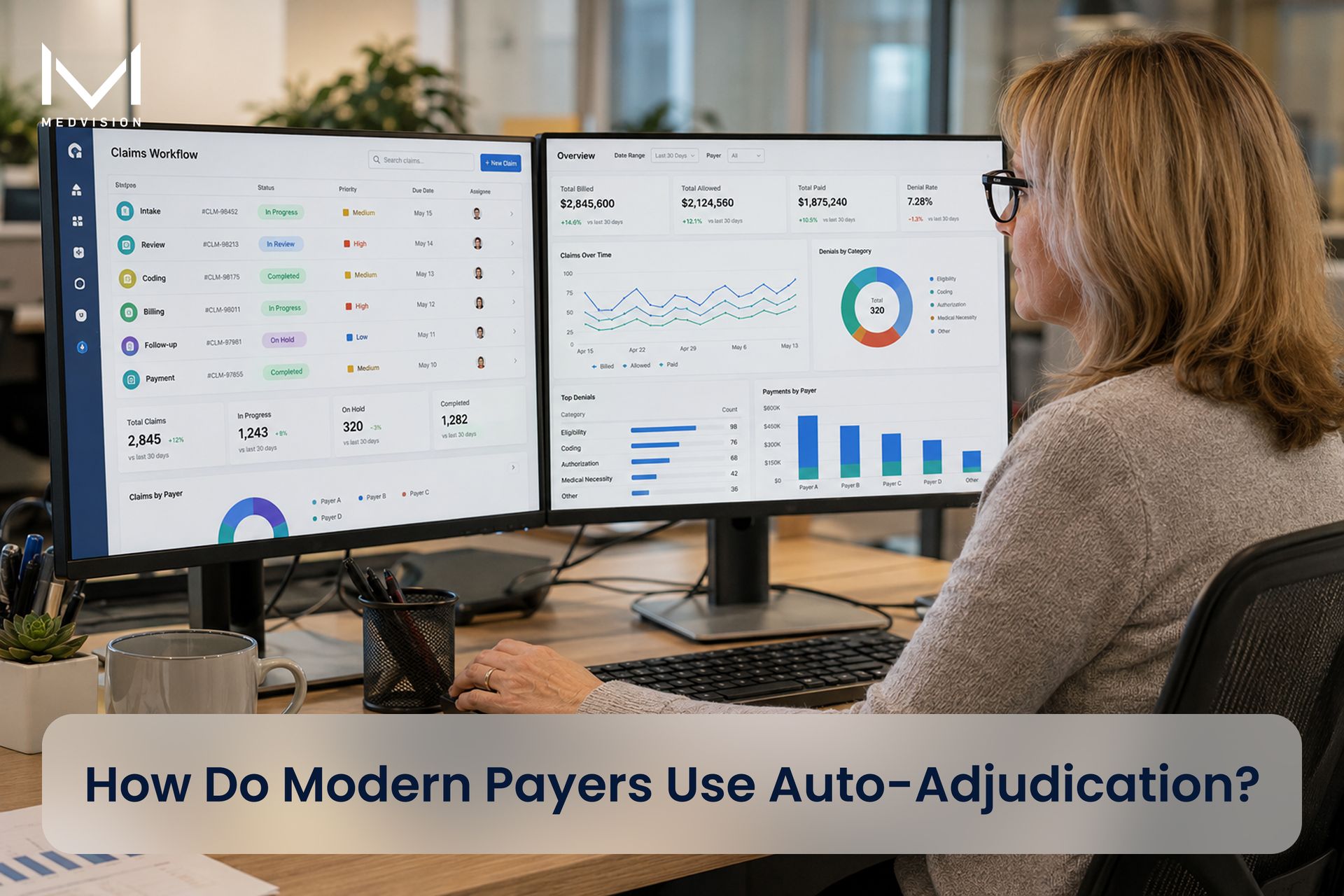
Every day, payers and TPAs process thousands of claims. When those claims move through a largely manual workflow, the costs compound quickly: delayed reimbursements, frustrated providers, staff tied up in repetitive review tasks, and a backlog that never quite clears. Auto adjudication of claims addresses that problem directly.
For organizations already stretched thin, the question isn't really whether to automate. It's how to do it well and how to measure whether it's working. This guide covers both.
AI-Powered Auto-Adjudications
What Is Auto-Adjudication of Claims?
Claims auto-adjudication is the process of using software to approve or deny healthcare claims without requiring a human to review each one individually. Instead of a claims examiner opening every file and cross-referencing coverage rules by hand, the system applies pre-configured logic to make that determination automatically and instantly.
The claim adjudication process has always involved multiple checkpoints: eligibility verification, coverage validation, duplicate detection, coding review, and payment calculation. Auto adjudication doesn't skip those steps. It automates them, running each check in seconds rather than hours.
This is the core value proposition of modern claims adjudication software: handle the high volume of routine, clean claims automatically, and route only the exceptions to human reviewers. For a broader look at how the full adjudication lifecycle works,
understanding Claims Adjudication, how it works, and why it matters is a useful starting point.
How Does Auto-Adjudication Work?
The claims adjudication process follows a structured sequence. Here's how it plays out in an automated environment:
1. Claim Intake
Claims arrive through multiple channels: EDI files, scanned documents, or direct system submissions. A capable claims adjudication system accepts all of these formats and begins processing immediately, checking each submission for completeness before anything else.
2. Eligibility and Coverage Verification
The system cross-references the claim against the member's active coverage, benefit plan, and authorization records. If eligibility can't be confirmed or the service falls outside the plan, the claim is flagged rather than passed along for payment.
3. Duplicate Detection
One of the clearest cost-protection functions. The system checks whether a matching claim has already been submitted and either paid or denied. Duplicate submissions, whether accidental or intentional, are caught here before they reach the payment queue.
4. Coding and Policy Validation
Diagnosis and procedure codes are reviewed against accepted medical coding standards and payer-specific rules. A missing modifier or an invalid CPT code gets flagged at this stage rather than after payment has gone out.
5. Payment Calculation
Once a claim clears the prior checks, the system calculates the appropriate reimbursement amount based on contracted rates, copays, deductibles, and applicable pricing rules. This is where tools like QuickCap's ClaimShop integration remove the guesswork, automating fee schedule retrieval for DRG, APC, and RBRVS claim types so that payment calculations are rule-aligned and accurate every time.
6. Approval, Denial, or Escalation
Clean claims are approved and queued for payment. Claims that fail one or more checks are either denied or escalated for manual review, depending on the nature of the issue.
Auto-Adjudication vs. Manual Adjudication: Key Differences
Manual adjudication isn't inherently flawed. For complex, high-dollar claims or unusual billing scenarios, human review is often the right call. The issue arises when manual review becomes the default for every claim, including the thousands of straightforward ones that don't need it.
| Auto-Adjudication | Manual Adjudication | |
|---|---|---|
| Speed | Seconds per claim | Hours to days |
| Consistency | The same rules applied every time | Varies by reviewer |
| Volume Capacity | Scales with submission volume | Constrained by staffing |
| Best For | Clean, standard claims | Complex or exception-based claims |
| Cost Per Claim | Lower | Higher |
The goal isn't to eliminate manual review. It's to reserve it for cases where it genuinely adds value, and let the claims adjudication system handle everything else. If you're deciding between rule-based and more advanced approaches,
Standard Auto-Adjudication vs. SQL-Based Adjudication breaks down the tradeoffs clearly.
What Is a Good Auto-Adjudication Rate and How Do You Achieve It?
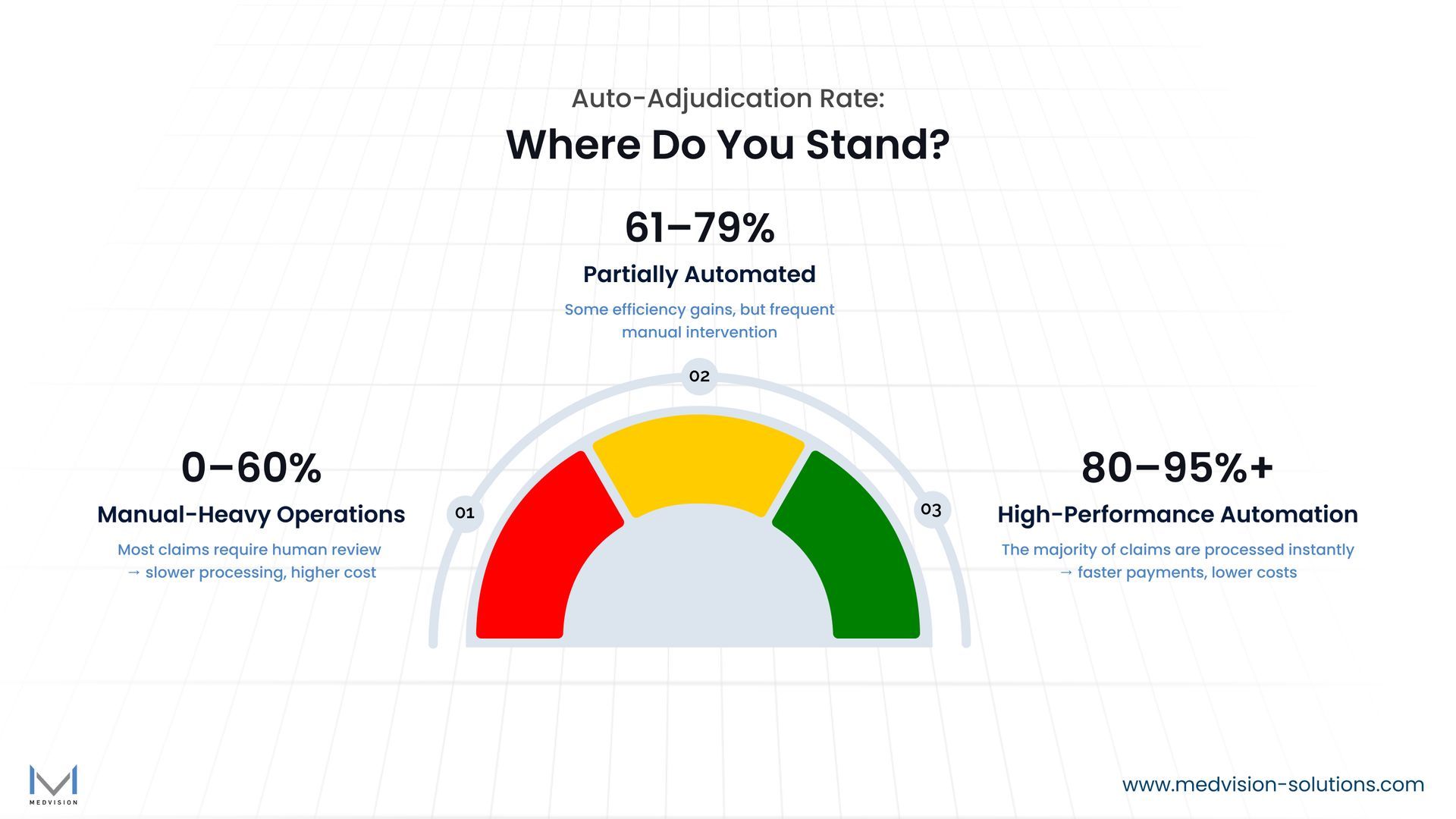
Your auto adjudication rate is the percentage of submitted claims processed without manual intervention. Industry benchmarks suggest that organizations with mature automation programs typically auto-adjudicate around 80% or more of their claims volume, with high-performing payers pushing closer to 90%.
If your rate sits well below that, the gap usually comes down to a handful of consistent issues: poor claim data quality at the point of submission, outdated eligibility records, adjudication rules that haven't kept pace with current contracts, or a platform that lacks the flexibility to handle edge cases cleanly.
Improving your rate isn't about flipping a switch. It requires tightening each part of the process: cleaning up data inputs, auditing your rule configurations, and using a platform that supports ongoing refinement without requiring an IT ticket for every change. QuickCap's SQL Query Builder allows operations teams to build and adjust adjudication rules using insights from live data, without needing coding expertise to do it. For a closer look at how AI is reshaping this side of operations,
AI-Based Adjudication for Clinical Claims and Authorization is worth reading.
Benefits of Auto-Adjudication for Payers and TPAs
The efficiency gains from claims auto-adjudication show up quickly. Backlogs shrink, turnaround times drop, and the manual workload on your team decreases. A few benefits go deeper than the obvious operational improvements.
Fewer Errors, Fewer Denials
Manual review introduces variability. When the same claim adjudication logic is applied differently by different reviewers, you get inconsistent outcomes and unnecessary downstream rework. Automated systems apply rules the same way, every time.
Stronger Fraud Detection
Rule-based flagging surfaces patterns that are easy to miss at volume: duplicate submissions, out-of-network billing that bypasses authorization, and anomalies in procedure codes or charge amounts.
Faster Provider Reimbursement
Providers care about payment speed. When clean claims move through in hours rather than days, it reduces the administrative back-and-forth that clogs operations on both sides and strengthens your network relationships.
Scalability Without Proportional Cost Growth
Manual operations require more staff as claim volume grows. A well-configured auto-adjudication healthcare platform absorbs volume increases without a matching increase in headcount.
Staff Available for Higher-Value Work
When your team isn't buried in routine claims, they're focused on complex cases, appeals, provider disputes, and the work that actually requires their expertise.
How QuickCap Powers Auto-Adjudication
QuickCap, MedVision's managed care platform, supports the full claims adjudication process for payers, TPAs, ACOs, IPAs, and MSOs.
Rule-Based Auto-Adjudication Engine
QuickCap's engine applies configurable parameters to each claim, validating eligibility, checking authorizations, detecting duplicates, and calculating payments automatically. Configurable trading partner parameters handle variability across EDI formats without requiring submitters to change how they work.
ClaimShop for Fee Schedule Automation
QuickCap's
ClaimShop integration automates fee schedule retrieval across DRG, APC, and RBRVS claim types, with configuration options for value-based pricing, sequestration, and HMO payer structures. Payment calculations reflect your actual contracted terms without manual lookups.
SQL Query Builder for Intelligent Rule Management
The platform's SQL Query Builder lets operations teams create and refine adjudication rules using data queries, without needing to memorize code. It's built for teams managing complex, multi-payer environments where rule sets require regular updates.
Claims Workflow Dashboard
Every claim in the system is visible through a centralized dashboard. Teams can sort, prioritize, and assign exception claims while maintaining full visibility into what's been processed, what's pending, and what needs escalation.
Multi-Format Claim Submission
QuickCap accepts claims via EDI, scanned documents, and direct system entry, accommodating the submission methods your submitters already use.
QuickCap is also
CAQH CORE-certified for Eligibility and Benefits, Claim Status, and Payment and Remittance, meaning its interoperability standards meet nationally recognized benchmarks for automated healthcare transactions.
Final Thoughts
The operational case for auto adjudication in healthcare is clear: faster processing, fewer errors, lower cost per claim, and a team that isn't overwhelmed by routine reviews. The nuance is in the execution. Building the right rule sets, maintaining clean data inputs, and using a claims adjudication software platform that can evolve alongside your contracts and coverage terms is what separates organizations with 60% rates from those hitting 90%.
For payers and TPAs looking to raise their claims auto adjudication rate and genuinely improve claims operations, QuickCap provides the tooling depth to make that practical rather than aspirational. Explore what's possible on the QuickCap platform page.
See Auto Adjudication in Action
Frequently Asked Questions
What is the difference between auto-adjudication and manual adjudication?
Auto adjudication uses software to process claims automatically based on pre-set rules, without a reviewer examining each claim individually. Manual adjudication involves a human examiner making decisions on claims one at a time. Auto-adjudication is faster and more consistent for standard claims; manual review is better suited to complex or exception-based situations.
What is a good auto-adjudication rate for a health plan or TPA?
A strong auto adjudication rate typically falls at 80% or higher, meaning at least 8 in 10 submitted claims are processed without manual intervention. High-performing payers often push that number to 85-95%. If your rate sits well below 80%, it's worth auditing your rule configurations, eligibility data, and claim submission quality.
How does claims adjudication software handle duplicate claims?
A properly configured claims adjudication system checks each incoming claim against historical submission records before processing. If a match is found by patient, provider, date of service, and procedure code, the duplicate is flagged automatically and removed from the payment queue before any payment action is taken.
How does QuickCap support auto-adjudication for payers and TPAs?
QuickCap's ClaimShop integration and SQL Query Builder work together to automate the full claims adjudication process, from eligibility verification and duplicate detection through fee schedule calculation and payment routing. The platform handles multiple EDI formats and submission types and is CAQH CORE-certified for healthcare data exchange.
Recently published articles


Keep in touch
Subscribe to get the latest update
Trending topics


Share your insights on social media
Upcoming events and company news