

Accountable Care Organizations: The Complete Guide for Payers and ACO Groups
Fee-for-service healthcare has a fundamental problem: it pays for volume, not outcomes. Accountable care organizations exist to change that. By linking reimbursement to quality performance and total cost of care, ACOs give providers and payers a shared stake in keeping people healthy rather than just treating them when they're sick.
If you're a payer, health plan, or organization operating under a value-based contract, understanding how ACOs work is no longer optional. This guide covers what an ACO is, how the major models differ, what Medicare programs govern them, and what it takes to manage one effectively at scale.
Managing ACO Population Health at Scale
What Is an Accountable Care Organization?
An accountable care organization is a network of physicians, hospitals, and other healthcare providers that voluntarily coordinate care for a defined patient population. Instead of each provider billing independently for every service rendered, the group operates under a shared accountability framework in which combined performance on quality and cost determines the group's financial outcome.
The concept stems from a straightforward premise: when providers share responsibility for the full care continuum, they have stronger incentives to prevent unnecessary hospitalizations, close care gaps, and manage chronic conditions proactively. Whether they earn shared savings or face shared losses depends on how well they meet those targets.
ACOs aren't a single entity type. They can be organized as physician groups, hospital systems, independent physician associations, or multi-stakeholder networks. What they share is a formal accountability structure and a CMS-approved or commercial payer arrangement that measures performance against defined benchmarks.
The ACO Healthcare Model: How It Works
The core mechanic of the ACO healthcare model is shared savings. CMS or another payer sets a spending benchmark for the ACO's attributed population. If the ACO comes in under that benchmark while meeting quality performance standards, it shares a portion of those savings. In two-sided risk arrangements, exceeding the benchmark means the ACO is liable for a share of the losses.
This differs from capitation, where providers receive a fixed payment per member regardless of utilization. In the ACO model, providers still bill fee-for-service, but total performance is reconciled against a benchmark at year-end.
Under the Medicare Shared Savings Program (MSSP), CMS offers two main participation tracks:
BASIC Track
It includes a glide path that allows eligible ACOs to enter under a one-sided model, with savings potential but no downside risk, and progressively take on more risk over time. It's designed to help organizations build toward value-based accountability without full exposure from day one.
ENHANCED Track
This carries the highest level of both risk and potential reward. ACOs here take on downside risk immediately but qualify for higher shared savings percentages and the Advanced APM designation under the Quality Payment Program.
Agreement periods run for at least
five years. Quality performance is assessed annually, and financial reconciliation follows each performance year. Per CMS program requirements, ACOs must have at least
5,000 attributed Medicare fee-for-service beneficiaries to participate in MSSP.
Value-Based Healthcare and the ACO's Role
Value-based healthcare reorients the entire incentive structure. Under traditional fee-for-service, providers earn more by delivering more. Under value-based arrangements, the goal is to achieve better outcomes with appropriate resource use.
ACOs are one of the most mature expressions of this model in practice. They connect provider-level care decisions to population-level outcomes in a way that fee-for-service can't replicate. When a care team detects early signs of kidney disease in a diabetic patient and adjusts treatment before hospitalization, the ACO benefits financially. When a high-risk patient is discharged without a follow-up plan and readmitted within 30 days, that cost hits the benchmark.
This bidirectional accountability is what separates ACOs from older pay-for-performance programs. The financial stakes are real and extend across the entire attributed population, not just individual episodes of care.
The Medicare ACO Program: MSSP and ACO REACH
Medicare Shared Savings Program (MSSP)
The MSSP is CMS's primary vehicle for ACO participation under original Medicare. Established under the Affordable Care Act, it operates on an annual performance cycle that covers beneficiary assignment, quality reporting, and financial reconciliation. Beginning in performance year 2025, Shared Savings Program ACOs are required to report quality data using the APM Performance Pathway (APP) Plus quality measure set. ACOs in BASIC Level E or the ENHANCED track qualify as Advanced APM participants under the Quality Payment Program, which affects how their clinicians interact with MIPS.
As of the 2026 performance year,
CMS reports that Shared Savings Program ACOs continue to serve millions of Medicare beneficiaries nationwide as value-based care participation expands
What Is the ACO REACH Model in Healthcare?
The ACO REACH model (Realizing Equity, Access, and Community Health) is a CMS Innovation Center model that runs parallel to, but separately from, MSSP. It's designed for organizations ready to take on greater risk and flexibility. ACO REACH supports prospective, population-based payment options. With a strong focus on health equity and underserved communities, and broader eligibility that includes provider-led and payer-led entities.
CMS generally does not allow the same Medicare beneficiary population to be aligned to both MSSP and ACO REACH arrangements simultaneously, and organizations should review current CMS participation rules before pursuing either model.
Care Coordination and Population Health in ACOs
Two operational capabilities determine ACO performance more than almost anything else: care coordination in healthcare and population health management.
Care coordination
Care coordination is how an ACO ensures that attributed patients receive connected, timely care across providers and settings. Without it, gaps emerge: a specialist referral isn't followed up, a post-discharge medication plan isn't communicated back to the primary care team, and a high-risk patient doesn't receive outreach until they're already in crisis. The downstream effect is avoidable utilization that pushes spending past the benchmark.
Our blog covers this dynamic in detail, and
this guide addresses how it translates into operational workflows.
Population health management
Population health management is the data infrastructure that enables proactive coordination. It segments the attributed population by risk tier, surfaces care gaps before they show up as quality-measure failures, and gives care teams and leadership the visibility needed to intervene at the right time. For ACOs managing large Medicare panels, a purpose-built
population health management platform is the key to closing the gap between data and action.
Healthcare Quality Improvement in ACOs
Healthcare quality improvement in the ACO context isn't aspirational. It's a condition of shared savings. Quality performance directly affects shared savings eligibility and payout levels, making quality and cost performance inseparable in MSSP
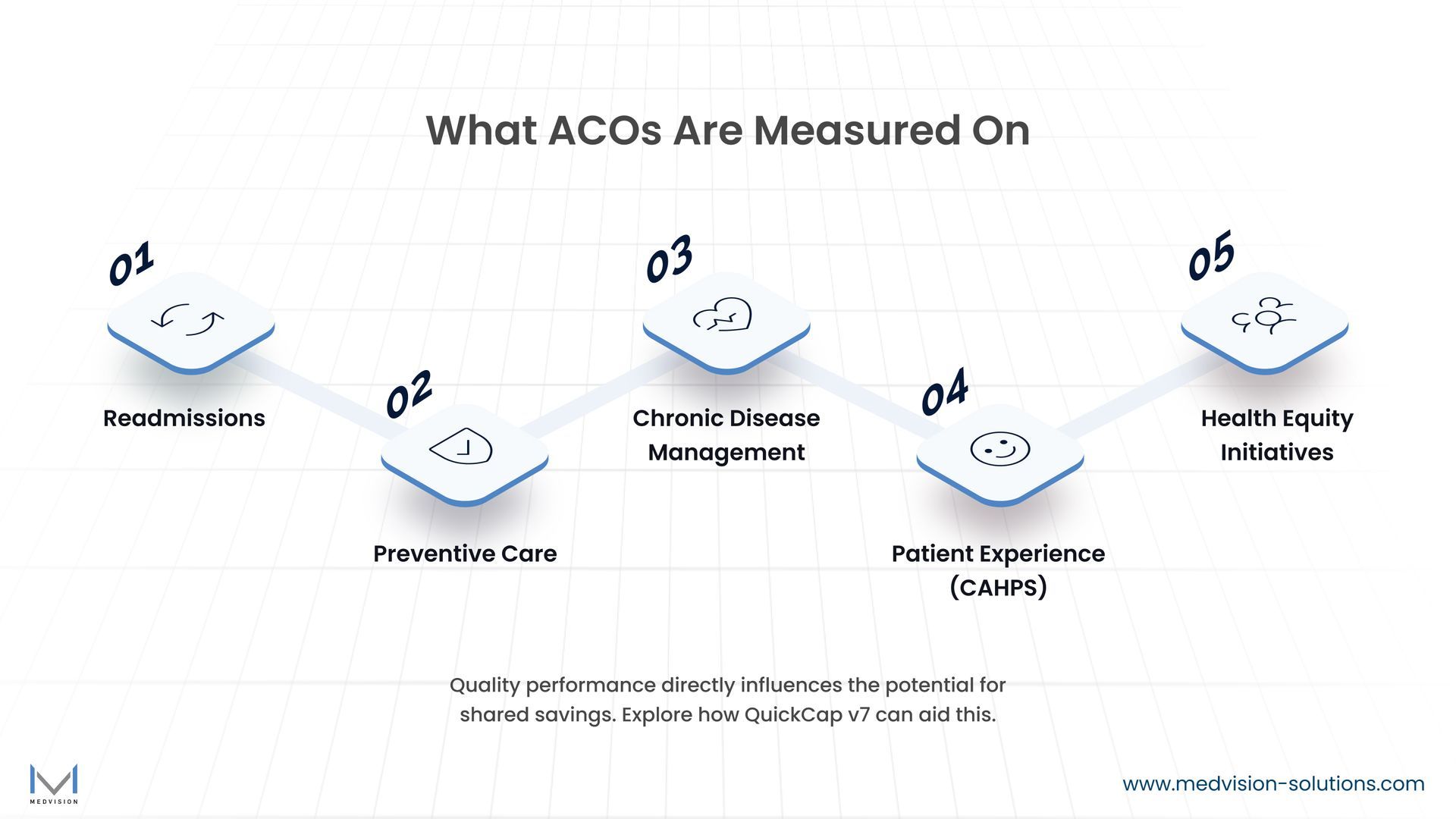
Current MSSP quality reporting relies on the APP Plus quality measure set, including readmissions, preventive screenings, chronic disease measures, and CAHPS patient experience reporting. ACO REACH incorporates health equity requirements and reporting expectations alongside quality and financial performance measures. Organizations need real-time tracking throughout the year, not just annual reporting, to close care gaps systematically rather than scrambling before submission deadlines.
Risk adjustment is also central. Accurate MRA, RAF, and HCC coding reflects the true clinical complexity of an ACO's population and directly affects the financial benchmark. An undercoded population carries an artificially low benchmark, making shared savings harder to achieve even when care quality is genuinely improving.
How QuickCap v7 Helps ACOs Operate
MedVision's QuickCap v7 is built for the operational complexity that ACO software needs to address. It brings claims administration, care coordination, population health, and quality reporting into a single platform so organizations aren't piecing together disconnected tools.
For ACOs, the relevant capabilities include:
- Risk Stratification and Clinical Alerts:
QuickCap v7 automates population-level risk segmentation and surfaces alerts for high-risk members, providing care teams with the information they need to intervene before utilization spikes. - MRA, RAF, and HCC Tracking and Reporting:
Accurate risk adjustment is essential for maintaining a fair financial benchmark. QuickCap v7 supports tracking and reporting across these measures, so organizations aren't leaving reimbursement on the table through coding gaps. - CMS Quality Measures Configuration:
Quality measure tracking is embedded in the platform workflow rather than bolted on at reporting time. Care gaps surface when there's still time to close them. - Claims Administration and EDI:
QuickCap v7 handles the full claims lifecycle with HIPAA-standard embedded EDI functionality, supporting adjudication and data exchange across the ACO's provider network. - Data Analytics and Executive Dashboards:
Configurable dashboards give leadership real-time visibility into savings and loss performance, network utilization, and population health trends without requiring separate reporting tools. - ACO REACH Support:
For organizations operating under the ACO REACH model, QuickCap v7’s configurable architecture handles program-specific requirements without a structural rebuild.
Final Thoughts
The ACO model is mature, but operational demands continue to rise. As CMS expands value-based programs and adds equity requirements, the organizations performing best are treating their operational infrastructure as a strategic asset rather than a compliance obligation.
Understanding what an ACO is in healthcare is the easy part. Managing one effectively across a large Medicare population, coordinating care across a distributed provider network, maintaining quality measure performance, and keeping claims accurate and timely, that's where the real challenge lies. The right platform doesn't just support those functions. It's what allows them to scale.
See QuickCap v7 in Action
Frequently Asked Questions
What is an accountable care organization in simple terms?
An accountable care organization is a group of healthcare providers, including physicians, hospitals, and other clinicians, that coordinate care for a defined patient population and accept shared financial accountability for quality and cost. When the ACO improves care outcomes while keeping spending below a set benchmark, it earns a share of the savings generated.
What is the difference between MSSP and the ACO REACH model?
The Medicare Shared Savings Program is CMS's primary ACO program under original Medicare, using a historical spending benchmark and annual reconciliation cycle. The ACO REACH model is a CMS Innovation Center program offering prospective population-based payments, a health equity focus, and broader eligibility. An organization cannot participate in both simultaneously.
What is the ACO REACH model in healthcare?
ACO REACH (Realizing Equity, Access, and Community Health) is a CMS model designed for organizations ready to take on greater financial risk and operational flexibility than MSSP allows. It features prospective payment options, strong health equity and underserved community requirements, and eligibility that extends to payer-led and provider-led entities. It replaced the earlier Direct Contracting model.
How does ACO software support population health and care coordination?
Purpose-built ACO software integrates risk stratification, care gap tracking, referral management, claims administration, and quality reporting in one environment. This allows care teams to identify high-risk members before utilization spikes, close care gaps before reporting deadlines, and maintain the administrative infrastructure needed to perform well against a shared savings benchmark.
Recently published articles


Keep in touch
Subscribe to get the latest update
Trending topics


Share your insights on social media
Upcoming events and company news