

Primary Care Capitation 101: A Payer's Guide to ACO LEAD

When CMS's ACO LEAD Model launches on January 1, 2027, prospective payment will be a core part of the model's financial design. Primary Care Capitation (PCC) is one of its main payment mechanisms, but it does not simply replace claims. Providers still submit claims, while CMS applies the applicable claims reductions and makes prospective capitation payments to the ACO.
For organizations supporting or administering these arrangements, that distinction matters. PCC changes how payments are calculated, how provider participation is configured, and how capitation and claims have to be managed together. This guide will cover each of these aspects.
Payer-Ready Capitation and Claims Management
What Is Primary Care Capitation?
Primary Care Capitation is a per-member, per-month payment (PMPM) for Medicare-covered primary care services delivered by eligible providers participating in a LEAD ACO.
CMS makes the prospective capitation payment to the ACO. The ACO then reimburses participating providers according to its own arrangements with them.
PCC is not a claims-free payment model
Providers still submit Medicare FFS claims for aligned beneficiaries, including services subject to capitated payment arrangements. CMS reduces the otherwise payable amount for services covered by the applicable arrangement, while the ACO receives the prospective capitation payment.
The basic idea
The basic idea behind the primary care capitation model is to move part of primary care payment from a purely service-by-service model to a prospective payment arrangement. All that while keeping claims in the system for payment processing, monitoring, quality measurement, and financial settlement.
How Primary Care Capitation Works Under ACO LEAD
LEAD offers two risk options, and the selected option determines which capitation choices are available.
| LEAD Risk Option | Shared Savings | Shared Losses | Capitation Choice |
|---|---|---|---|
| Professional Risk | Up to 60% | Up to 50% | Primary Care Capitation (PCC) |
| Global Risk | Up to 100% | Up to 100% | PCC or Total Care Capitation |
Professional Risk ACOs must use Primary Care Capitation because Total Care Capitation is available only to Global Risk ACOs. Global Risk ACOs can choose between PCC and TCC.
What Happens to Claims?
PCC does not eliminate Medicare claims.
- Providers continue submitting claims for aligned beneficiaries.
- CMS applies the applicable claims reduction to services covered by the selected payment arrangement.
- CMS makes prospective capitation payments to the ACO.
- The ACO then reimburses providers according to its arrangements with them.
For PCC specifically, CMS updates prospective payments during the performance year as beneficiary alignment and benchmark information are updated. These updates do not mean LEAD uses traditional rebasing. LEAD has a 10-year performance period without rebasing.
Whole-TIN Participation Matters
LEAD uses a whole-TIN approach for Participant Providers. Participant TINs drive beneficiary alignment, while provider participation in the various payment mechanisms depends on the provider's specialty and the ACO's selected risk and payment options.
For an ACO that elects PCC, primary care providers in Participant TINs participate in PCC, while non-primary care specialists under those TINs are not included in PCC. Those specialists can participate in NPCC or APO at the NPI level, subject to CMS rules. Preferred Providers have separate participation rules.
What Other Payment Options Does LEAD Offer?
PCC is only one part of
LEAD's payment structure. Some other options include:
Total Care Capitation
Available only to Global Risk ACOs, TCC provides capitated payments for Medicare Part A and Part B services delivered by the ACO's Participant Providers and participating Preferred Providers, including primary and specialty care.
Non-Primary Care Capitation
ACOs that select PCC can also elect Non-Primary Care Capitation (NPCC). This is a monthly capitated payment for eligible non-primary care services, including services provided by specialists and certain post-acute care providers. Unlike APO, NPCC is not reconciled against actual FFS billing at financial settlement.
Advanced Payment Option
The Advanced Payment Option (APO) is also available to ACOs that elect PCC. It provides an upfront monthly payment for eligible non-primary care services and is reconciled against actual FFS billing during the performance year.
Administrative Add-On
Eligible higher-spending ACOs can receive a 1.5%
Administrative Add-On calculated against the ACO's performance-year benchmark. CMS says this payment is made monthly, is not included in performance-year expenditures for shared savings or losses, and does not have to be repaid at settlement.
What Operations Teams Need Ready for 2027
The practical challenge with PCC is not understanding the definition. It is making sure the underlying payment workflows are ready.
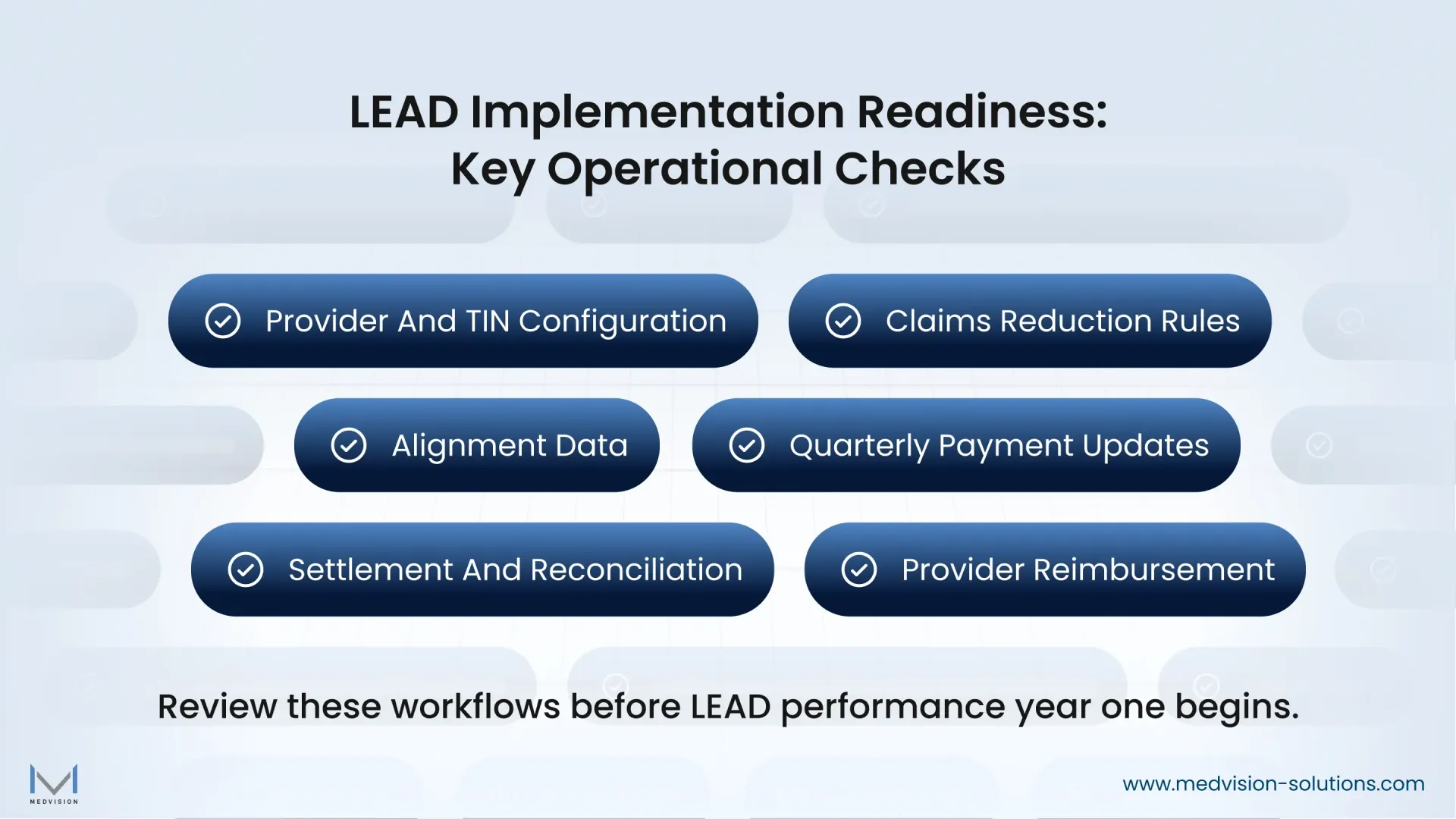
Before performance year one, review:
Provider and TIN configuration
Confirm which providers fall under Participant TINs, which are Preferred Providers, and which providers are subject to PCC.
Claims reduction rules
Make sure the system can identify services affected by the selected capitation arrangement and apply the appropriate claims reduction.
Alignment data
LEAD financial calculations depend on beneficiary alignment and beneficiary months. That information affects prospective payments and benchmark calculations.
Quarterly payment updates
CMS will update prospective capitation payments during the performance year as alignment, benchmark, and other relevant information changes.
Settlement and reconciliation
Do not treat every capitation mechanism the same way. PCC, TCC, NPCC, and APO have different settlement and adjustment rules. For PCC, CMS states that the final retrospective adjustment to payments is based on beneficiary alignment counts.
Provider reimbursement
CMS pays the ACO, and the ACO reimburses participating providers under its arrangements. That means the downstream provider payment logic also needs to be clearly defined.
One LEAD Detail Operations Teams Should Not Miss
For PY 2027, LEAD's minimum alignment requirements vary by ACO type:
- Standard/Renewing ACOs: 5,000 aligned beneficiaries, plus 3,000 claims-based aligned beneficiaries in at least one historical base year.
- High Needs/ESRD eligible ACOs: 800 aligned beneficiaries, plus 500 claims-based aligned beneficiaries in at least one historical base year.
- Newly Entering ACOs: 1,000 aligned beneficiaries, plus 600 claims-based aligned beneficiaries in at least one historical base year.
To qualify for the lower High Needs/ESRD minimum, at least 40% of the ACO's aligned population must fall into the High Needs and/or ESRD categories, along with additional care-delivery requirements established by CMS.
How MedVision Supports LEAD Operations
LEAD requires payment, claims, provider, and reporting workflows to work together. QuickCap v7 already supports those core functions, including capitation payment calculation, claims adjudication, provider contracting, workflow automation, reporting, and risk stratification.
Its configurable reimbursement capabilities also support both fee-for-service and capitation-based payment structures, giving payer and ACO organizations an operational foundation for managing different payment arrangements in one system. An efficient software choice makes all the difference in running successful operations under the LEAD model.
Conclusion
The primary care capitation model is one of the core payment mechanisms in the ACO LEAD Model, which begins January 1, 2027. Professional Risk ACOs will use PCC, while Global Risk ACOs can choose between PCC and Total Care Capitation.
The important operational point is that PCC does not replace claims. It adds a prospective payment layer that has to work alongside Medicare FFS claims, provider participation rules, beneficiary alignment, quarterly payment updates, and final settlement.
For organizations preparing for LEAD, the useful work starts with the fundamentals: validate provider and TIN data, map payment rules correctly, confirm claims reduction logic, and ensure capitation and settlement workflows can be reconciled without manual workarounds. Before the LEAD model begins, use this time to evaluate software vendors for a smooth transition. Check our
guide written specifically for this context.
Get Your Operations LEAD-Ready
Frequently Asked Questions
What is the difference between Primary Care Capitation and Total Care Capitation?
Primary Care Capitation covers eligible Medicare-covered primary care services. Total Care Capitation is broader and covers Medicare Parts A and B services delivered by participating Participant and Preferred Providers. TCC is available only to Global Risk ACOs.
Is Primary Care Capitation mandatory under ACO LEAD?
Professional Risk ACOs must select PCC. Global Risk ACOs can choose PCC or Total Care Capitation. ACOs that select PCC can also elect NPCC or the Advanced Payment Option, subject to CMS participation rules.
Do providers still submit claims when services are paid through capitation?
Yes. CMS requires providers to continue submitting claims for aligned beneficiaries even when services are subject to TCC, PCC, NPCC, or APO.
When does Primary Care Capitation start under ACO LEAD?
LEAD begins on January 1, 2027, and runs through December 31, 2036.
Recently published articles


Keep in touch
Subscribe to get the latest update
Trending topics


Share your insights on social media
Upcoming events and company news