CMS LEAD Model Alignment Options for Payers

Every ACO applying to the LEAD Model faces a choice that shapes how their organization will handle beneficiary alignment each Performance Year: Prospective Alignment or Hybrid Alignment. It sounds like a technical checkbox buried in the application. It isn't. This decision determines whether your ACO's roster locks in on day one of the Performance Year or keeps growing as new members, providers, and voluntary sign-ups come in throughout the year.
This affects payer groups managing multiple ACOs, or organizations still weighing their LEAD application strategy. Understanding the difference between Prospective and Hybrid Alignment matters just as much as picking a risk track or capitation option. If you rush, you could end up with a smaller panel than expected or scramble to build systems for monthly roster updates you didn't plan for.
This guide breaks down how each alignment method works, what CMS requires operationally, and how to decide which one fits your organization's growth plans and administrative capacity.
20+ Years In Payer Operations
What Beneficiary Alignment Means in LEAD
Before comparing the two options, it helps to know what alignment does. Under the CMS LEAD Model, a beneficiary joins your ACO's panel through one of two mechanisms: claims-based alignment or voluntary alignment.
Claims-based alignment looks at where a Medicare beneficiary received the plurality of their Primary Care Qualified Evaluation and Management (PQEM) services. This is measured by allowed charges during a defined lookback period.
Voluntary alignment works differently. A beneficiary actively designates a provider as their main source of care, either through Medicare.gov (Medicare.gov Voluntary Alignment, or MVA) or by signing a form at their provider's office (Signature-based Voluntary Alignment, or SVA).
Both mechanisms exist under either alignment frequency. The difference between Prospective and Hybrid is how often CMS runs these processes each year, and that timing has real consequences for panel growth, benchmarking, and your team's administrative workload.
Prospective Alignment: How It Works
Prospective Alignment is the simpler option. CMS runs both claims-based and voluntary alignment once, before the Performance Year starts. Prospective Alignment does not allow new beneficiaries to be added during the Performance Year. Alignment can still change under CMS eligibility and other applicable alignment rules.
That stability cuts both ways. It gives ACOs a predictable panel to plan care coordination and staffing around. It also means an ACO can't recover from a soft initial alignment run by adding new voluntary sign-ups or new provider TINs mid-year. If your network grows in March, those new patients won't count toward your LEAD panel until the following year's prospective run.
Hybrid Alignment: How It Works
Hybrid Alignment starts the same way Prospective Alignment does, with an initial claims-based and voluntary alignment run before the Performance Year begins. From there, it opens two additional doors.
First, ACOs that elect hybrid alignment get one additional opportunity to add new Participant TINs during the Performance Year, and CMS runs claims-based alignment for beneficiaries tied to those new TINs. For Performance Year 2027, that mid-year Participant TIN Add Window runs December 14, 2026 through January 14, 2027, with new beneficiaries becoming effective April 1, according to CMS's LEAD Alignment and Financial Methodology Paper. The mid-year claims-based refresh uses a separate prior-year lookback period rather than claims generated during the current Performance Year.
Second, hybrid ACOs can add voluntarily aligned beneficiaries on a rolling monthly basis all year, through both MVA and SVA. For a signature-based attestation to take effect on the first of a given month, the ACO must submit it to CMS at least 45 days beforehand. That is a tighter cadence than ACO REACH's optional Prospective Plus Alignment approach, which added voluntary alignment before subsequent calendar quarters.
One guardrail applies either way under Hybrid Alignment rules. Beneficiaries cannot be newly aligned to your ACO mid-year if they already belong to another LEAD ACO, a Shared Savings initiative, or a prohibited overlapping model.
Prospective vs Hybrid Alignment: Key Differences
The two approaches differ in these key areas:
Claims-based alignment frequency
Prospective: Once a year, before the Performance Year, with drops allowed only for lost eligibility.
Hybrid: Twice a year, once before the Performance Year and once mid-year, though the mid-year run only adds beneficiaries tied to newly added Participant TINs.
Voluntary alignment frequency
Prospective: Once a year, before the Performance Year.
Hybrid: Monthly, accepting both MVA and SVA submissions throughout the year.
Panel growth during the Performance Year
Prospective: None. Whatever beneficiaries you have on January 1 is your panel, aside from eligibility-related drops.
Hybrid: Yes, through new TINs added mid-year and ongoing voluntary alignment.
Administrative demand
Prospective: Lighter. One annual cycle to manage.
Hybrid:
Heavier. Ongoing SVA tracking, a mid-year TIN process, and recurring alignment-file reconciliation.
Which Option Fits Your ACO or Payer Group
There's no universally right answer here, but a few questions tend to point ACOs and payer groups in one direction or the other.
Is your provider network stable or still expanding?
If you're adding new Participant TINs through LEAD's mid-year TIN Add Window, Hybrid Alignment can align beneficiaries associated with those TINs sooner than waiting for the next annual alignment cycle. The mid-year claims-based refresh is limited to newly added Participant TINs. ACOs with a settled network, where the participant list won't change much year to year, may find prospective alignment a better fit.
How much does voluntary alignment matter to your strategy?
If your ACO relies on patients actively designating your providers as their main source of care, hybrid's monthly voluntary alignment cadence captures those attestations faster than waiting for one annual run. Unlike
MSSP, which can use preliminary prospective assignment with retrospective reconciliation or prospective assignment, both LEAD alignment options establish beneficiary alignment prospectively. LEAD's capitated payment mechanisms are a separate part of the model's financial design.
Can your systems handle monthly roster updates?
This is the operational question payer groups overseeing multiple ACOs should weigh carefully. Hybrid alignment isn't just a policy election; it's a recurring workflow that involves collecting SVA forms on a rolling basis and submitting them ahead of the 45-day deadline. Additionally, it requires tracking the mid-year TIN Add Window, monitoring monthly voluntary-alignment additions, and reconciling CMS alignment files against the current panel.
An ACO without a system built for that cadence
risks missed deadlines and beneficiaries who should have been aligned but weren't.
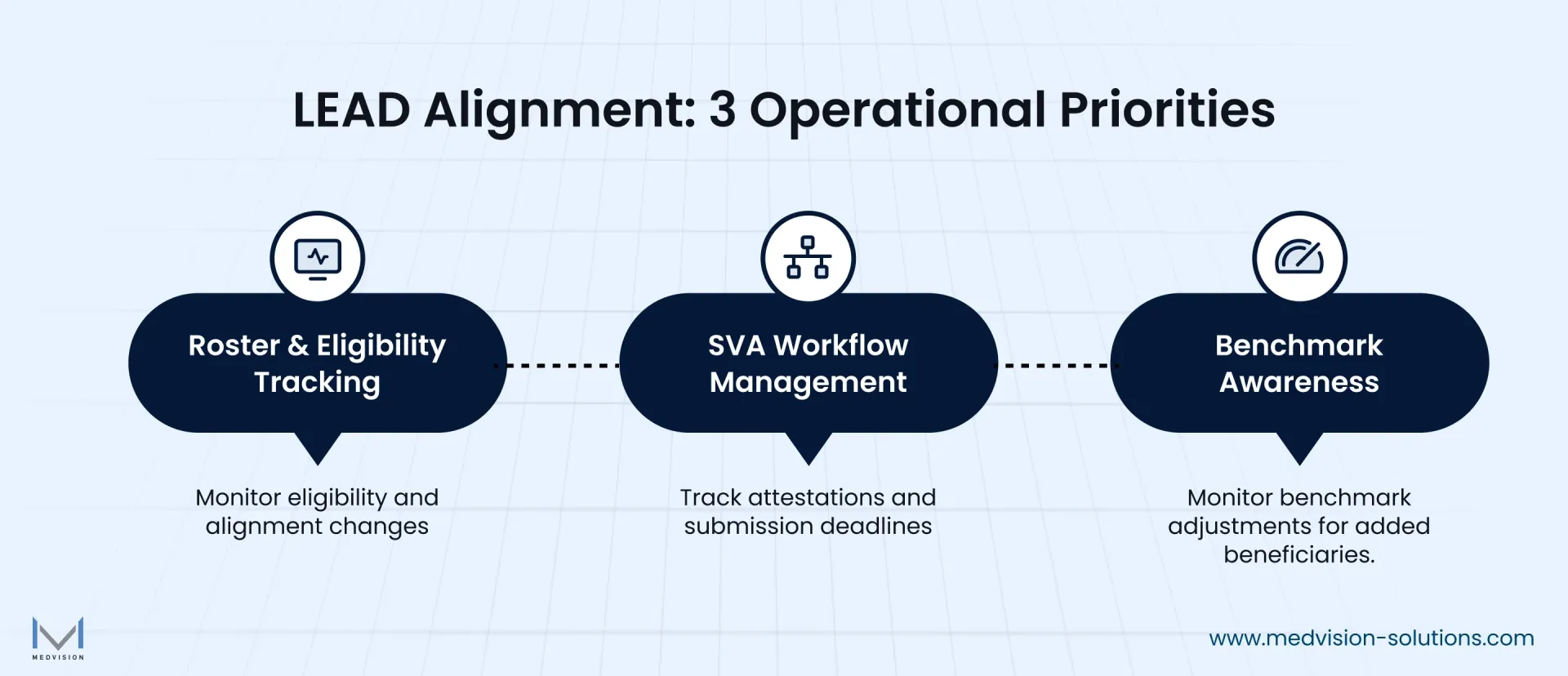
What Payer Groups and ACOs Should Build For
Whichever alignment approach you choose, LEAD rewards organizations that had the right infrastructure in place before Performance Year one. A few capabilities matter most:
Roster and eligibility tracking
Whether you're processing an annual prospective run or monthly hybrid updates, you need a system that flags eligibility changes, catches overlap conflicts with other Medicare initiatives, and reconciles your panel against CMS's alignment files without manual cross-checking.
SVA workflow management
Hybrid ACOs need a repeatable process for collect signature-based attestations, track the 45-day submission deadline for each effective month, and confirm which attestations remain valid under CMS rules.
Benchmark awareness
Hybrid alignment applies a separate benchmark adjustment to beneficiaries added during the Performance Year. This adjustment accounts for the different expenditure profile of beneficiaries aligned for only part of the year, including seasonal spending differences.
Hybrid Alignment introduces additional operational requirements, including monthly voluntary-alignment processing and a mid-year Participant TIN process.
Conclusion
Prospective and Hybrid Alignment are more than application selections; they determine how beneficiary alignment is handled during each Performance Year. Prospective offers simplicity and a predictable panel. Hybrid allows additional beneficiary alignment during the Performance Year through monthly voluntary alignment and one mid-year claims-based refresh for newly added Participant TINs.
Neither is the objectively better choice. The right choice depends on how your network is evolving and how much weight voluntary alignment carries in your strategy. It also depends on whether your systems can support monthly roster changes without missing a 45-day SVA deadline.
Before your ACO or payer group finalizes its alignment election, take an honest look at your current administrative infrastructure. Before finalizing the election, review whether your administrative infrastructure can support the alignment cadence you select. If you have any questions, we’re always a click or phone call away.
Operationalize Your Alignment Strategy
Frequently Asked Questions
What's the difference between Prospective and Hybrid Alignment in the LEAD Model?
Prospective Alignment is conducted once before the Performance Year begins and does not allow new beneficiaries to be aligned during the Performance Year. Hybrid Alignment adds monthly voluntary alignment opportunities and one mid-year, claims-based refresh for newly added Participant TINs.
How does an ACO choose between Prospective and Hybrid Alignment?
ACOs indicate their alignment approach as part of their LEAD application, alongside their risk-sharing option and capitation elections.
Does Hybrid Alignment affect an ACO's benchmark?
Yes. CMS applies a separate benchmark adjustment for beneficiaries added under Hybrid Alignment during the Performance Year, since those beneficiaries contribute less than a full year of experience to the ACO's panel.
Which alignment option should new or growing ACOs consider?
ACOs planning to use the mid-year Participant TIN Add Window or relying heavily on voluntary alignment may find Hybrid Alignment more operationally relevant, provided they can support its recurring alignment requirements.
Recently published articles


Keep in touch
Subscribe to get the latest update
Trending topics


Share your insights on social media
Upcoming events and company news