

The Transition to ACO LEAD: Your Action Plan for 2027
ACO REACH is phasing out. CMS confirmed that the model will conclude at the end of 2026, while its successor, the Long-term Enhanced ACO Design (LEAD) Model, is preparing for its January 2027 launch. For ACOs, MSOs, IPAs, and the payer groups that administer them, this isn't a small policy change. It's a full reset of how benchmarks, risk sharing, and quality reporting will work for the next decade.
The LEAD Model builds on what worked in ACO REACH and tries to fix what didn't, especially for smaller, rural, and independent organizations that sat out earlier models. If your organization supports ACOs today, whether you're the ACO itself or the payer infrastructure behind one, now's the time to understand what's different and what your next move looks like.
Built to Handle Complex ACO Payment Models
ACO REACH vs ACO LEAD: What's Staying the Same
Before getting into what's new, it's worth knowing what carries over. CMS didn't rebuild accountable care from scratch; it refined it.
The core financial structure is unchanged. ACOs still choose between two risk-sharing tracks: Global Risk, where organizations can keep up to 100% of savings but also absorb up to 100% of losses, and Professional Risk, capped at 50% on both sides. Both tracks still qualify as
Advanced Alternative Payment Models, which matters for providers tracking their APM participation status.
Capitated, population-based payments are central to the model, including Primary Care and Total Care Capitation, with a new
Non-Primary Care option for certain ACOs. Most enhancements from ACO REACH, such as Part B cost-sharing support, carry over to LEAD, allowing organizations familiar with REACH to continue seamlessly.
ACO REACH vs ACO LEAD: What's Changing
The differences are where things get interesting, and where operational teams will feel the biggest impact.
A longer, steadier runway
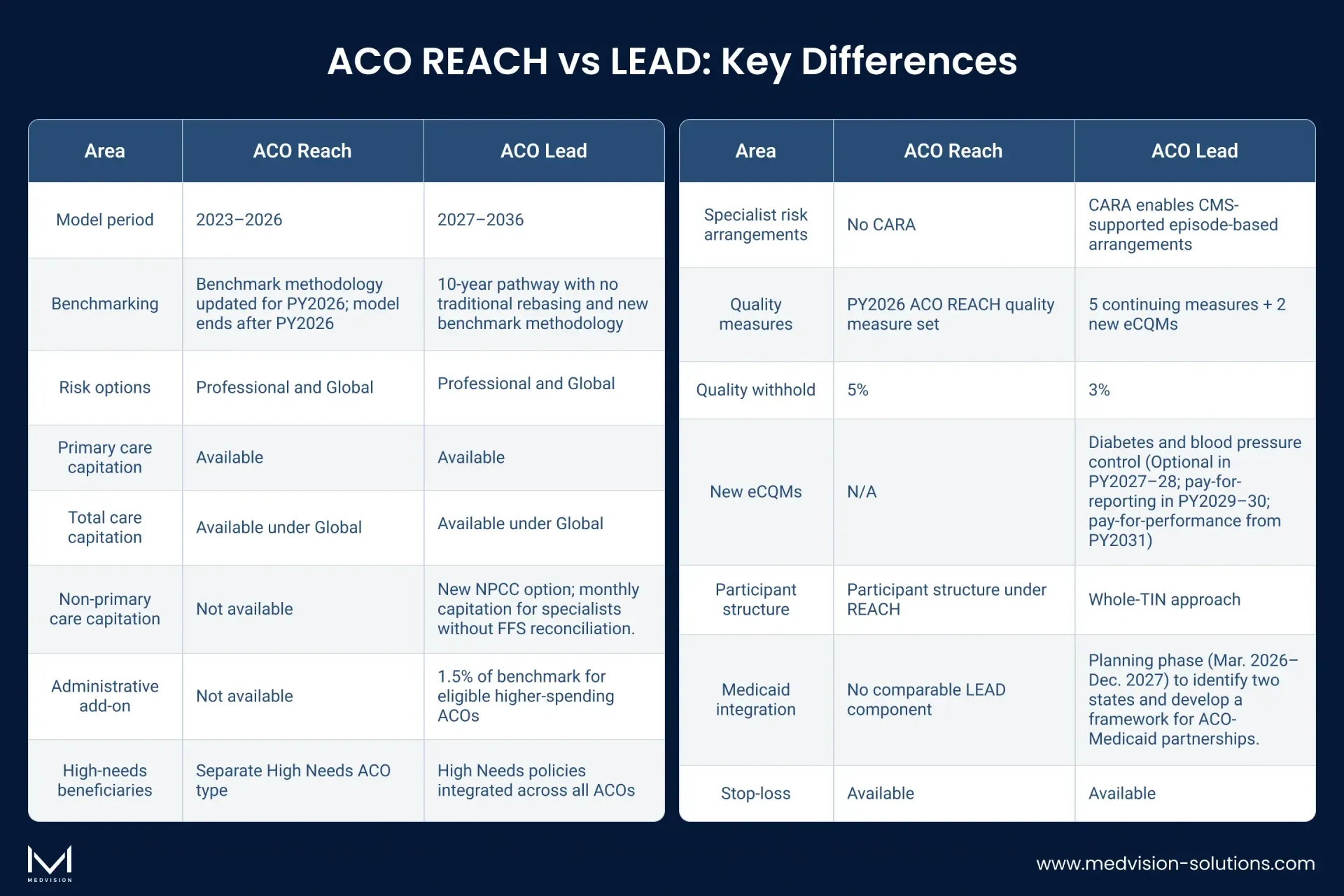
LEAD runs for 10 years, January 2027 through December 2036, without the periodic benchmark rebasing that has historically
penalized ACOs for their own success. ACO REACH runs for four performance years, from 2023 through 2026. This 10-year timeline in LEAD is meant to allow organizations to plan investments in care coordination and infrastructure without worrying that a benchmark reset will erase their gains.
A wider door for new entrants
LEAD lowers beneficiary alignment minimums for organizations serving a high share of high-needs patients and for ACOs new to accountable care altogether. LEAD eliminates the separate High Needs ACO type used in ACO REACH. Instead, High Needs policies apply at the beneficiary level across all LEAD ACOs, with specialized benchmarking and risk adjustment for these beneficiaries.
New payment and specialist tools
LEAD introduces Non-Primary Care Capitation for specialists, alongside an upfront 1.5% Administrative Add-On for eligible higher-spending ACOs that is exempt from repayment. A new initiative called CMS Administered Risk Arrangements, or CARA, gives ACOs the infrastructure to build episode-based risk arrangements directly with specialists, including an episode-based falls-prevention program.
Lighter quality withhold, familiar measures
LEAD keeps the five ACO REACH quality measures and phases in two new electronic clinical quality measures for diabetes and blood pressure control, but the annual quality withhold drops to 3% of the benchmark, down from ACO REACH's 5%.
The two new eCQMs are:
- Optional in PY2027 and PY2028
- Pay-for-reporting in PY2029 and PY2030
- Pay-for-performance beginning in PY2031
This gives ACOs time to build reporting infrastructure.
Simpler enrollment
LEAD uses an approach similar to the Medicare Shared Savings Program, and employs a whole-TIN participation approach: all providers and suppliers billing under a Participant TIN must agree to participate. ACO REACH allowed ACOs to selectively include specific providers under a TIN. That's a real operational shift for organizations managing enrollment and attribution.
A path toward Medicaid integration
Between March 2026 and December 2027, CMS will identify two states to participate in an initial planning phase to design a framework for ACOs to formally coordinate with Medicaid organizations on behalf of dually eligible beneficiaries, a population LEAD is explicitly built to serve better.
What ACOs and Payer Groups Should Do Now
The first LEAD application window has closed, but organizations still have different paths forward. What happens next depends on whether you're entering LEAD, preparing for a future cohort, staying with MSSP, or stepping back from downside risk.
1. Selected for LEAD
If your organization was selected, the focus now shifts to implementation. Finalize participant information, prepare systems for LEAD's payment and reporting requirements, and get ready for the January 1, 2027 launch.
2. Preparing for a Future Cohort
If you missed the window or weren't ready for the first cohort, use the time to prepare. CMS expects future opportunities to apply, although timing and details have not yet been announced. Strengthen your data, risk adjustment, and reporting capabilities now.
3. Staying With or Considering MSSP
LEAD isn't the only path. The Medicare Shared Savings Program remains an option for organizations that may find its risk arrangements and operational requirements a better fit.
4. Stepping Back From ACO Risk
Some organizations may decide they're not ready for another downside-risk arrangement. For them, strengthening infrastructure first may make more sense than taking on additional financial exposure.
Whichever path you take, the administrative demands persist. Capitation reconciliation, claims management, risk adjustment, and quality reporting all require systems like
QuickCap v7 that can keep up.
QuickCap v7 is Ready For This Shift
MedVision has spent over 30 years building administration software for exactly this kind of complexity. QuickCap v7 gives ACOs, MSOs, IPAs, and payer groups a single platform to manage capitation payments, claims adjudication, risk adjustment, and quality reporting.
Whether your organization is preparing for a LEAD launch, weighing a future cohort, or managing an MSSP transition, QuickCap v7 has answers. Our customizable workflows and reporting tools support whichever path you take. MedVision is CORE, SOC 2, and HITRUST-certified, processing more than 480,000 claims and $250 million in claims volume every month for organizations navigating such transitions.
Conclusion
CMS designed LEAD to address several barriers identified through earlier ACO models, including ACO REACH, while creating a longer-term path for accountable care.
Whether your organization is already preparing for a January 2027 launch or still deciding which path fits best, the underlying work is the same. You need clean data, accurate risk adjustment, and administrative systems that can handle capitation, quality reporting, and specialist payments without falling behind. The model will change. The operational bar won’t get any lower.
Ready for the LEAD Model Transition?
Frequently Asked Questions
What is the difference between ACO REACH and ACO LEAD?
LEAD extends the performance period from 6 years to 10, removes periodic benchmark rebasing, lowers the quality withhold to 3%, mainstreams high-needs patient support across all ACOs, and adds new specialist payment tools through CARA. ACO REACH ends December 31, 2026.
When does the LEAD Model start and how long does it run?
LEAD launches January 1, 2027, and runs through December 31, 2036, the longest model the CMS Innovation Center has tested.
Can ACO REACH participants move directly into LEAD?
Yes. Current ACO REACH participants can submit a streamlined application for LEAD's first performance year, and REACH's end date aligns directly with LEAD's start date to avoid a coverage gap.
How does LEAD support payers and MSOs managing multiple ACOs?
LEAD's whole-TIN enrollment approach, expanded capitation options, and phased quality reporting timeline are designed to reduce some administrative friction, but organizations still need strong claims, risk adjustment, and reporting infrastructure to manage the added complexity of specialist episode payments and eCQM requirements.
Recently published articles


Keep in touch
Subscribe to get the latest update
Trending topics


Share your insights on social media
Upcoming events and company news