

What Is PACE? A Complete Guide to PACE Software Solutions

PACE model isn't new. The model dates back to the 1970s, when a nonprofit in San Francisco started keeping frail older adults out of nursing homes by bringing care to them instead. What's changed is the pressure it's under today. More states are approving new programs, and more people are enrolling every year. A lot of the back-office software running these programs wasn't built to handle that scale.
So, what is PACE, exactly, and what does it take to run one well right now?
This guide covers both. We'll walk through what the Program of All-Inclusive Care for the Elderly does, the operational challenges that come with it, and how the right PACE software, like MedVision's QuickCap v7, helps payers and PACE organizations keep up with the growth without compromising compliance, cost, or care quality.
Continued PACE Success
What Is PACE?
PACE stands for the Program of All-Inclusive Care for the Elderly. It's a joint Medicare and Medicaid model that lets older adults who need nursing home-level care stay in their own homes and communities. A PACE organization coordinates nearly all of their medical and social support instead of a nursing facility. In Pennsylvania, the same model runs under a different name:
LIFE, or Living Independence for the Elderly.
Some people search for it as the PACE program for all-inclusive care of the elderly, though the official name places those two words in the other order: the Program of All-Inclusive Care for the Elderly.
To enroll, a person generally must be
55 or older, live in an area served by a PACE organization, and be certified by a state Medicaid agency as needing a nursing home level of care. Most participants who join PACE are dually eligible for both Medicare and Medicaid. PACE organization receives one fixed monthly payment per participant to cover essentially every service those elders might need.
That last detail matters more than it sounds. PACE organizations don't bill piece by piece. They take on full financial risk for each participant's care, so every missed care gap or workflow inefficiency comes straight out of the program's own margin.
Why PACE Programs Are Under Growing Pressure
PACE isn't a niche program anymore. More than 200 PACE organizations now serve upward of
96,000 participants across 33 states and the District of Columbia, and that number keeps climbing as states approve new service areas and existing programs expand into rural communities.
Research also found that for-profit PACE organizations grew far faster than nonprofit ones between 2016 and 2022. This shows how much investor and health system interest the model is now attracting.
Growth is good news for participants. It's a different story operationally. Running a PACE program means managing:
- Care coordination across a large interdisciplinary team.
Every participant's plan touches a primary care provider, nurse, social worker, therapists, and a dietitian, all of whom need to stay on the same page. - Data spread across multiple systems.
Health records, pharmacy data, and claims often live in separate places, creating gaps and slowing decisions. - Heavy CMS and state reporting requirements.
PACE organizations answer to both Medicare and Medicaid rules, and manual tracking eats up staff time that should go toward care. - Full financial risk on every participant.
Capitation means the organization absorbs the cost of every service, so claims accuracy and utilization management directly affect the bottom line.
For a closer look at these operational hurdles, see our breakdown of the
top challenges PACE programs face.
How Modern PACE Software Solves These Challenges
None of the four pressures above disappear on their own, but the right PACE software takes most of the manual burden off your staff.
Care coordination
It gets easier when every discipline works from one shared care plan instead of separate notes and spreadsheets. Automated alerts flag at-risk participants, like a missed medication refill or a drop in vitals, so the interdisciplinary team can step in before a small issue becomes a hospital visit.
Data integration
Closing the gaps between EHRs, pharmacy systems, and claims data gives care teams one accurate view of each participant instead of four partial ones.
Compliance and reporting automation
Building CMS and state requirements directly into daily workflows, so audit readiness isn't a scramble every quarter. HEDIS quality measures are tracked as care happens, not reconstructed after.
Financial and utilization management tools
Handling capitation calculations, claims adjudication, and IBNR reporting automatically gives finance teams a real-time read on margin instead of a month-end surprise.
Participant and family portals round it out by giving families visibility into care plans and schedules, building the trust that keeps enrollment and satisfaction high.
Must-Have Features in the Best PACE Software
Not every platform marketed as PACE software fits how PACE organizations operate. When you're evaluating the best PACE software for your program, a few features separate genuine elder care management solutions from generic tools stretched to cover it:
EHR interoperability
The system should connect to your existing electronic health records, not force a rebuild.
Automated scheduling and transportation
Day center visits, home care, and transportation need to line up without daily manual coordination.
Medication management with MAR charting
Real-time tracking and refill alerts reduce missed doses and simplify documentation.
Capitation and claims automation
Look for accurate capitation calculations, claims adjudication, and appeals handling built specifically for full-risk contracts.
HEDIS and quality reporting
Built-in quality measures should track automatically, not requiring a separate spreadsheet at reporting time.
RAF and risk tracking
A risk adjustment factor dashboard helps you monitor participant needs and catch coding gaps early.
Usable design
Staff and caregivers need to use the system, so a clean interface matters as much as the feature list behind it.
The best PACE systems don't just digitize your existing paperwork. They fundamentally change how your team works.
The Real Impact of Better PACE Software
When PACE organizations put the right software behind their day-to-day operations, the payoff shows up in a few consistent places.
- Interdisciplinary teams spend less time chasing information across systems and more time managing participant care.
- Claims and capitation get processed with fewer errors, which protects margin on a model where every dollar is already at risk.
- CMS and state audits shift from a scramble to a routine pull of already accurate data.
- Participants and families get a program that feels responsive instead of bureaucratic, which matters for retention in a model built on long-term relationships.
None of that requires a long technology overhaul. It requires a platform built around how PACE works: full-risk, interdisciplinary, and accountable to both federal and state regulators at once.
MedVision QuickCap v7: Built for PACE Program Excellence
MedVision built QuickCap v7 around how PACE organizations operate, not a generic care management template.
On the enrollment side, QuickCap v7 verifies health plan eligibility quickly and lets you customize assessments for case management and annual health reviews. It tracks each participant's status through a dedicated RAF dashboard.
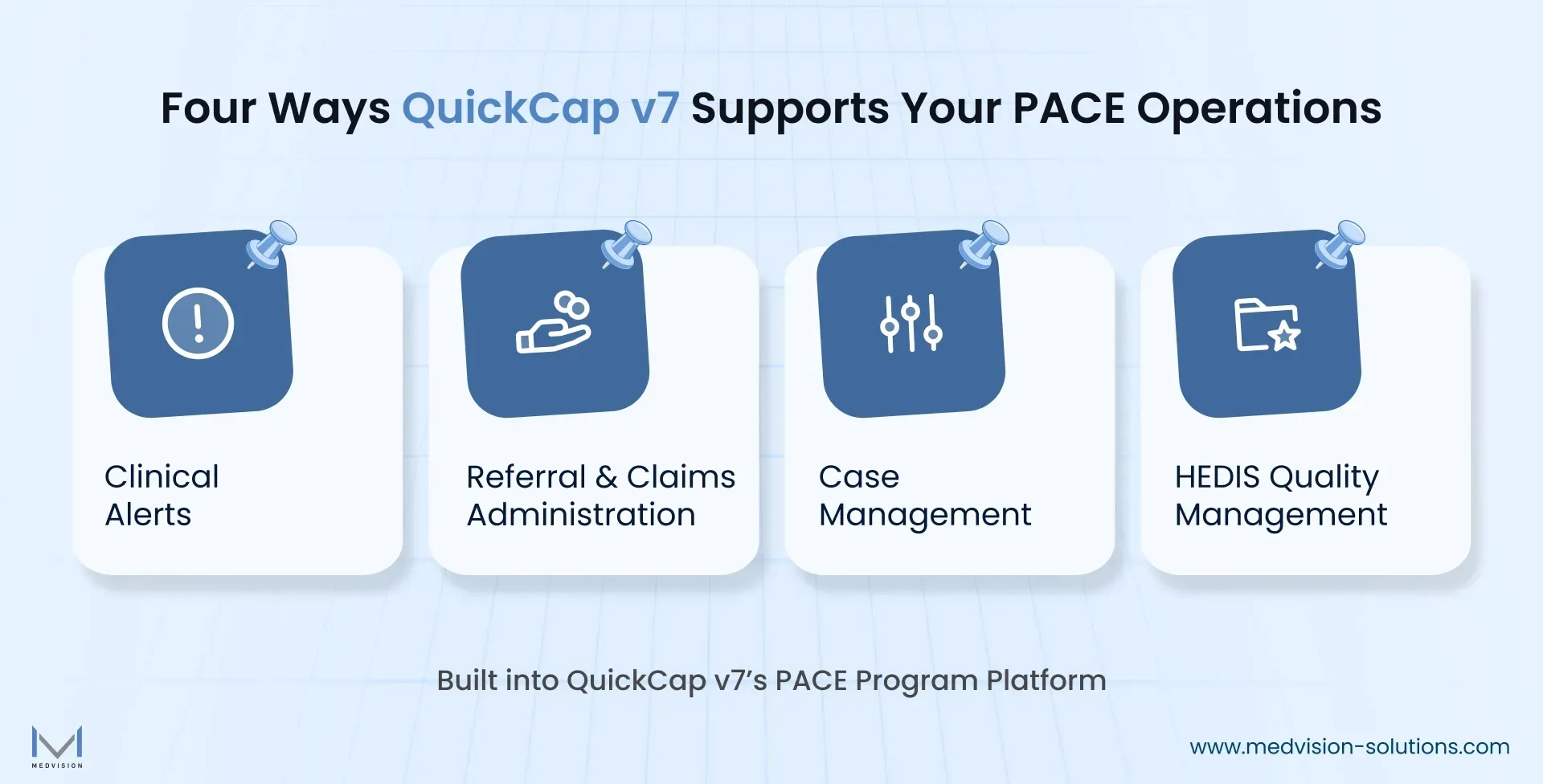
Day-to-day, four capabilities do most of the work:
- Clinical Alerts
modules, with customization, flag at-risk participants early by watching for changes in vitals, medication adherence, and behavior. - Referral and Claims Administration
automates authorizations and claims processing built specifically for PACE workflows, reducing denied claims and delayed reimbursement. - Case Management
gives your interdisciplinary team a shared space for assessments, goal tracking, and progress notes. - HEDIS Quality Management
keeps quality measures aligned with industry benchmarks as care happens, instead of being reconstructed at reporting time.
On the financial side, QuickCap v7 handles capitation calculations, provider reimbursement configurations, and IBNR reporting. Your finance team always has an accurate read on where the program stands. It's all inside QuickCap v7, the same platform MedVision already built for ACOs, MSOs, IPAs, and other value-based care organizations, adapted specifically for PACE and LIFE programs.
QuickCap v7 For Your PACE Program
Frequently Asked Questions
What is a PACE program?
PACE stands for the Program of All-Inclusive Care for the Elderly, a joint Medicare and Medicaid program that helps older adults who need nursing home-level care continue living in their own communities.
What is PACE software?
PACE software, sometimes called an elderly care management system, is administrative technology built for PACE organizations to handle care coordination, capitation billing, claims, and CMS or state compliance reporting in one platform.
How is a PACE program funded?
PACE organizations receive a fixed monthly capitation payment per participant from Medicare and Medicaid, or private pay for those not eligible for either, and assume full financial risk for that participant's care.
How is PACE different from a Medicare Advantage plan?
A PACE organization directly delivers and coordinates nearly all care through its own interdisciplinary team and day center, while a Medicare Advantage plan typically pays claims across an outside provider network.
Recently published articles


Keep in touch
Subscribe to get the latest update
Trending topics


Share your insights on social media
Upcoming events and company news