

The Complete Guide to Insurance Claims Management Software for Payers

Every payer organization runs on claims. Thousands move through the system every week, and each one carries a coverage decision, a payment calculation, and a relationship with a provider who's waiting to get paid. When that volume outpaces your tools, the cracks show up fast: backlogs, inconsistent decisions, and a staff stretched too thin to catch the claims that actually need a second look.
That's the problem insurance claims management software is built to solve. Not just adjudication, but the entire operational layer around it: intake, validation, payment logic, exception handling, and the reporting that tells you whether your process is actually working. For payers, TPAs, ACOs, IPAs, and MSOs managing delegated risk, getting this layer right affects more than throughput. It touches network relationships, compliance standing, and the bottom line.
This guide walks through what claims management software actually does, the features worth prioritizing, and where most organizations run into trouble. We'll also look at how QuickCap v7, MedVision's managed care platform, handles this work in practice.
Built for Optimal Payer Operations
What Is Insurance Claims Management Software?
Insurance claims management software is the platform payers and risk-bearing organizations use to receive, validate, process, and pay claims submitted for member services. It's a broader category than just adjudication software. While adjudication is one step, the decision point is where a claim gets approved, denied, or flagged. Claims management covers everything related to that decision, including how the claim enters the system and how it's checked against coverage and authorization rules. It also encompasses how payment is calculated and how the entire process is tracked and reported.
A true health insurance claims management software platform also has to account for the realities of payer operations specifically. That means handling multiple lines of business under one roof (Medicare Advantage, Medicaid, commercial, PACE, ACO REACH), supporting capitation and value-based arrangements alongside fee-for-service claims, and giving operations teams the visibility to manage exceptions without waiting on IT for every rule change. For a closer look at the full workflow this software supports, our guide to
healthcare claims processing breaks down each stage in detail.
Why Insurance Claims Management Matters
The financial stakes here are significant and rest squarely with the payer. Every claim that moves through your system carries administrative costs regardless of the outcome, and those costs climb quickly when processes rely on manual review. The CAQH Index tracks administrative transaction costs across hundreds of health plans.
It found that the industry could save $21 billion annually by shifting remaining manual administrative workflows to electronic processes. For payers managing high claim volumes across multiple lines of business, that gap shows up directly in administrative spend, not somewhere abstract.
Beyond cost, accuracy carries its own weight. A miscalculated payment, an overpayment that goes uncaught, or an inconsistent rule applied across similar claims creates exposure on two fronts. One is financial leakage that's hard to recover. Secondly, there is a compliance risk if regulators or auditors come asking how a decision was made.
For organizations holding delegated risk through capitation or value-based contracts, that exposure compounds, since payment accuracy directly affects your margin, not just your operations. Strong claims and risk management practices protect both sides of that equation at once.
Key Features of Claims Management Systems
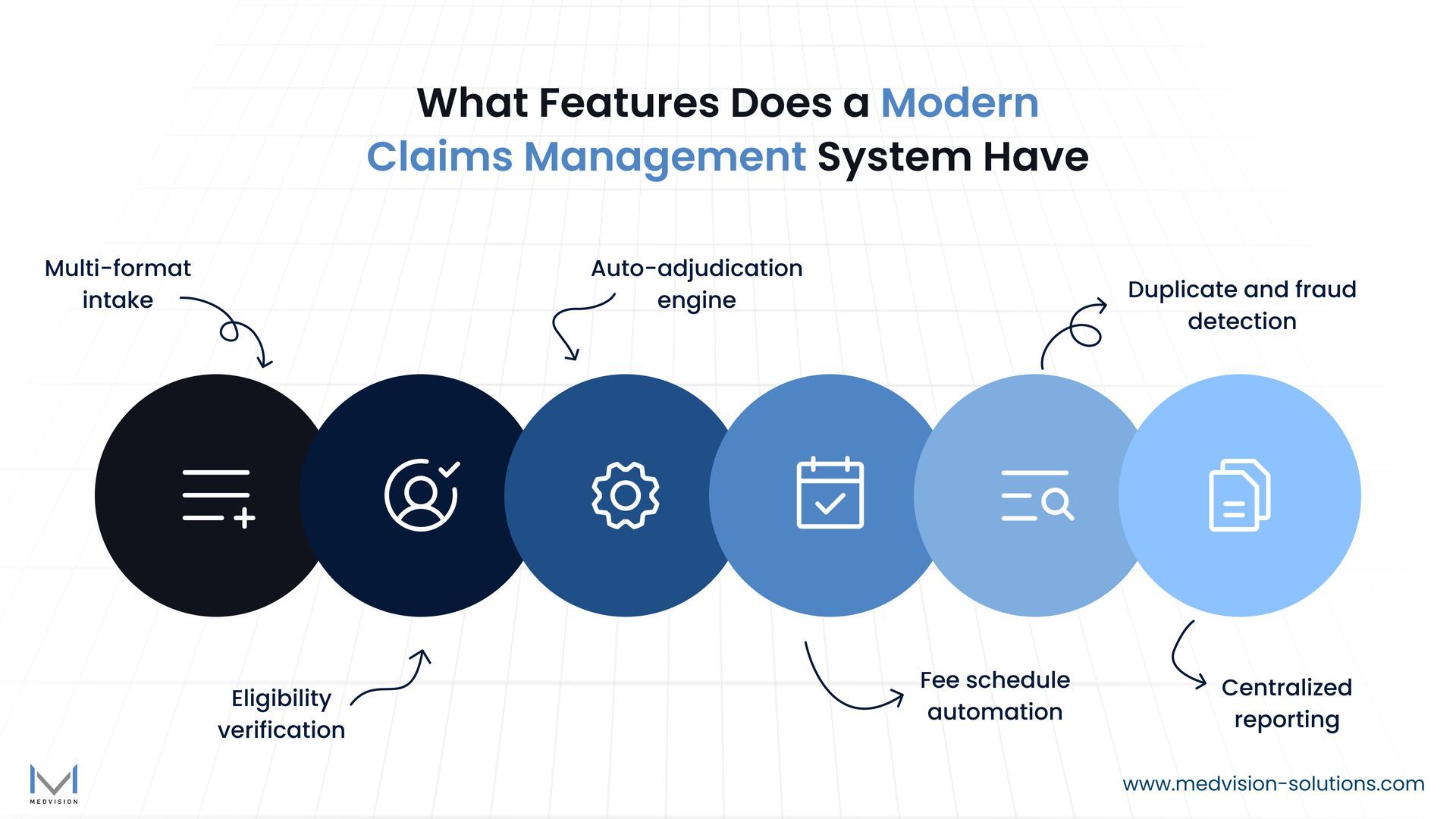
Not every platform marketed as claims software does the same job. Here's what genuinely capable claims management systems for insurance organizations should include.
Multi-Format Claim Intake
Claims arrive through EDI files, clearinghouses, scanned documents, and direct system entry. A capable system accepts all of these and checks for completeness immediately, before a malformed submission eats up downstream processing time.
Eligibility and Authorization Verification
The system needs to confirm the member's active coverage, benefit plan, and any required prior authorization before a claim moves forward. Gaps here are one of the most common sources of avoidable denials.
Auto-Adjudication Engine
This is where routine, clean claims are automatically approved or denied based on configurable rules, without tying up a human reviewer. For background on how this specific function works and what a strong automation rate looks like, see our breakdown of
auto-adjudication in healthcare.
Fee Schedule and Payment Automation
Accurate payment calculation depends on automatically pulling the correct contracted rates, copays, and deductibles across DRG, APC, and RBRVS claim types, rather than relying on manual lookups.
Duplicate and Fraud Detection
Rule-based and analytics-driven detection catches duplicate submissions and suspicious billing patterns at volumes no manual reviewer could realistically screen.
Centralized Reporting and Dashboards
Operations teams need a single view of what's processed, what's pending, and what's been escalated, without having to pull data from five different places.
Even well-resourced payers and TPAs run into these operational friction points.
Inconsistent Data at Submission
Outdated eligibility records and incomplete demographic data create exceptions that didn't need to happen in the first place.
Rule Maintenance Across Multiple Lines of Business
Organizations running Medicare Advantage, Medicaid, commercial, and ACO REACH business simultaneously often juggle different benefit structures and fee schedules within a single system. Keeping rules current across all of them, without a constant backlog of IT tickets, is harder than it sounds.
EDI and Submitter Variability
Not every trading partner formats claims the same way. A system that forces submitters to change how they work creates friction across your entire network.
Fraud, Waste, and Abuse at Scale
Manual review simply can't catch every anomaly across hundreds of thousands of monthly claims. This is where systematic, rule-based monitoring earns its keep, and it's a core part of any modern insurance claims management company's toolset.
Benefits of Insurance Claims Management Software
When the right platform is in place, the gains show up in cost, accuracy, and control.
Lower Cost Per Claim
Automated processing handles routine, clean claims for a fraction of the cost of manual review, and that gap widens as volume grows. Industry administrative cost data consistently show that electronic transactions cost significantly less than manual ones.
More Accurate Payment the First Time
Automated rule application doesn't vary by reviewer or workload. The same logic applies to every claim, which means fewer payment corrections, fewer overpayment recoveries to chase, and a cleaner audit trail when regulators or delegated-risk partners come asking.
Stronger Risk and Fraud Controls
Pattern-based detection surfaces duplicate billing and anomalies that manual review often misses at volume, supporting tighter claims and risk management across the organization.
Scalability Without Proportional Headcount Growth
A well-configured system absorbs rising claim volume without forcing you to staff up at the same pace.
Staff Time Redirected to What Actually Needs Judgment
When routine claims process themselves, your team's attention goes to appeals, complex cases, and provider disputes, the work that genuinely benefits from human expertise.
QuickCap v7’s Take
QuickCap v7, MedVision's managed care platform, is built specifically for the operational realities payers, TPAs, ACOs, IPAs, and MSOs deal with every day. A few capabilities stand out.
Auto-Adjudication Engine: Applies configurable rules to validate eligibility, check authorizations, detect duplicates, and automatically calculate payments, with parameters that adapt to EDI variability across submitters.
ClaimShop Integration: Automates fee schedule retrieval across DRG, APC, and RBRVS claim types, with support for value-based pricing and HMO payer structures, so payment calculations reflect your actual contracted terms.
SQL Query Builder: Lets operations teams build and adjust adjudication rules using live data insights, without coding expertise. Useful when you're managing rules across multiple lines of business and contracts that shift regularly.
Claims Workflow Dashboard: Centralized visibility into every claim, with the ability to sort, prioritize, and assign exceptions while tracking what's processed and what's pending.
CAQH CORE Certification: QuickCap v7 is certified for Eligibility and Benefits, Claim Status, and Payment and Remittance transactions, meeting recognized interoperability benchmarks for automated healthcare data exchange.
The platform also supports organizations across delegated risk models, including [TPAs] managing multiple client lines of business under one roof.
Conclusion
Strong insurance claims management isn't a single feature you buy off a list. It's a full operational system: intake that doesn't bottleneck, validation rules that keep pace with your contracts, payment calculations you can trust, and reporting that tells you where things actually stand. Organizations that get this right see lower administrative costs per claim, tighter payment accuracy, and a team that's focused on the claims that genuinely need their judgment.
That's the gap QuickCap v7 is built to close, with the configurability and automation depth payers and delegated risk organizations need to manage claims at scale.
See QuickCap v7, Built for Payer Operations
Frequently Asked Questions
What is insurance claims management software?
It's a platform that handles the full claims lifecycle for payers, from intake and eligibility verification through adjudication, payment calculation, and reporting, rather than just the adjudication decision alone.
How is claims management different from claims processing?
Claims processing usually refers to the step-by-step workflow a single claim moves through. Claims management is the broader system that encompasses reporting, rule configuration, fraud detection, and oversight across your entire claims volume.
How does claims management relate to risk management for payers?
Claims data is one of the clearest signals of a payer's operational and financial risk. Strong claims and risk management practices, like duplicate detection and consistent rule application, catch issues before they affect margins or compliance standing.
How does QuickCap v7 support insurance claims management for payers?
QuickCap v7 combines an auto-adjudication engine, ClaimShop fee schedule automation, an SQL Query Builder for rule management, and a centralized workflow dashboard, supporting payers, TPAs, ACOs, IPAs, and MSOs across multiple lines of business.
Recently published articles


Keep in touch
Subscribe to get the latest update
Trending topics


Share your insights on social media
Upcoming events and company news