What to Look for in a Population Health Platform
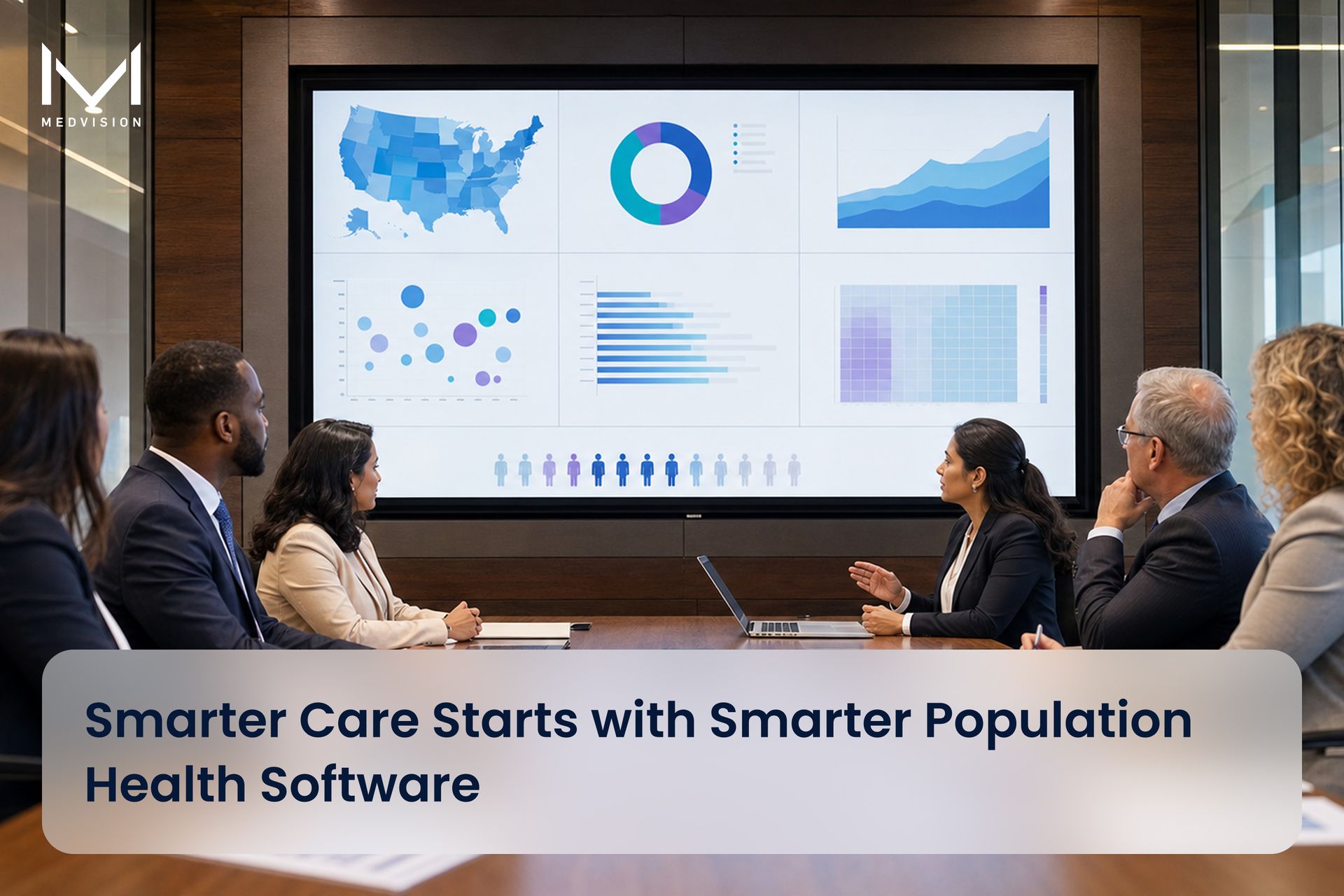
There's a version of population health management that looks great in a conference presentation, with colorful charts, clear risk tiers, and smooth care-coordination pathways. Then there's the version most healthcare organizations are actually living with, where data sits in disconnected systems, high-risk members slip through the gaps, and the team is too buried in administrative tasks to act on the information they do have.
That problem looks slightly different depending on where you sit. For health plans and payer groups, it shows up as incomplete member panel visibility, capitation payments that can't be verified against accurate attribution data, and network performance that's hard to monitor until a quality measure fails. For provider-side organizations like ACOs, IPAs, and MSOs, it's care gaps that surface too late and risk scores that don't translate into timely outreach.
The gap between those two realities often comes down to the software. Choosing the right population health management software isn't just a technology decision. It's a clinical and operational strategy that determines how well your organization can identify risk early, coordinate care across settings, and ultimately deliver on the outcomes that value-based arrangements demand, regardless of which side of the payer-provider relationship you're on.
This guide covers what these platforms actually do, what separates the functional ones from the genuinely effective ones, and what to consider when evaluating your options.
Put Population Health Data to Work
What Is Population Health Management Software (and Who Needs It Most)?
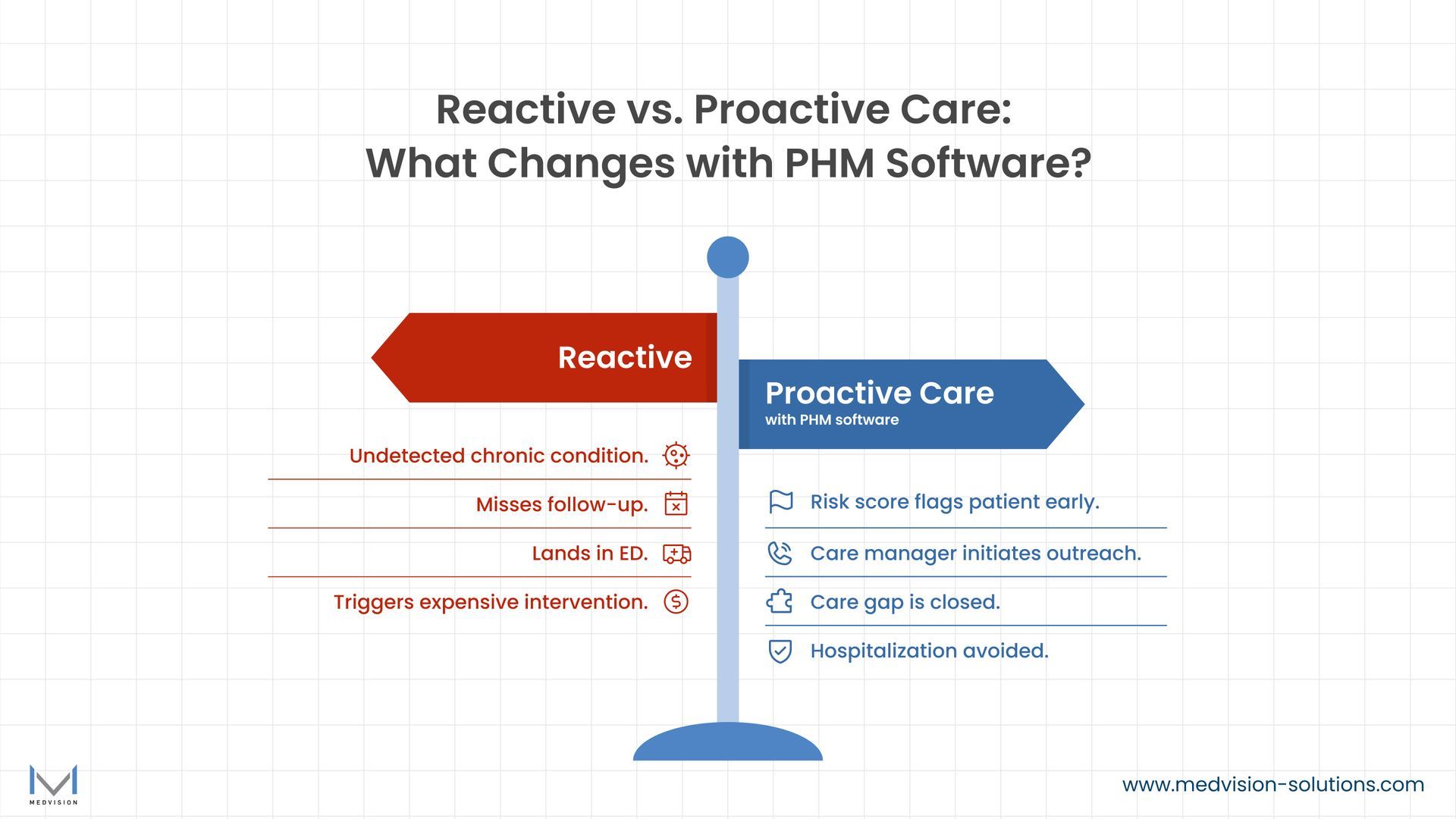
Population health management software refers to digital platforms that aggregate, analyze, and act on health data across defined patient groups. The goal is to shift care from reactive to proactive: identifying members who are at risk before they show up in an emergency department, surfacing care gaps before they become quality measure failures, and giving decision-makers the data they need to intervene at the right time.
A population health platform integrates data from various sources, such as EHRs, claims systems, pharmacy records, and lab results, including social determinants of health. This structured data drives decision-making rather than merely documenting history.
Organizations that benefit most from population health software fall into two categories: payer-side entities, including health plans, TPAs, and managed care organizations, that use the software to monitor network performance, manage capitation, track quality metrics, and ensure compliance with care contracts; and provider-side organizations like ACOs, IPAs, and FQHCs that rely on the platform to manage patient outcomes under value-based contracts.
According to the
CDC, around 129 million people in the U.S. are living with at least one major chronic disease. Hence, proactive population management is essential for organizations assuming risk, whether on the payer or provider side. The need for effective population health solutions is necessary to enhance care delivery and patient outcomes across the healthcare landscape.
Why Population Health Management Software Is Important for Healthcare Organizations
The shift to value-based care has changed how patient populations are managed, with varying stakes depending on one's role. CMS initiatives like the Primary Care First program launched in March 2025 indicate that Medicare reimbursement is moving toward outcome accountability and preventive care.
Payers and delegated organizations in capitated or risk-sharing models must understand real-time member panel management. Key concerns include identifying provider groups causing avoidable utilization and ensuring attributed members receive necessary care. Without a systematic platform for actionable insights, administrators rely on outdated metrics. Provider organizations face similar issues, as fragmented data like claims history and utilization patterns in disconnected systems obscure critical clinical intelligence.
The practical consequences of that fragmentation are significant across both sides. Care teams spend time tracking down information rather than using it. Network performance problems don't surface until a contract review. Quality metrics suffer. Costs go up. And in a value-based environment, all of that has direct financial consequences. When population health analytics tools work correctly, organizations on both sides of the payer-provider relationship can identify high-risk members in time to intervene, close care gaps systematically rather than reactively, and demonstrate the outcomes that increasingly determine reimbursement rates.
Key Features to Look for in Population Health Management Software
Not every platform marketed as population health management software is built to the same standard. Here's what actually separates the platforms that drive outcomes from the ones that generate reports no one acts on.
Risk Stratification
This is the foundation. Effective patient risk stratification software segments your population by risk level using a combination of clinical data, claims history, and socioeconomic factors. The output should be actionable: a clear, prioritized view of who needs intervention, what kind, and when. If a platform can't tell you which of your members is likely to land in the hospital next quarter, it's not doing the core job.
Integrated Care Management
Risk stratification is only valuable if care teams can act on it. Look for platforms that connect risk data to care management workflows directly, whether that's triggering outreach, assigning care managers, or flagging gaps for a provider at the point of care. Care coordination software capabilities should include referral management, care plan tracking, and cross-setting communication that keeps everyone working from the same patient record.
Real-Time Analytics and Reporting
Static reports that tell you what happened last quarter aren't enough. Your platform should surface real-time dashboards covering quality metrics, utilization trends, payer performance, and program-level outcomes. The best population health analytics tools let you drill down from a population-level view to an individual patient in a few clicks, so clinical and administrative teams can make decisions at the right level of detail.
Data Integration and Interoperability
A platform is only as good as the data it has access to. It should pull from EHRs, claims systems, pharmacy data, labs, and external sources using standardized EDI formats. If the platform requires your team to manually import or reconcile data from disconnected systems, it's creating more administrative burden, not less.
Automated Workflows
From prior authorization to care gap alerts to member outreach, automation is what makes population health management scalable. Platforms that rely on manual triggers for routine processes are limited by the time and attention of your staff. Automated workflows, including
automated claims processing and healthcare functions, keep the administrative engine running without requiring human intervention at every step.
Compliance and Audit Readiness
In a regulated environment, documentation isn't optional. Your platform should maintain audit-ready records, support CMS and NCQA reporting requirements, and update automatically when regulatory standards change. Reactive compliance management, where your team scrambles ahead of a reporting deadline, is a resource drain that the right software eliminates. For a closer look at what this looks like in practice, our
guide to achieving compliance in healthcare administration walks through the operational specifics.
Member Enrollment, Eligibility, and Capitation Management
This is crucial for payers and related organizations. Health plans and delegated entities require accurate, updated member rosters to manage capitation payments, confirm attribution, and prevent over- or under-resourcing of members. A platform that can't maintain a real-time member panel can create financial risks, such as inaccurate capitation payments, eligibility verification issues, and gaps in member outreach, which can affect quality scores and renewal rates. Payer organizations should ask how a platform handles enrollment changes, retroactive eligibility updates, and multi-payer member tracking.
Network Performance and Contract Management
For payers managing delegated provider groups, visibility into network performance is as important as visibility into individual member risk. The platform should let plan administrators track utilization trends by provider or provider group, monitor performance against contracted quality metrics, and identify where network gaps are causing unnecessary costs or care disruptions. This connects directly to contract decisions and is a capability that purely clinical PHM tools often underinvest in.
How to Choose the Right Population Health Management Software
Once you know what features matter, the evaluation process gets more specific. Here's where most organizations underinvest their attention
Match the platform to your organizational model
ACO care management software has different requirements than a platform built for a Medicaid managed care plan, a TPA, or a PACE program. Payer organizations specifically need to ask whether the platform supports capitation management, delegated group performance monitoring, and plan-specific member panel configuration. Before you sit through a demo, be clear on your specific population, your payer mix, and the contract structures you're managing. A platform that doesn't natively support your care model will require expensive workarounds regardless of how well it performs in other areas.
Demand evidence, not promises
Ask vendors for documented first-pass claim acceptance rates, quality metric improvement data, and case studies from organizations of comparable size and complexity. If a vendor can't produce specific performance evidence from live deployments, that's a signal worth taking seriously.
Evaluate the data infrastructure first
The most important thing a platform does is aggregate data correctly. Before you assess any front-end features, understand what data sources the platform connects to, how it normalizes data across different formats, and what happens when data from two systems conflicts. A slick dashboard built on incomplete or inconsistent data is worse than no dashboard at all.
Ask about implementation timelines honestly
Cloud-based platforms generally implement faster than on-premise solutions. But the timeline isn't just about technical setup; it's about data migration, staff training, workflow redesign, and integration with your existing systems. Get a realistic project timeline scoped to your organization's size and complexity, not a generic estimate from a sales deck.
Think about long-term fit, not just current needs
The platform you implement today needs to support your operational structure in two or three years. That means asking directly about how the platform scales when you add new payer contracts, new locations, new lines of business, or new regulatory requirements. Scalability shouldn't be an afterthought.
Benefits of Using Population Health Management Software
The ROI from the best population health management software shows up across multiple dimensions. Some are immediate; others compound over time.
Earlier, more targeted interventions
When risk stratification is effective, care teams can reach high-risk members before a care gap leads to hospitalization. That shift from reactive to preventive care is the operational core of what value-based contracts are designed to incentivize. For ACOs in particular, accurate patient attribution and proactive outreach are among the highest-leverage activities available.
Tighter financial control for payers
Population health software improves capitation accuracy and medical loss ratio management for health plans. Real-time member attribution ensures capitation reflects actual enrollment. Analyzing utilization trends by provider group helps administrators pinpoint cost drivers early. Financial visibility is difficult when member, claims, and network data are in separate systems.
Measurable quality metric improvement
Population health platforms enable tracking of HEDIS measures, STAR ratings, and other quality benchmarks in real time, rather than discovering gaps during the reporting period. Organizations that can close care gaps systematically, rather than scrambling before submission deadlines, consistently perform better on quality metrics that tie directly to reimbursement.
Administrative efficiency at scale
Automated workflows reduce the time staff spend on manual tasks, such as prior auth tracking, eligibility verification, care gap documentation, and member outreach scheduling. That time doesn't disappear; it gets redirected toward higher-value clinical and operational work.
Financial performance stability
In value-based arrangements, financial performance is downstream of clinical performance. When your platform helps you manage costs proactively through risk identification, appropriate resource allocation, and reduced unnecessary utilization, the financial results follow.
Better data for better decisions
Leadership teams in organizations with mature population health platforms consistently report that they're making strategic resource decisions based on actual data rather than estimates. When you can see utilization trends by payer, risk tier, and care setting in real time, the decisions you make about staffing, contracting, and program investment are fundamentally more grounded.
How QuickCap Supports Population Health Management
MedVision's QuickCap is built specifically for organizations that face the greatest complexity in population health management. On the payer side, that includes health plans, TPAs, and managed care organizations managing delegated provider networks, capitated contracts, and multi-plan member populations. On the provider side, it covers ACOs, IPAs, MSOs, PHOs, FQHCs, and PACE programs operating under value-based and risk-based arrangements.
As a population health platform, QuickCap brings together the capabilities that matter across both organizational types in a single integrated environment. For payer organizations, that means real-time member enrollment and eligibility management, capitation payment processing tied to accurate attribution data, provider credentialing and network management, and plan-level performance dashboards that surface HEDIS and STAR gaps by provider group. Plan administrators can monitor network utilization trends, flag underperforming delegated groups, and generate the audit-ready documentation that CMS and NCQA require, without piecing together data from separate systems.
For provider-side organizations, risk-based population dashboards give care teams and leadership a real-time view of member health status, stratified by risk tier and filterable by payer, program, or provider network. Referral management automatically tracks inbound and outbound referrals, ensuring patients don't fall out of the care continuum between specialist visits. Integrated utilization management handles prior authorizations and medical necessity reviews through automation, replacing the manual follow-up that typically consumes significant staff time.
On the claims side, QuickCap's automated claims processing healthcare infrastructure supports adjudication, payer-specific rule integration, and HIPAA-compliant EDI submission, keeping the revenue cycle clean as patient and member volumes grow. The platform currently manages more than 5.1 million member lives per month and processes over 480,000 claims, a performance that's documented at scale rather than projected in a sales deck.
For organizations operating across multiple lines of business, including Medicare Advantage, Medicaid, PACE, ACO REACH, or dual health plans, QuickCap's configurable architecture handles program-specific requirements without requiring a structural rebuild for each new context.
Final Thoughts
The organizations getting the most out of population health management aren't the ones with the most data. They're the ones with the right infrastructure to act on it. A platform that aggregates data without enabling action is just expensive storage. The right population health management software closes the loop between insight and intervention, whether that means a care manager reaching a high-risk member before a hospitalization, or a plan administrator identifying a network utilization pattern before it becomes a budget problem.
If your current tools are leaving your team reactive instead of proactive, whether you're a health plan trying to manage a delegated provider network or a provider organization carrying downside risk, it's worth a close look at what a purpose-built population health platform could change about the way your organization operates and the outcomes it delivers.
See It in Action
Frequently Asked Questions
What is population health management software, and how does it differ from an EHR?
EHRs document individual patient care, while population health management (PHM) software aggregates data across populations to identify risk patterns and care gaps, facilitating proactive interventions for thousands of patients. Many organizations use both, with PHM software analyzing EHR data rather than replacing it.
Which types of organizations need population health management software most?
Population health software improves capitation accuracy and medical loss ratio management for health plans. Real-time member attribution ensures capitation reflects actual enrollment. Analyzing utilization trends by provider group helps administrators pinpoint cost drivers early. Financial visibility is difficult when member, claims, and network data are in separate systems.
How does population health management software serve payers differently from providers?
For payers, the platform offers visibility into member panel management and provider network performance, including enrollment accuracy, capitation verification, HEDIS, STAR gap tracking, and utilization monitoring. For providers, the emphasis is on clinical care management, encompassing risk stratification, care gap closure, referral tracking, and prior authorization workflows. Platforms like QuickCap integrate these functions in a single environment, eliminating the need for separate tools.
Can population health management software integrate with our existing EHR?
Most modern platforms are built to integrate with major EHR systems through standardized data exchange formats. Before committing to any platform, confirm specifically which EHR systems it integrates with natively, how frequently the data sync occurs, and what happens when data from multiple sources conflicts. Integration depth varies significantly between vendors.
How does care coordination software within a PHM platform work?
Care coordination tools within a PHM platform connect risk data to care management workflows. When a patient is flagged as high risk, the platform can automatically generate a care manager assignment, schedule outreach, track referrals, and document the interaction, all within the same system. This replaces the manual handoffs and disconnected tracking that typically cause patients to fall through the cracks between providers and care settings.
Recently published articles


Keep in touch
Subscribe to get the latest update
Trending topics


Share your insights on social media
Upcoming events and company news