

Beyond Manual Checks: Automating Eligibility Verification with QuickCap 7
For payer-side organizations, eligibility management isn't a clerical starting point. It is the one factor that impacts almost every financial and operational outcome downstream. It is the factor that, if misunderstood, means you are paying capitation on members who left your plan two months ago.
It means you are paying claims on incorrect benefit configurations. It means you are paying for costs that another payer should be responsible for. And your team is spending significant hours each cycle manually reconciling member rosters that should have updated automatically.
In a value-based environment, where reimbursement is tied to the accuracy of your member data, your risk stratification, and your ability to manage a defined population, those errors aren't just administrative inconveniences. They erode the financial assumptions your contracts are built on.
Eligibility verification in value-based care is where accurate administration begins. QuickCap 7 is built to handle it with the rigor that risk-based organizations actually need.
Value-Based Care Simplified
Why You Need to Verify Eligibility
The assumption that underlies every payer and every payer-delegate organization is that the members within your system are indeed the members for whom you have actual responsibility. When that assumption is violated, the financial risk is very real and can be recurring. Here’s where it shows up:
Capitation overpayment
Capitation payments go out monthly based on your enrolled member panel. If a member disenrolls and your roster isn't updated promptly, you continue paying providers for members who are no longer attributed to your organization. Over a large panel, the lag compounds quickly.
Claims processed against lapsed coverage
When eligibility records are not up to date, you risk paying claims processed by your adjudication system for members who no longer have coverage. It costs significantly more to recover these claims than to avoid them in the first place.
Benefit plan mismatches
Value-based organizations often manage multiple contracts with different benefit tiers and cost-sharing structures. If a member's record isn't aligned to the correct plan configuration, the payment calculation is wrong from the first step.
Coordination of benefits (COB) errors
For dual-eligible populations (Medicare and Medicaid, or commercial and government programs), the payer sequencing must be correct. A COB error doesn’t just prolong the process; it costs your organization money that the primary payer was responsible for.
These are not exceptions; they are common stress points for IPAs, ACOs, MSOs, and TPAs who are serving a population under a risk contract.
What Accurate, Automated Eligibility Management Looks Like
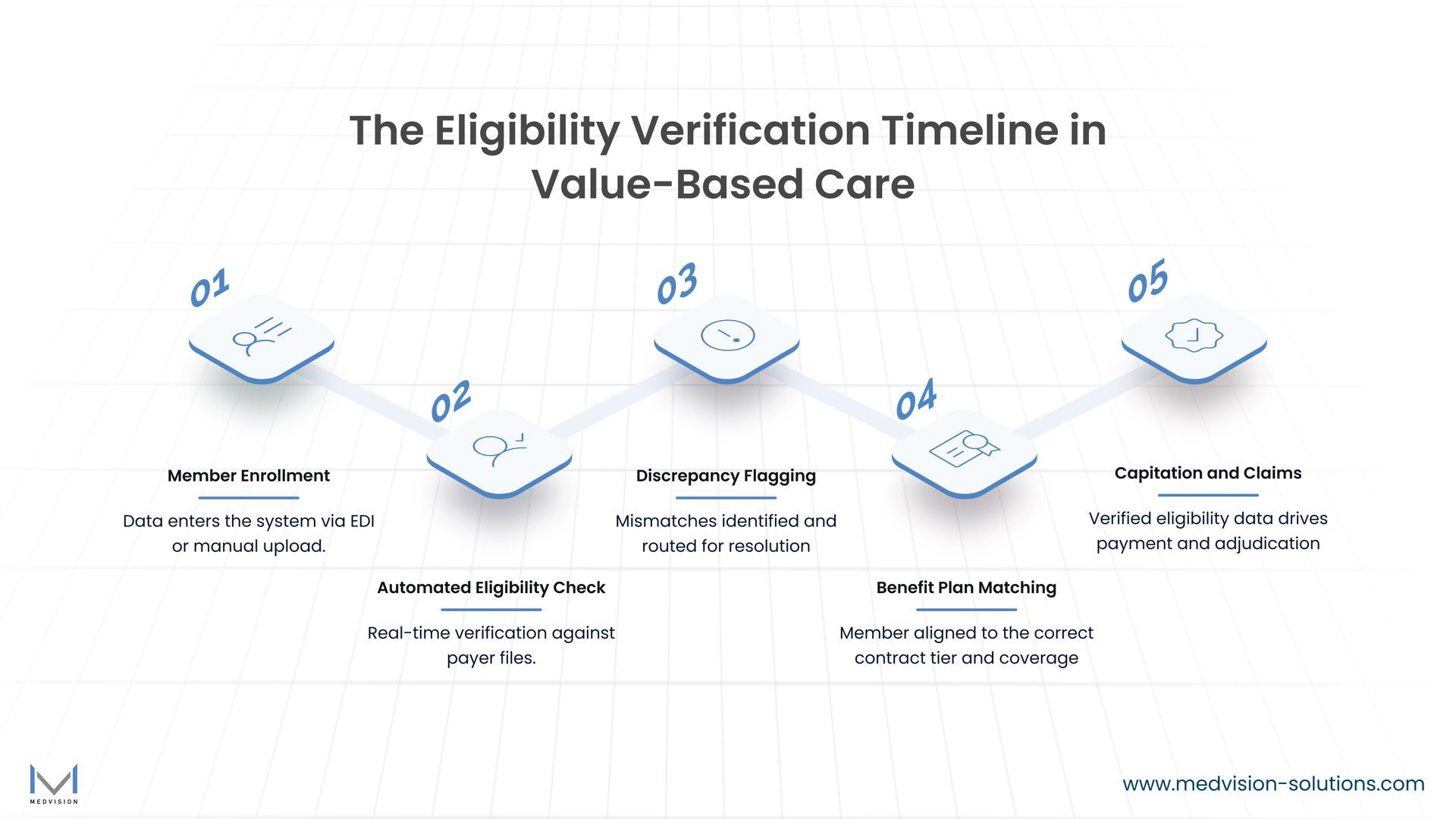
When automated eligibility verification is working correctly, your operational team isn't spending cycles on manual roster reconciliation. Member data stays current as health plans push updates. Your benefit plan configurations are matched accurately. And when something does require attention, the system surfaces it before it affects a payment run.
Continuous member record updates
QuickCap automatically updates eligible members and relevant codes as information changes, keeping your system aligned with payer files continuously rather than relying on periodic manual imports. What your system reflects is what's actually true about your member panel.
Eligibility validation is built into the workflow
Rather than flagging discrepancies only when a transaction fails, QuickCap validates eligibility earlier in the process and completes final checks before the workflow advances. That means your capitation runs and claims adjudication are operating from data that's been confirmed, not assumed.
Real-time verification when it matters
QuickCap's latest update includes real-time eligibility verification powered by
FinThrive's APO integration, enabling instant coverage verification at the point of need. For organizations handling high transaction volumes, that speed translates directly into processing efficiency and fewer downstream corrections.
The QuickCap Advantage for Eligibility Management
MedVision holds CORE Certification in accordance with CAQH CORE Operating Rules for Eligibility & Benefits, Claim Status, and Payment & Remittance. That certification validates adherence to nationally recognized standards for interoperability and automation in healthcare transactions and reflects how the system is designed at the architectural level.
Here's how QuickCap's member eligibility management capabilities address the operational realities of payer-side organizations:
Advanced Eligibility Verification and Benefit Plan Platform
Determine member eligibility, pull coverage details from benefit plan documents, and configure settings based on contracted health plan terms, all within a single interface. For TPAs and IPAs managing layered contract structures with multiple downstream payers, centralized configuration significantly reduces the risk of mismatched benefit rules.
Inclusive eligibility verification functions
QuickCap takes into consideration all the variables of a patient during processing. It can process cases involving complex member profiles, including dual eligibles, carve-out populations, and risk-adjusted populations, consistently. This is particularly important to organizations that are essentially benefit-complex in nature, such as PACE programs/Dual Health Plan administrators.
Capitation and reimbursement alignment
Eligibility data is directly used to calculate capitation payments and reconcile members. If a member's status changes, that change will automatically be reflected in your payment processing. This ensures your panels and payments are always in sync.
EDI-integrated data exchange
QuickCap uses HIPAA-standard EDI formats to communicate with health plans reliably and in a standardized manner, reducing the need for human intervention in the eligibility update process. That’s the operational interoperability that keeps a value-based reimbursement system running without the need for reconciliation, which is required in a manual system.
Eligibility management is not only an administrative goal under a delegated risk arrangement but also a contractual requirement. You can learn more about how QuickCap supports the IPA operational process and claim adjudication workflows in blog posts from MedVision.
Conclusion
For payer-side organizations operating under delegated risk, eligibility accuracy isn't a background function. It's a direct input into how much you pay, who you pay it for, and whether your population health programs are working from a reliable member panel. The further downstream an eligibility error travels, the more expensive it gets to correct.
The way QuickCap handles Eligibility verification in value-based care is all part of a system that also processes capitation, authorization, claims adjudication, and reporting. Your data on eligibility is not stored in a separate system module; it's used throughout the system. And that's what keeps your membership list, your benefit designs, and your payments in sync.
Streamline Your Eligibility Process
FAQs
Why does eligibility verification accuracy matter more in value-based care than in fee-for-service?
In fee for service, payment is made on a per-encounter basis. In value-based models, payer-side organizations may pay capitation based on an attributed member panel and take on risk for that population. If you're paying for a population of members who are not currently enrolled, you're essentially paying for a population beyond what you're actually accountable for. Eligibility accuracy impacts your cost base directly.
How do stale eligibility checks affect capitation payments?
Capitation is calculated based on enrolled membership. If a disenrollment has occurred and your system has not been updated, your organization will continue to make capitation payments on behalf of that disenrolled member until your system is updated. In large panels, a short time for system reconciliation can result in substantial overpayment that then needs to be recaptured.
What is CORE Certification, and why is it relevant for payer organizations?
CORE Certification, which is issued by CAQH, ensures that a system complies with national standards regarding eligibility and benefits transactions, claim status, and remittance of payments. In regards to payer-side organizations, CORE Certification ensures that data exchange between health plans and eligibility data occurs in a standardized manner.
How does eligibility data connect to capitation runs in QuickCap?
Member eligibility data is integrated into the capitation process of QuickCap. When the eligibility of a member changes, i.e., when a new enrollment occurs, a termination occurs, or the plan changes, the changes are reflected in the calculations to keep your monthly capitation runs up to date with your actual attributed membership.
Recently published articles


Keep in touch
Subscribe to get the latest update
Trending topics


Share your insights on social media
Upcoming events and company news