

CARA Explained: How Specialist Episodes Work in the ACO LEAD Model

Picture an orthopedic group that’s ready to share risk on its joint procedures. Who prices the episode? Who tracks the spending, and who settles the difference a year later?
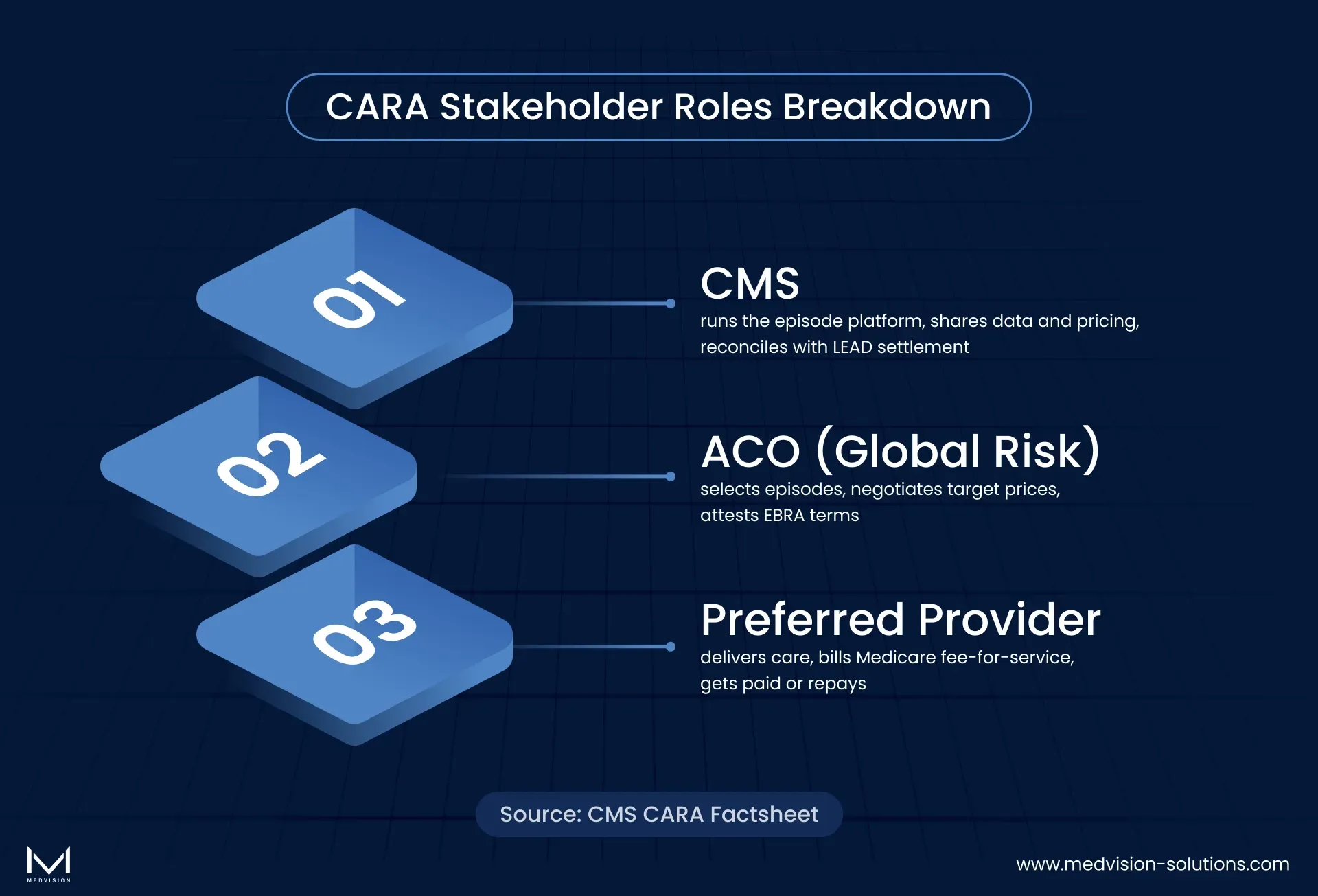
That’s what CARA, or CMS-Administered Risk Arrangements, is meant to help with. Eligible LEAD ACOs that choose Global Risk and opt in will have access to CMS episode data, pricing information, and a platform to work through risk arrangements with specialists. CMS plans to start sharing data in 2027, with episodes expected to trigger in 2028.
This guide explains how the options work and what ACO and payer teams can do to prepare.
Run Capitation, Claims, and Risk in One Platform
What Is CARA in the ACO LEAD Model?
What is CARA? It’s a voluntary LEAD initiative for ACOs that choose the Global Risk Option. Through it, CMS provides the infrastructure for an ACO to negotiate with a specialist, called a Preferred Provider in LEAD, and set up an episode-based risk arrangement (EBRA). The specialist then takes on financial risk for aligned beneficiaries who start an episode, according to the
CMS CARA factsheet.
CMS eases the load in practical ways. It runs a platform that tracks episode selections, supplies standard EBRA provisions, and shares episode data, benchmarks, reconciliation data, and quality results. The ACO LEAD model itself runs from January 1, 2027, through December 31, 2036. If you need the model basics first, start with our
LEAD roadmap for payers and ACOs.
Why Did Specialist Value-Based Care Struggle Before CARA?
Specialists drive a substantial share of spending, and they shape site-of-service choices and downstream use. Yet
experts note that engaging them has stayed hard even as accountable care matured. For payers and payer groups, that gap looks like spending you can see but can’t steer.
Without CARA's CMS-supported tools, ACOs and specialists arranging episode-based risk would need to work through episode design, target pricing, contract terms, and reconciliation themselves. CARA is designed to reduce that setup burden through CMS-provided data, pricing information, and standard agreement provisions.
That’s heavy for any organization, and heavier across several arrangements. CMS says CARA reduces those barriers by sharing data and calculating payment amounts.
How Do CARA Episodes Work? Default vs. Max Flex
CARA uses episode-based cost measures. CMS plans to offer acute medical and procedural episodes in 2028 and phase in chronic condition episodes in future years. Think sepsis admissions, colon resections, or orthopedic and cardiovascular procedures.
ACOs then pick one of two paths:
- Default Approach: CMS builds the episode. You can’t change triggers, length, or inclusions and exclusions, but you can set discounts or premiums to the target price and choose quality measures for the performance adjustment.
- Max Flex: You can also customize trigger codes, episode length, and inclusions or exclusions, and you can work with an outside vendor on alternative construction methods.
CMS reviews episode risk parameters, including applicable pricing and performance-adjustment specifications, under both options.
CARA also includes a falls prevention episode called RISE to Age in Place. Occupational therapists and registered nurses deliver home-based falls-prevention services through an interdisciplinary care team.
Follow-up visits are paid in acuity-tiered bundles, and the ACO funds handyperson services such as grab bars.
How Does CARA Financial Reconciliation Work?
Specialists keep billing Medicare fee-for-service. CMS then reconciles alongside LEAD settlement. If fee-for-service spending lands below the target price, the specialist receives payment. If it lands above, the specialist owes repayment. Quality counts too, since performance adjustments rest on measures such as risk-standardized admissions or a MIPS-comparable measure.
For payer operations teams, the money moves at settlement, but the signals show up all year. Payer operations and ACO teams should establish a process for reviewing available episode data against negotiated target prices. Accurate Preferred Provider records, episode mapping, and timely discrepancy resolution can help teams prepare for reconciliation.
What Is the CARA Timeline?
CMS marks these dates as tentative:
| Milestone | What happens |
|---|---|
| Q2 2027 | CARA reports with target prices, as applicable, become available for performance year 2028. |
| 2028 | First performance year, when episodes trigger |
| Mid-2029 | First concurrent LEAD and CARA reconciliation |
To take part, an ACO selects Global Risk when applying to LEAD, signs the LEAD Participation Agreement CARA Amendment, uses the CARA module in CMS’s 4i platform to prepare for negotiations, then verifies EBRA terms and completes an attestation there. So the risk option your ACO chose matters, since CMS is initially testing CARA only among Global Risk ACOs.
How Can LEAD ACOs Prepare for CARA Now?
Waiting for the Q2 2027 reports is reasonable. Starting the groundwork sooner is smarter.
- Confirm specialist data. Check Preferred Provider lists, provider IDs, and contract status.
- Pick starting episodes. Review available claims and episode data to identify specialist spending patterns and episode types relevant to your organization.
- Choose Default or Max Flex early. Max Flex asks for stronger analytics and possibly an outside vendor.
- Establish a spending review process. Define how your team will review available episode data against negotiated target prices and resolve discrepancies before reconciliation.
- Set downstream payment rules. Settle who pays what, including RISE handyperson costs, before the first episode triggers.
For a wider checklist, see our 8 LEAD readiness questions.
How QuickCap v7 Supports This Shift
CMS's 4i platform handles CARA episode setup and attestation. QuickCap v7 supports related payer-administration workflows, including:
- Provider contracting and credentialing, so specialist agreements and network data stay current
- Claims adjudication plus referral and authorization workflows, so specialist activity is captured accurately
- Capitation payment processing and claims administration for broader payer workflows
- Risk stratification, analytics, and executive dashboards for operational reporting
MedVision builds to client feature requests, and ships updates quarterly, so your workflows can follow CMS guidance as CARA details firm up.
Conclusion
CARA provides CMS-supported infrastructure for specialist risk arrangements, while ACOs remain responsible for episode selection, negotiations, and agreement terms.
CMS expects to make applicable reports and target prices available in Q2 2027, ahead of the planned start of episode accountability in 2028.
Use the preparation period to verify specialist records, review episode options, and clarify responsibility for reconciliation. If you'd like more insight into CARA or the ACO LEAD model, we’re just a phone call away.
More Insights On LEAD
Frequently Asked Questions
Is CARA mandatory in the ACO LEAD model?
No. CARA is voluntary. CMS is initially testing it among Global Risk ACOs that choose to take part.
When do CARA episodes begin?
CMS tentatively lists 2028 as the first performance year. Reports with target prices are expected in Q2 2027.
What is the difference between Default and Max Flex?
Default uses CMS-constructed episodes; ACOs can adjust pricing and quality. Max Flex allows episode customization, with external vendors helping build episodes; both are subject to CMS review.
Do specialists still bill Medicare directly under CARA?
Yes. They bill fee-for-service, and CMS reconciles alongside LEAD settlement. Spending below the target price earns a payment, and spending above it means repayment.
Which ACOs can use CARA?
CARA is open to LEAD ACOs under the Global Risk Option. Professional Risk ACOs are not part of the initial test.
Recently published articles

Keep in touch
Subscribe to get the latest update
Trending topics


Share your insights on social media
Upcoming events and company news