

Best Healthcare Claims Adjudication Software: 2026 Guide

How many claims does your team still manage manually every week? If that number worries you, you're not alone. Manual adjudication remains one of the biggest drains on payer operations, and picking the wrong healthcare claims adjudication software only makes it worse. Here's a look at seven platforms built to help payers and payer groups adjudicate claims faster and with fewer errors.
Different payer groups operate in different ways. For example, a TPA organization has significantly different operational needs than, let's say, an ACO. For that reason, this guide covers claims adjudication software for all payer groups.
Designed for Value-Based Care
What Does a Claim Adjudication Software Do?
Claims adjudication software isn't a single feature. Its core function is to apply eligibility, benefit, pricing, and other configured rules to a claim to determine whether and how to pay, deny, or pend it. Some platforms are built for massive national payers running one line of business at enterprise scale. Others are built for payer groups that manage several lines of business at once and need the system to bend to them, not the other way around.
Top 7 Claims Adjudication Software
Here's how seven of the leading claims adjudication software options stack up.
| # | Software | Best For |
|---|---|---|
| 1 | QuickCap v7 (MedVision Inc.) | Payers and payer groups needing adjudication configured to their own rules across MA, Medicaid, PACE, dual, and specialty lines |
| 2 | TriZetto Facets (Cognizant) | Large national commercial, MA, and Medicaid payers |
| 3 | HSP Payer Suite (Conduent) | High-volume payers wanting high straight-through auto-adjudication rates |
| 4 | CareFabric (Netsmart) | State agencies and MCOs whose claims are tied to EHR and EVV data |
| 5 | PLEXIS Payer Platforms (PLEXIS Healthcare Systems) | Payers modernizing a legacy core administration system |
| 6 | Javelina (Mphasis) | Payers and TPAs modernizing core claims administration with configurable adjudication workflows. |
| 7 | Encompass+ (Integrated Payor Solutions) | TPAs and health plan administrators already built on Salesforce |
1. QuickCap v7 (MedVision Inc.)
QuickCap v7 is built for organizations that don't fit a single mold. It supports IPAs, MSOs, PHOs, TPAs, ACOs, and health plans managing Medicare Advantage, Medicaid/Medi-Cal, PACE, dual-eligible, or specialty carve-out lines.
Automated editing, embedded HIPAA-standard EDI formats, and referral and authorization processing all sit inside one system. MedVision ships quarterly updates instead of leaving payers to wait on a multi-year roadmap. What sets QuickCap v7 apart from most large players is its willingness to build to a client's specific feature request rather than asking the client to adapt to the software.
Best for: payers and payer groups that need configurable, multi-line-of-business claims adjudication software without an enterprise-only price tag or a rigid release cycle.
2. TriZetto Facets (Cognizant)
Facets is a long-standing core administration platform integrating consumer, care, claims, and revenue management. It supports commercial, individual, Medicaid, Medicare Advantage, and Part D lines with a broad ecosystem of add-on modules.
Best for: large national payers that want an established, enterprise-scale system and have the IT resources to run it.
3. HSP Payer Suite (Conduent)
Conduent's HSP platform is a modern, modular core administrative processing system supporting Medicaid managed care, Medicare Advantage, commercial, dental, vision, TPA, and behavioral health plans.
Best for: payers and TPAs modernizing core claims administration with configurable adjudication workflows.
4. CareFabric (Netsmart)
Netsmart's claims adjudication tools sit inside its CareFabric platform, built around a business rules engine and automated claims matching for state agencies and managed care organizations. It integrates directly with electronic visit verification and EHR data, which fits naturally with behavioral health and home and community-based service lines.
Best for: state agencies and MCOs whose claims data lives in EHR and EVV systems.
5. PLEXIS Payer Platforms (PLEXIS Healthcare Systems)
PLEXIS offers a comprehensive core administration and benefit administration platform aimed at payers modernizing older, legacy systems. It leans on a rules-based configuration model to support commercial and government lines.
Best for: payers replacing a legacy core system who want configurable benefit administration bundled into a broader platform.
6. Javelina (Mphasis)
Javelina is Mphasis' core administration and claims adjudication platform, supporting automated claims processing and configurable payer workflows
Best for: payers that want a dedicated, standalone claims adjudication module rather than a full core administration suite.
7. Encompass+ (Integrated Payor Solutions)
Encompass+ is a claims administration platform built on Salesforce. It gives TPAs and health plan administrators a configurable claims workflow layered on a CRM they may already use for other operations.
Best for: TPAs and administrators already standardized on Salesforce who want claims administration on that same foundation.
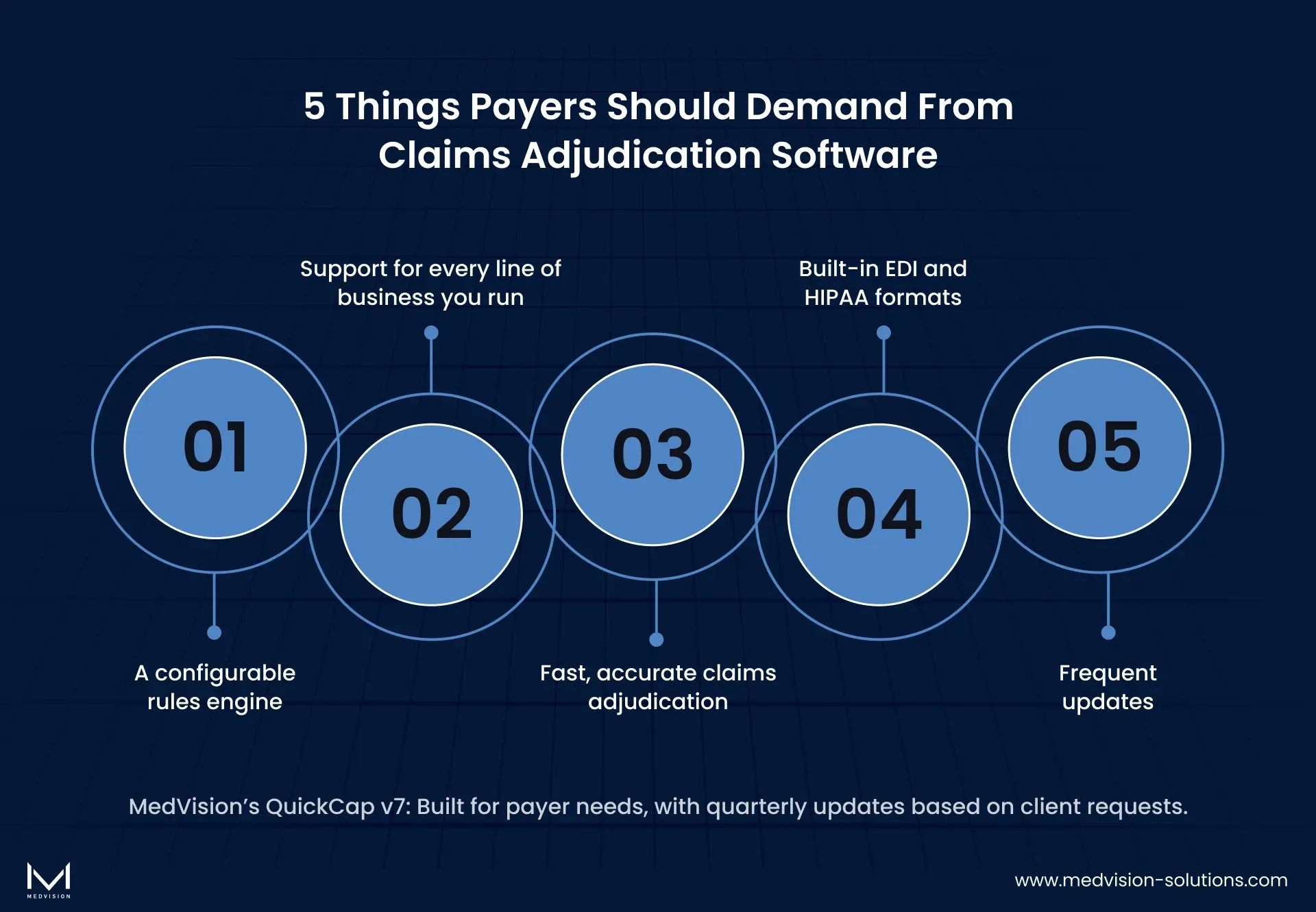
Why MedVision's QuickCap v7 Leads This List
MedVision has built healthcare administration software since 1994. QuickCap v7 now processes more than 480,000 claims and over $250 million in claims volume for more than 5.1 million lives every month. What differentiates QuickCap v7 is MedVision's focus on configurable workflows and incorporating evolving client requirements into product updates.
Rather than telling a payer to wait for the next major version, MedVision builds requested features into quarterly releases, a pace most enterprise vendors don't match.
This agility and scale come from the following features and capabilities:
- Customize: Teams control dashboards, user roles, and reimbursement configurations.
- Automate: Claims, authorizations, and referrals move through the system with less manual touch.
- Analyze: Teams get predictive analytics and risk stratification instead of static reports.
- Compliance: CMS-0057-F establishes prior authorization decision-timeframe requirements that began January 1, 2026. Impacted payers must implement required prior authorization APIs beginning in 2027, subject to program-specific compliance dates.
- Security: MedVision has achieved CAQH CORE Certification, completed a SOC audit, and holds HITRUST Risk-Based 2-Year Certification.
- Versatility: It supports a wide range of value-based organizations. This includes ACOs, MSOs, TPAs, and PACE programs across Medicare Advantage, Medicaid/Medi-Cal, dual health plans, and specialty carve-out lines.
Conclusion
There's no single best claims adjudication software for every payer. A national commercial insurer running one line of business at massive scale has different needs. In contrast, a TPA managing Medicaid, Medicare Advantage, and PACE contracts for a dozen different clients has its own unique requirements. What matters is matching the platform to how your organization operates.
For payers and payer groups that need a system flexible enough to handle several lines of business, QuickCap v7 is built to meet those needs. It can also respond to specific feature requests and keep pace with regulatory requirements.
Organizations should evaluate each platform against their lines of business, claims volume, configuration requirements, integrations, implementation needs, and operational workflows. That said, we’re just a phone call away for any queries.
Client-Driven Quarterly Updates
Frequently Asked Questions
What is claims adjudication software?
It's the system payers use to review a submitted claim against a member's eligibility, benefits, and contract terms, then decide whether to pay, deny, or pend it. Good claim adjudication software automates most of that review so only exceptions need manual attention.
How is claims adjudication different from general claims processing?
Claims processing covers the full claim journey, from intake to payment. Adjudication is the specific decision-making step inside that journey, where the system determines what's owed and to whom.
Does claims adjudication software work differently for Medicaid and Medicare Advantage?
Yes. Each program has its own coding, reporting, and compliance rules, so platforms need configurable rule sets by line of business rather than a single generic ruleset applied everywhere.
How long does implementation usually take?
Implementation timelines vary significantly by platform, scope, data complexity, integrations, configuration, testing, and organizational readiness.
Recently published articles


Keep in touch
Subscribe to get the latest update
Trending topics


Share your insights on social media
Upcoming events and company news